Deal or no deal? US President Trump could send Silver to $46

May you live in interesting times, the Chinese curse says. Well, here we are living those interesting times. United States President Donald Trump’s desire to ‘Make America Great Again’ is reaching concerning thresholds with no zenith in sight.
Indeed, keeping the United States of America as the number one global economy has been the ultimate goal of all presidents, left and right. But the costs President Trump is willing to make the world pay are not.
Drill, baby, drill!
Trump has decided that the US needs to dominate global energy. He revived the “drill, baby, drill” Republican slogan, embracing the exploitation of fossil fuels, but also decided to take down competitors. Venezuela fell first, and then he turned his eyes to the Middle East. Iran has been no easy rival, despite the US joining forces with Israel, and the ongoing war in the Persian Gulf is on its way to spread the harm throughout all economies, developed or emerging ones.
An intermediate consequence of the Iran war is the closure of the Strait of Hormuz and the interruption of crude oil and gas extraction/distribution. Energy prices soared amid fears it would push inflation to worrisome levels. Central banks dropped their caution and turned hawkish, warning they may need to hike interest rates to prevent inflation from reaching post-pandemic levels.
Trump knows he may have gone too far, so he decided to pause attacks and try going for talks, to no avail. Iran is not willing to negotiate, regardless of whatever hopeful headline you are reading these days; in fact, lawmakers called to continue the war until the enemy is deterred, according to the Islamic Society of North America (ISNA). As a result, Crude Oil prices are back near their recent highs, with the black gold fluctuating far above pre-war levels.
Meanwhile, the US Dollar is back in fashion as hopes for a quick resolution in the Iran war faded. Risk sentiment took over financial markets, but precious metals remain unattractive. As noted in a previous report, government bond returns in the current scenario overshadow Silver and Gold when it comes to safety.
Whatever Silver may do in the next few weeks depends on the damage resulting from the war and its extent. The best-case scenario is that the conflict ends in the next few days, quite an unlikely one. Still, even if the war ends, a certain amount of damage remains, and the odds for a rally back toward its recent highs above $120 per ounce are off the table.
Markets are now speculating that the war will end by the end of April, which means the worst-case scenario is that it extends beyond April. That would mean oil prices are likely to surpass their war peaks and spur inflation-related concerns, alongside bets of rate hikes. The more it extends, the worse it will be. The Greenback will likely continue to take advantage of this chaotic picture, and Silver may then pierce the $50 mark.
XAG/USD could test $46
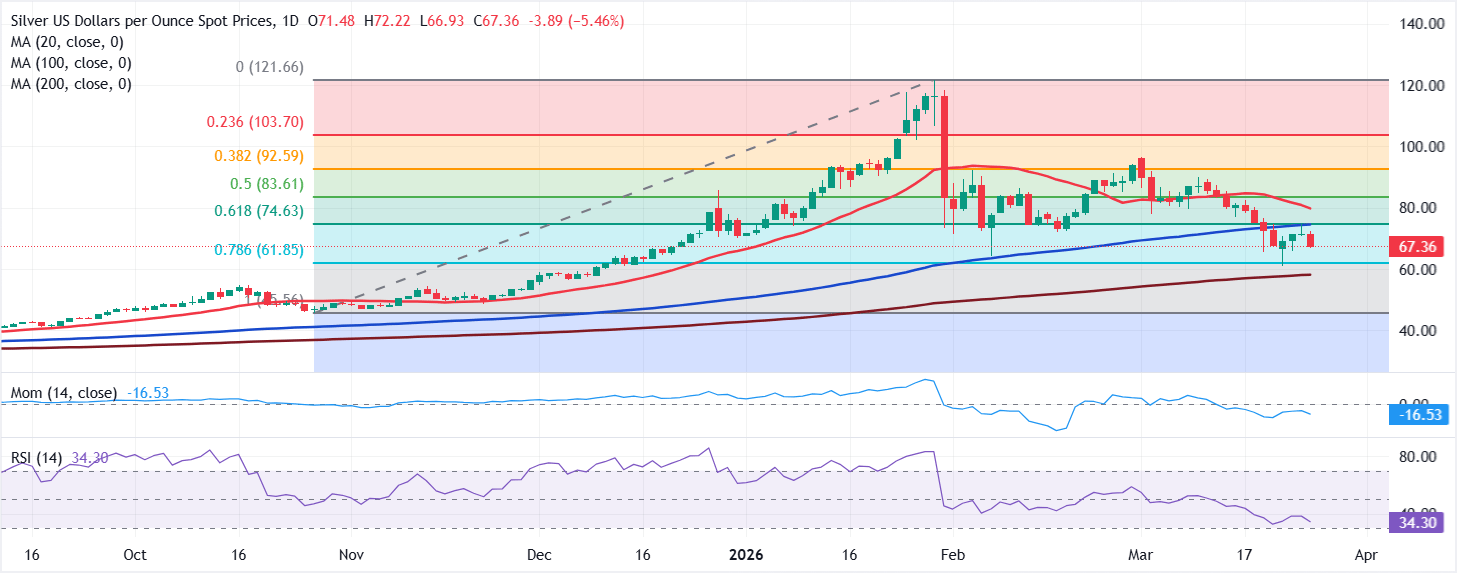
Taking a look at the daily chart, the XAG/USD pair rallied pretty much straight from the low of late October at $45.56 to the record $121 posted in January. It broke below the 61.8% Fibonacci retracement of such a rally after the first week of the war, and it’s now finding resistance around $74.63. As long as the latter holds, the risk skews to the downside, as the same chart shows a mildly bullish 100-day Simple Moving Average (SMA) converges with the Fibonacci level, reinforcing its relevance. At the same time, the 20-day SMA turned south above the 100 SMA, reflecting increased selling interest. Technical indicators also aim lower below their midlines, supporting the bearish case.
A recent low at $61 provides immediate support ahead of the 200-day SMA at around $58. Once the latter gives up, Silver is likely to complete a 100% retracement and slide towards $46. A recovery beyond $75 does not grant a return to record highs. The XAG/USD pair will face the next hurdle of sellers at around $83.60, while further gains will likely be capped by the 38.2% Fibonacci retracement at $92.60.
Author

Valeria Bednarik
FXStreet
Valeria Bednarik was born and lives in Buenos Aires, Argentina. Her passion for math and numbers pushed her into studying economics in her younger years.















