What the US CPI headline doesn’t tell you about inflation

Brent crude has fallen about a third since mid-October on hopes the Iran war is ending, but diesel, freight and fertiliser costs haven't followed. Those costs reach US consumer prices in stages through 2027 and could keep inflation high after gasoline gets cheaper.
US prices outside fuel are rising faster than they were before the Iran war, and cheaper crude won't stop them, because the war's costs have already moved out of the fuel bill. The war has pushed prices up in three rounds, and only the first, gasoline, moves with the price of crude. The second is running through truck freight, airfares and restaurant bills now, and the third, through fertiliser and the 2027 harvest, is still on its way.
The Consumer Price Index (CPI) rose 0.4% in October, above the 0.3% forecast, and prices outside food and energy, known as core, rose 0.3% for a third month running. Brent is trading at its lowest since August on talk of a deal to end the war. The Bureau of Labor Statistics (BLS) couldn't say how much prices rose over the year because it didn't collect them in October 2025.
Prices outside fuel are rising at nearly 4% a year, and the rise is spreading
BLS didn't collect prices during the October 2025 government shutdown, so it can't publish yearly changes for most of the October 2026 index. Gasoline is one of the few categories that kept a yearly figure, up 37.4%, and anyone who has filled a tank lately didn't need it.
Filling the gap with simple estimates puts the yearly rate at 3.9%-4% and core at 2.6%-2.8%. In February, the last month before the war, the two were 2.4% and 2.5%.
The yearly figures are slow to show how fast core is picking up. Core rose at a yearly pace of about 3.8% over the three months to October, against 2.7% over six months, and services outside energy rose at 4.2%. Core leaves fuel out, so that's the war's costs moving from the fuel bill into everything else, along with tariffs on imported goods.
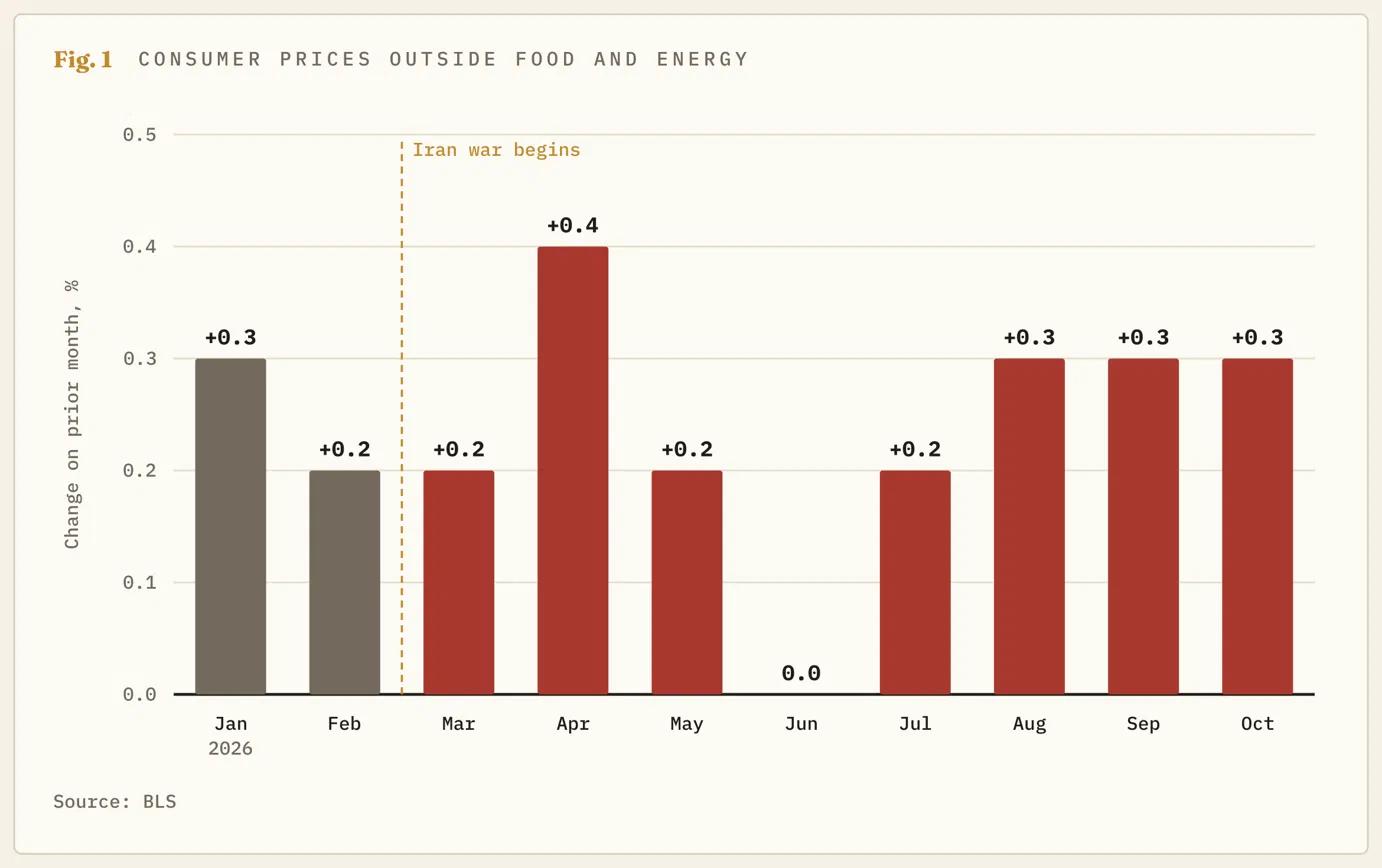
The Fed's preferred gauge shows the same thing. The Personal Consumption Expenditures Price Index (PCE) outside food and energy rose 3.1% through September, half a point above the CPI version. Fed Governor Waller said in London on Tuesday that more than 70% of its service categories are rising at 3% or more. If core CPI keeps rising 0.3% a month, its yearly rate reaches about 3.6% by mid-2027.
Cheaper gasoline improves the overall number and nothing else
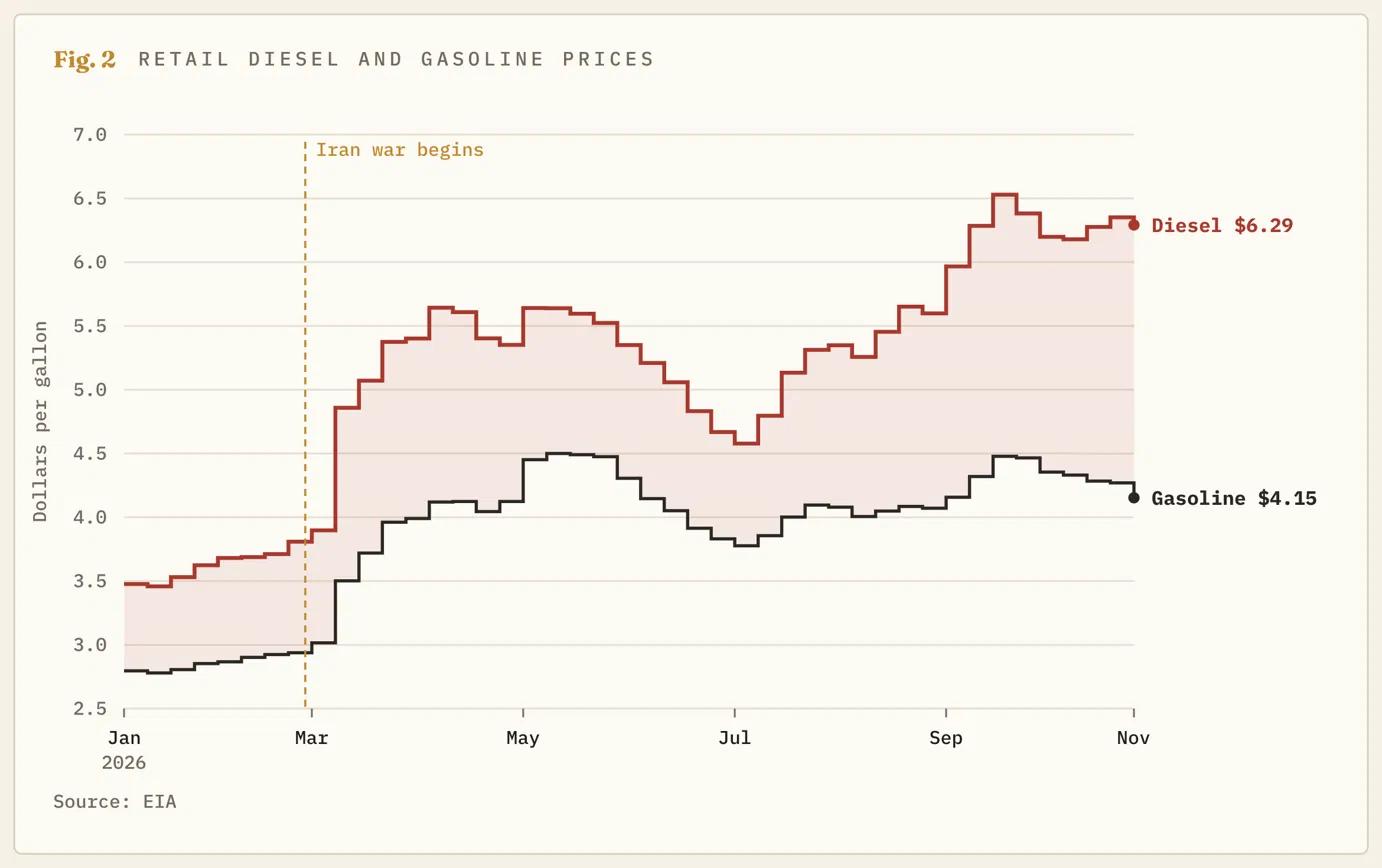
Gasoline is about 4% of the CPI. The national average went from $2.87 a gallon in early February to $4.15 in the week of November 2, on Energy Information Administration (EIA) figures. It's heading below $4 for the first time since July. The official October figure adjusts for the usual autumn fall in pump prices, so gasoline rose 1% on paper and fell 0.7% at the pump.
From spring, last year's gasoline spike leaves the yearly comparison. The gasoline index in October was only 4% above its April 2026 level, and energy added about 1.3 points to September's 3.7%. That means the overall rate could drop by around a point by April 2027 without anything outside fuel getting cheaper. That drop is arithmetic on last year's fuel bill, and it lands on top of core inflation that's still climbing.
Crude fell 30% and diesel at the pump barely moved
Diesel and jet fuel are made from crude, but the shortage is in the refined fuel. The war has cost the Gulf refining capacity, and a lower crude price doesn't rebuild a refinery. Diesel at the pump was $6.29 a gallon in the week of November 2, 71% above early February and less than 4% below its September record. US stocks of diesel and heating Oil are about 13% below their five-year average for the time of year.
Diesel and jet fuel move goods and people, so the cost shows up first in what businesses bill each other. The BLS Producer Price Index (PPI), which tracks the prices businesses receive, showed diesel up 115% year on year in September and jet fuel up 104%. Long-distance truckload freight was up 17.9%, with a 4.6% rise in September alone, and scheduled airfares were up 19.5%. Truck freight rates rose more in September than consumer prices outside food and energy have risen in a year.
Shoppers are starting to pay it. Airline fares were up 22.4% in the year to September, and in October full-service restaurant prices rose 0.7% and moving and freight services 3%. Goods outside food and energy have risen 2.1% over three months, against about 1% before the war, though tariffs account for some of that.
Producer prices outside food and energy are up 5% on the year, against 2.6% for consumer prices. The two cover different baskets, but a gap that wide suggests businesses have absorbed most of the cost so far, and October looks like the start of passing it on. Governor Waller said lower Oil hadn't eased his concern, because of the lost refinery capacity, and cited Fed staff work suggesting the pressure could last well into 2027.
Round three is in the fertiliser, and it's due with the 2027 harvest
Groceries are the round that hasn't fully arrived. Food at home rose 0.4% in October, its biggest monthly increase since April, with beef up 0.9% and dairy up 0.6%. The cost behind the next increases has already been paid.
That cost is fertiliser, which farmers buy months before they sell a crop. About 29% of world trade in urea, the most common nitrogen fertiliser, normally passes through the Strait of Hormuz, according to an October 19 report from S&P Global (SPGI). The report expects the effect on food prices to lag into 2027. The PPI for nitrogen fertiliser was up 19% on the year in September, and the crop still reaches the shelves by diesel truck. The shortage hasn't reached supermarkets yet because it hasn't reached harvest yet.
What keeps it climbing into 2027
Friday's October PPI is the next reading on round two. Truck freight and diesel producer prices rose again in September, US diesel stocks are still short for the season, and a Hormuz deal doesn't rebuild a refinery. As those costs keep moving through, core could keep rising at 0.3% a month, about 3.7% a year, through the first half of 2027.
Round three runs on fertiliser bought for spring planting and on the 2027 harvest. A Hormuz deal that brought diesel down by spring would be a little late for crops already in the ground.
The Fed raised its rate to 3.75%-4.00% in September and held it in October. Governor Waller said on Tuesday, before the release, that he leans towards a quarter-point rise in December, and that a half-point should be considered if October core came in at 0.3% or more. It came in at exactly 0.3%, and the committee decides on December 9.
The bond market expects inflation to average 2.25% over the next five years, going by the gap between ordinary and inflation-protected Treasury yields. That forecast counts the cheaper gasoline and very little of the freight, airfare, and grocery costs still on the way. The case is wrong if core rises 0.2% or less in both November and December.
Author

Joshua Gibson
FXStreet
Joshua joins the FXStreet team as an Economics and Finance double major from Vancouver Island University with twelve years' experience as an independent trader focusing on technical analysis.











