Daily life disruption from COVID-19 might be severe

Outlook:
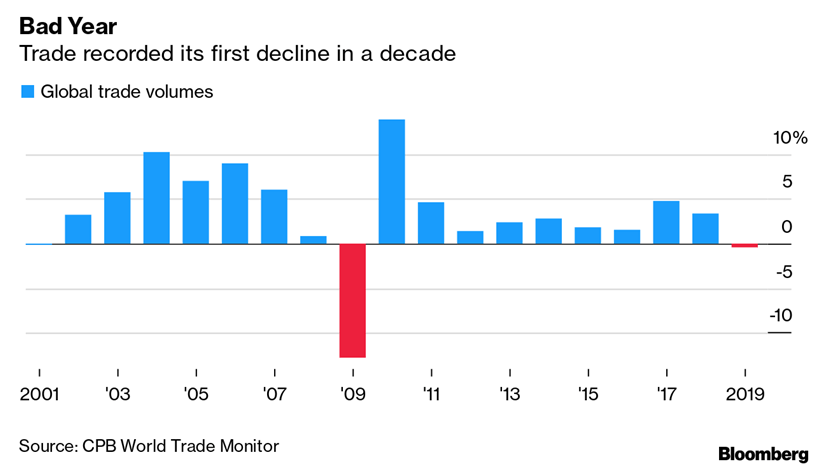
Even if the coronavirus peters out by late spring, preparations like shutting down activities (schools, travel, eating out in Chinese restaurants) and self-quarantines are going to take world trade and growth down in a big way. Bloomberg notes that in 2019, trade volumes were already down 0.4%. See the chart.
Mastercard is the latest company to warn of lousy earnings ahead. Some 20% of the S&P 500 have already issued warnings, including might Proctor & Gamble, meaning current P/E's are starting to look overly optimistic. As well publicized, luxury goods companies are complaining the virus will cost them over $40 billion. United Airlines just scrapped its 2020 profit forecast altogether. We have no real idea what it means when the CDC says "The disruption of daily life (from coronavirus) might be severe."
To an economist, this means a sharp contraction in consumer spending—unless we think everyone can get everything they need for daily life via Amazon delivery. The consumer is two-thirds of the US economy. A deep drop in consumer spending automatically, mechanically cuts GDP. It's unavoidable. And that is to assume an epidemic in the US does not affect employment and wage growth, a longer term concern but one that should not be neglected.
On top of the stock market tanking, businesses faltering and consumer income and spending heading south, there is the political fall-out. Just as the cover-up can be worse than the crime, the response to the coronavirus may be worse than the virus. In the US, this is even more so because the federal government is not preparing at all and state and local governments have limitations. Supplies are short—only four states even have tests. Worse, the citizens are not going to put up with state-line temperature checks and getting hauled off to an Army base on the spot if the reading is too high. Think of all those guns.
One analyst said last night the markets freaked out on Monday because of the virus spreading to Italy. Yesterday it was not only the likely spread to the US, it was also loss of trust in the US government competence to deal with a crisis. The federal government is unprepared, as was shown in the bungling of flying the cruise ship passengers home (the State Dept bullied the CDC).
Quarantine centers are not established, and a proposal for a center in one California town is being resisted and taken to court. It won't be long before people start thinking about how badly the federal government responded to the hurricane in Puerto Rico. A thread of thought has it Trump doesn't care about brown people, especially those who can't vote, but we all know that as a narcissist, he lacks empathy for all people, not just non-whites. He also can't manage his way out of a paper bag. He lacks basic administrative capabilities and has put utterly unqualified people in charge of things they know nothing about. We will know the mud has hit the fan when he starts firing the CDC officials.
We can't trust the data from China. Pretty soon we will feel we can't trust the data from the US, either. How the Olympic committee can make a decision about the summer Olympic games in Japan is a mystery. It's contemplating cancellation, which may be a blessing in disguise. Think about what happened to the Greek economy when it was disclosed the government had lost a vast pile on the Athens Olympics. Or take a tour of Toronto and see the huge, vacant stadium.
Bottom line, "this might be bad," as the CDC says. Yesterday Roubini said in the FT that the Fed has only 1.5% of room left but it will likely cut rates anyway, despite the power of monetary policy to aid in pandemic circumstances at zero. A temporary boost in equities from rate cuts will be short-lived. And "The coronavirus outbreak is likely to be only one of many negative shocks that will hit the global economy this year. Others include the risk of a war between US and Iran causing a spike in oil prices; political chaos in the US as foreign rivals interfere in the upcoming election; and an escalation in tensions between US and China. Take all of this together, and the risk of a global recession is rising."
Taking it one step further, consider that Trump's modus operandi is to create distractions from actual events. In this case, the actual event is the stock market collapsing. Trump sees the stock market as his personal ratings machine. What can outmatch a drop he cannot control? How about a nice little war?
Politics: We watched the Democratic candidate debate, painful though it was, plus the after-debate talking heads. Here's the bottom line: we need Biden to win South Carolina on Saturday to put a dent in Bernie's momentum and growing delegate lead. Forget the polls—it's the number of committed delegates going into the convention that counts. If Bernie gets a plurality, it's nearly impossible to deny him the nomination. Oddly, Bernie is the authentic anti-establishment guy on the political stage today, not Trump, who has been feeding the swamp creatures rather than draining the swamp.
Bernie did not respond well to a barrage of attacks on him, including boos from the crowd. He came across as grouchy and like competitor Warren, someone who thinks he knows better than anyone else. As analysts have noted, a pretence of humility and a show of respect for the voter is prerequisite for a successful candidate.
To some extent, the debate last night was addressed to voters in two states on Super Tuesday next week—Texas and California. Mayor Pete got in the best shot, referring to Sander having said at least Castro brought literacy to Cuba—nobody who praises Castro for anything can win a US presidential election.
Bloomberg did better but no cigar. In the end, the scariest thought is this: as we saw in the 2016 election, the fans of Bernie are actually a "movement" and if they don't get Bernie at the top of the ticket, they won't vote at all. But we should worry that centrists will stay home if it's Bernie--the policy center is against Medicare for all (no choice) and against sloppy budget ideas. Amy Klobuchar made the point that Bernie's plans add up to a cost of $60 trillion, triple the current GDP for one year. We literally cannot afford Bernie. Again Mayor Pete got in the trenchant comment: if it's Bernie vs. Fat Donny, imagine how the rest of 2020 plays out—more turmoil, more divisiveness. This is drama on an Italian scale.
This is an excerpt from “The Rockefeller Morning Briefing,” which is far larger (about 10 pages). The Briefing has been published every day for over 25 years and represents experienced analysis and insight. The report offers deep background and is not intended to guide FX trading. Rockefeller produces other reports (in spot and futures) for trading purposes.
To get a two-week trial of the full reports, including the Traders Advisories, send $3.95 to [email protected] using Paypal.
This is an excerpt from “The Rockefeller Morning Briefing,” which is far larger (about 10 pages). The Briefing has been published every day for over 25 years and represents experienced analysis and insight. The report offers deep background and is not intended to guide FX trading. Rockefeller produces other reports (in spot and futures) for trading purposes.
To get a two-week trial of the full reports plus traders advice for only $3.95. Click here!
Author
Barbara Rockefeller
Rockefeller Treasury Services, Inc.
Experience Before founding Rockefeller Treasury, Barbara worked at Citibank and other banks as a risk manager, new product developer (Cititrend), FX trader, advisor and loan officer. Miss Rockefeller is engaged to perform FX-relat