China’s Yuan Problems

Is China manipulating the yuan is not the interesting question. The yuan is a managed currency. The People’s Bank of China is controlled by the nation’s political leadership. The yuan moves at the behest of Beijing.
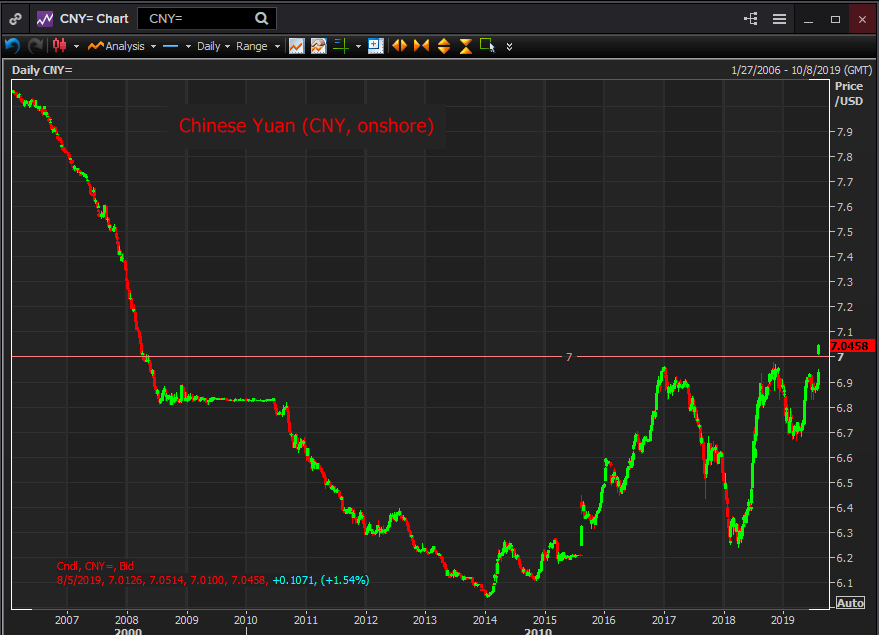
The relevant question is what do Xi Jinping and the party chiefs hope to accomplish by dropping the yuan below seven to the dollar. It is a move that they knew would spark fear and turmoil in markets around the world, including China.
Just a sampling of market reactions on Monday in New York: The Dow lost 767 points, 2.90%, the S&P 500 87 points 2.98%, the generic 10-year Treasury yield 12 points to 1.74%, its lowest since late 2016. The Shanghai Composite is down 3% since Thursday’s close, 14.2% since April.

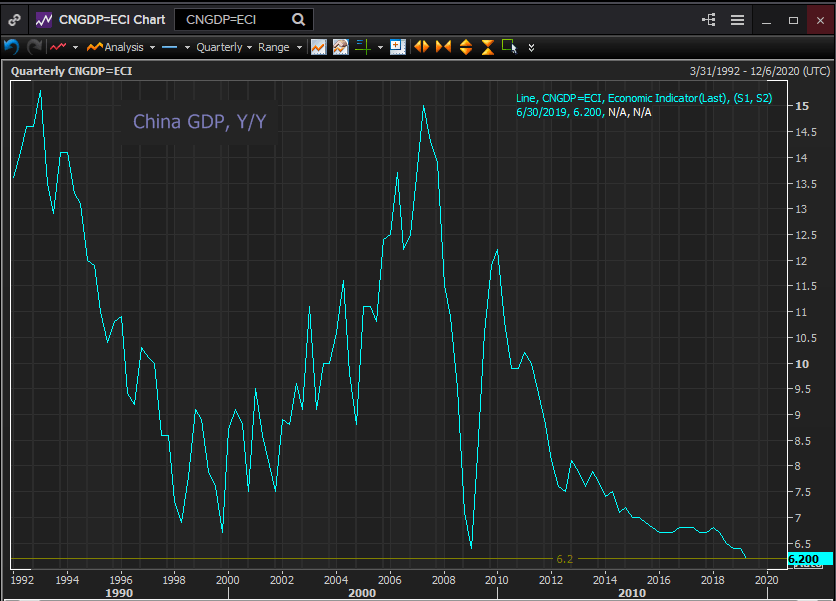
That is the initial logic. It is a warning that Beijing as well as Washington has access to the markets. China can send the Dow, the FTSE and the DAX plummeting, whenever it wants. If China’s economy just suffered its lowest growth of the capitalist era, the Dow was having its worst day of the year on Monday.
There is another way to look at the breach of seven.
Where would the Yuan be if it were a market traded currency? Put it another way. With the trade war between the US and China running on 18 months and escalating, with Chinese economy having recorded 6.2% GDP in the second quarter, far below the 8% that used to be considered by Beijing as the lowest limit that could insure social stability, a market yuan would be far weaker against the dollar than it is now. The yuan rate would have passed 7.5 last year and be closing in on 8. It is quite possible to see the PBOC devaluation as a concession to market forces rather than a manipulation of the same.
This is not to say that the devaluation is not a deliberate weapon in the trade war with the US. It is. But it is a salvo whose most immediate and greatest damage is exacted through the markets.
Beijing is running low on ammunition. It exports far more to the US than it receives in return and it cannot match the tariffs Washington has imposed.
The actual and potential damage to the Chinese economy and its social contract from the confrontation with the US is far greater than the reverse. President Trump risks re-election. A hot trade war with the United States affects all of China’s trading and investment relations from the Pacific Rim to Europe.
That is why Beijing has turned to such a volatile weapon, one with as much potential for harming the Chinese economy as exacting an economic toll on the United States.
In the long run permanent yuan devaluation is antithetical to China’s industrial development. It discourages foreign direct investment and encourages capital departure. What company will look at a 20 years investment horizon in China if it is under a regime of politically motivated currency management?
Yuan devaluation undermines Chinese domestic purchasing power. If you go through the modern malls in Beijing you will find store after store of luxury Western merchandise. The Communists’ main promise to the nation is that they have delivered economic prosperity. China imports billions of dollars of raw material and almost all of its oil. Those goods are priced in dollars, with every point of devaluation Beijing imports inflation and damages its own consumers.
There is also Hong Kong. The city is China’s entrepot. A large portion of mainland financing goes through the former British colony. The political turmoil that has riven the city for weeks is a threat to Beijing’s control. Tiananmen may be a forbidden topic in China but if its memory is alive in Hong Kong it cannot be erased from Beijing.
The Central Committee and Xi Jinping face greater domestic and external challenges than at any time in the generation since Tiananmen. That is why they have chosen such an equivocal weapon. It demonstrates the risks they are willing to run to secure success.
Author

Joseph Trevisani
FXStreet
Joseph Trevisani began his thirty-year career in the financial markets at Credit Suisse in New York and Singapore where he worked for 12 years as an interbank currency trader and trading desk manager.
















