|premium|

Chart of the Week: Gold price reaches a wall of resistance

  • XAU/USD has been in the hands of the bulls as fundamentals ripen. 
  • The charts, on the other hand, may paint a different picture, at least in the meantime. 

Gold positions have got longer in both the futures and spot markets as the rate environment has become more favourable to the yellow metal as US nominal rates have started to trend lower which points to additional upward price pressure for XAU/USD. This means we should see additional short covering and new longs in the coming weeks.

A disappointing Nonfarm Payrolls report which has featured higher-than-expected wage increases and unemployment rates will likely see gold challenge technical resistance near $1,850/oz in the coming days or weeks.

This brings us to the charts. 

The following is a top-down analysis that illustrates the structure of the market across the main time frames.

Monthly chart
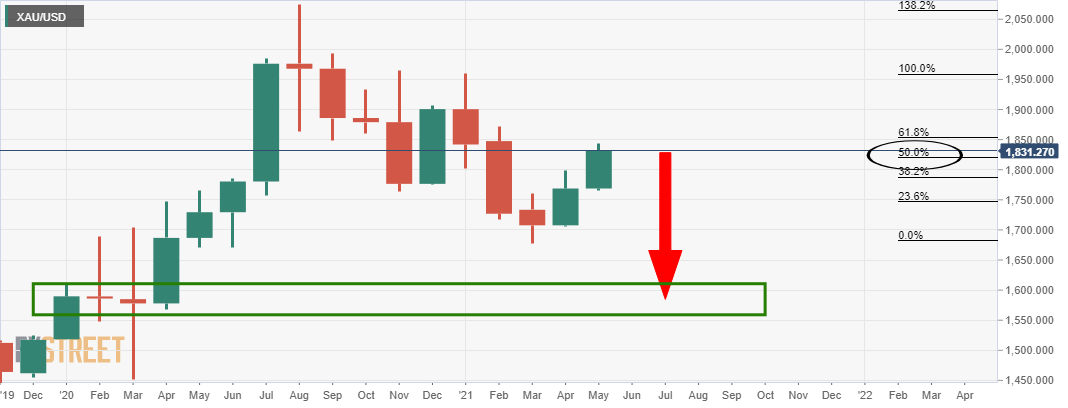
While the fundamental bias is to the upside, the monthly chart still has some work to do before a convincing technical bullish case can be made.

The correction of the last bearish impulse is still too shallow at a 50% mean reversion. 

Weekly chart
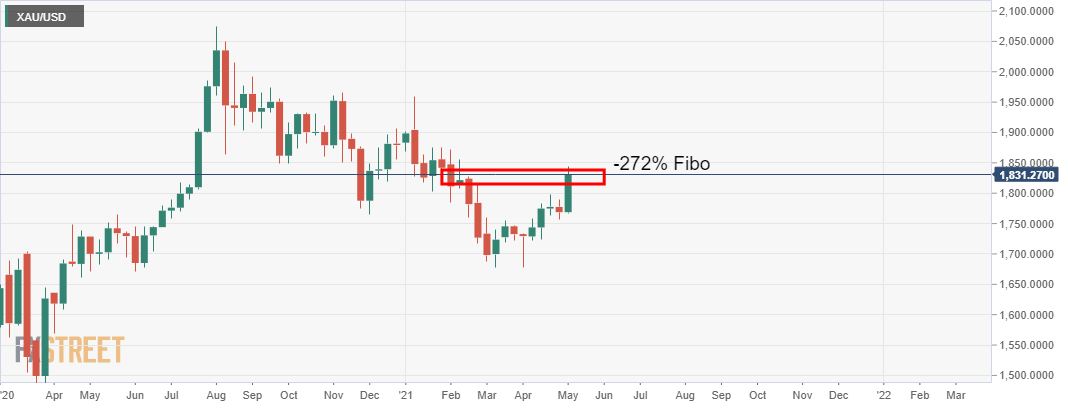
The weekly chart shows that the impulse has made a -272% Fibonacci retracement of the prior bullish impulse as it takes on resistance. 

Daily chart
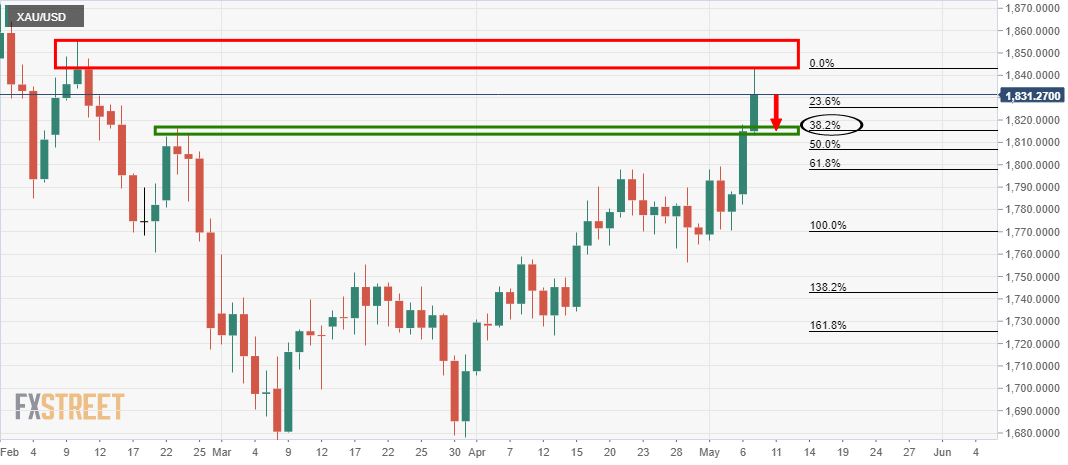
Meanwhile, there is scope for a deeper retracement on the daily chart to test the 38.2% Fibo of the prior daily impulse.

However, the bullish close is compelling, which leaves an upside continuation deeper into the supply zone on the cards for the opening session.

Premium

You have reached your limit of 3 free articles for this month.

Start your subscription and get access to all our original articles.

Subscribe to PremiumSign In

Author

Ross J Burland

Ross J Burland, born in England, UK, is a sportsman at heart. He played Rugby and Judo for his county, Kent and the South East of England Rugby team.


More from Ross J Burland
Share:

Editor's Picks

EUR/USD gains traction to near 1.1800 as tariff uncertainty weighs on US Dollar

The EUR/USD pair holds positive ground around 1.1795 during the early Asian session on Tuesday. The US Dollar weakens against the Euro amid US tariff uncertainty. The release of the US January Producer Price Index report will be in the spotlight later on Friday. 

GBP/USD treads water near 1.3500 as BoE-Fed divergence debate stalls

GBP/USD spent Monday spinning in place as market participants await a fresh catalyst to break the pair out of its recent range. The BoE's February hold came with a surprisingly dovish 5-4 split, and UK Consumer Price Index data last week showed inflation easing to 3.0%, reinforcing the case for earlier rate cuts, with most economists now looking to April or March for the next move. 

Gold down but not out as key $5,140 support holds

Gold consolidates the advance to monthly top of $5,250 in Tuesday’s Asian trades. The US Dollar finds demand as liquidity returns and risk sentiment recovers, despite US tariffs uncertainty. Gold defends 61.8% Fibo resistance at $5,142 amid the pullback, daily RSI remains bullish.

Top Crypto Losers: BCH, HYPE, PUMP extend losses as Bitcoin drops below $64,000

Altcoins, including Bitcoin Cash, Hyperliquid, and Pump.fun, are leading losses over the last 24 hours as Bitcoin falls below $64,000 on Tuesday. The technical outlook for BCH, HYPE, and PUMP flags downside risk amid broader market selling.

Supreme Court nixes tariffs, Trump teases 15% global tariff

On February 20th, the Supreme Court ruled that Trump’s global tariffs under IEEPA authority were unconstitutional, effectively nullifying the framework. However, the relief was short-lived. Within hours, Trump floated a 15% blanket tariff under an alternative legal authority.

XRP recovers slightly as bearish sentiment dominates crypto market

Ripple is rising above $1.40 at the time of writing on Monday amid fresh tariff-triggered headwinds in the broader cryptocurrency market. The sell-off to $1.33, the token’s intraday low, can be attributed to macroeconomic uncertainty, geopolitical tensions and risk-averse sentiment among other factors.














