|

CFTC Positioning Report: Speculators turned positive on JPY

These are the main highlights of the CFTC Positioning Report for the week ended on August 13.

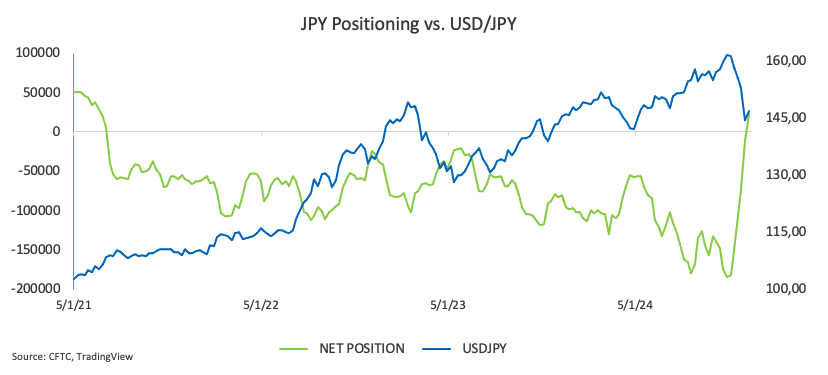
  • Japanese yen positioning shifted to net long for the first time since Q2 2021, as speculators continued to digest the latest BoJ hawkish message and global markets saw calmer waters as US recession concerns kept dwindling. Meanwhile, USD/JPY entered a consolidative phase around the 147.00 region.
  • Non-commercial net longs in the European currency dropped to two-week lows amidst an uptick in open interest. Absent news from the ECB, the focus of attention remained on the US economy. That said, disinflationary pressures remained well in place, allowing investors to further price in the start of the easing cycle by the Fed in September, albeit by a smaller size. EUR/USD maintained business above the 1.0900 barrier, although with a bullish bias.
  • Net longs in the US Dollar climbed to four-week highs, amidst shrinking concerns of a potential US slowdown and steady speculation of a rate reduction by the Fed as soon as next month. The US Dollar Index (DXY) managed to climb to tops near 103.50, although that move fizzled out afterwards, sending the index back to the sub-103.00 region.
  • Net longs in the British pound shrank for the third consecutive week, following the all-time high recorded in the week to July 23 (142,183K contracts). In fact, investors continued to unwind longs in the wake of the dovish cut by the BoE on August 1, although they remained vigilant on further results around the UK economy, particularly employment and inflation. GBP/USD bottomed out near 1.2665, managing to regain strong traction afterwards, mostly on USD weakness.
  • In the commodity complex, net longs in Gold climbed to three-week tops against the backdrop of escalating geopolitical risks in the Middle East and the Russia-Ukraine conflict, while prospects of interest rate cuts by the Fed continued to underpin the yellow metal’s uptick.
Author

Pablo Piovano

Born and bred in Argentina, Pablo has been carrying on with his passion for FX markets and trading since his first college years.

More from Pablo Piovano

Share:

Editor's Picks

AUD/USD hits nine-week lows below 0.7000 on RBA Bullock's remarks

AUD/USD reverses a brief uptick and turns lower to hit nine-week lows below 0.7000 in the European morning on Tuesday, as traders digest cautious remarks from Reserve Bank of Australia (RBA) Governor Michele Bullock during the press conference. Earlier on, the RBA raised the cash rate to 4.60%, as widely expected, leaving the door open to further rate hikes if needed.

USD/JPY consolidates near 157.50 as a bullish USD counters intervention risks

USD/JPY struggles to capitalize on the overnight bounce from a one-week low, consolidating around 157.50 in the Asian session on Tuesday. Trump's concerns about the Japanese Yen's weakness fueled speculation about another US-Japan joint intervention. This, along with the hawkish BoJ, underpins the JPY and caps the currency pair. Meanwhile, rising Fed rate-hike bets and oil-driven inflation fears continue to push US bond yields to multi-year highs, keeping the US Dollar pinned near a two-month high and supporting the pair.

Gold regains some traction; focus remains on $4,100

Gold manages to gather some composure and bounces off recent lows near the key $4,100 mark per troy ounce on Tuesday. The move higher in the precious metal comes despite the firmer US Dollar and rising US Treasury yields across the board, while escalating geopolitical tensions appear to limit the downside potential.

Crypto Today: Bitcoin, Ethereum, XRP correct upward amid declining ETF inflows

The cryptocurrency market upholds a neutral-to-bullish bias on Tuesday, with Bitcoin edging closer to a breakout above $84,000. Altcoins mirror BTC’s outlook, with Ethereum holding above $2,700 and Ripple pushing past the reclaimed $1.50 level.

RBA recap: Rate hikes are on the table as demand stays too strong

The Reserve Bank of Australia unanimously tightened monetary policy, warning that inflation remained too high and that several upside risks had begun to materialise. Governor Michele Bullock said the Board would raise rates again if necessary.

Fed vs BoJ: Both hiked. The market only believes one of them – and the chart shows which

The Fed and the BoJ have just done something remarkably similar. Both central banks raised interest rates by 25 bps last week, both are confronting inflation risks, and both signal that future decisions will depend on incoming economic data.