|

CFTC Positioning Report: JPY Net shorts at multi-year lows

These are the main highlights of the CFTC Positioning Report for the week ending on August 6.

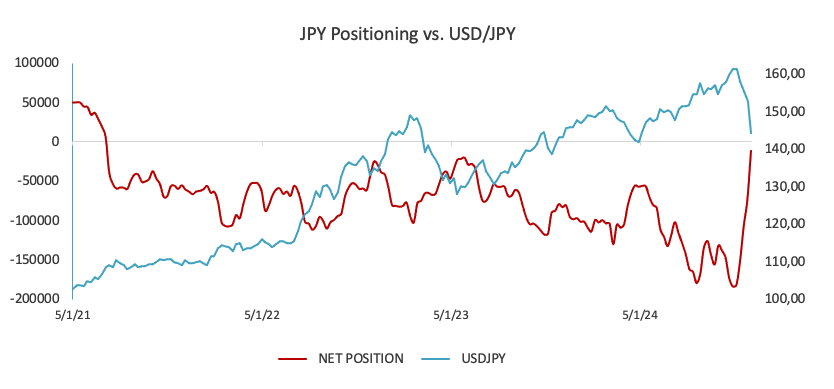
  • Net shorts in the Japanese yen extended their retracement during last week, this time reaching levels last seen in Q1 2021 around 11.3K contracts. During that period, investors continued to buy the Yen in response to the change of heart around the currency in the wake of the hawkish move by the BoJ at its meeting on July 31.
  • The neutral tone at the FOMC meeting, disheartening NFP data, and the hawkish tilt by the BoJ reignited recession fears and sparked a pronounced sell-off in the US Dollar in tandem with speculation of an emergency rate cut by the Fed. That said, net shorts in the Greenback dwindled to eight-week lows, and DXY sank to multi-month lows near 102.15.
  • Net longs in the European currency nearly doubled from the previous week. While EUR/USD managed to surpass the key 1.1000 barrier during the period, that move eventually fizzled out in the following days.
  • Net longs in the British pound retreated to five-week lows in line with a poor performance of GBP/USD, which flirted with the critical 200-day SMA near 1.2660 as investors continued to assess the BoE’s interest rate cut on August 1.
  • Gross longs in the Australian Dollar continued to edge lower last week, prompting net shorts to advance for the third straight week. Persistent demand concerns from China and the incessant weakness in commodity prices sent AUD/USD to new 2024 lows near 0.6350 just before the cut-off data on August 5.
Premium

You have reached your limit of 3 free articles for this month.

Start your subscription and get access to all our original articles.

Subscribe to PremiumSign In

Author

Pablo Piovano

Born and bred in Argentina, Pablo has been carrying on with his passion for FX markets and trading since his first college years.

More from Pablo Piovano

Share:

Markets move fast. We move first.

Orange Juice Newsletter brings you expert driven insights - not headlines. Every day on your inbox.

By subscribing you agree to our Terms and conditions.

Editor's Picks

EUR/USD eases to near 1.1650, eyes US PCE for fresh impetus

EUR/USD turns south to test 1.1650 in European trading on Friday, facing rejection once again near seven-week highs. The pair, however, continues to draw support from persistent US Dollar selling bias, despite a cautious market mood. Traders now await the US September PCE inflation and UoM Consumer Sentiment data. 

GBP/USD holds gains near 1.3350 ahead of US data

GBP/USD sticks to a positive bias near 1.3350 in the European session on Friday. Traders prefer to wait on the sidelines ahead of the key US inflation and sentiment data due later in the day. In the meantime, broad-based US Dollar weakness helps the pair stay afloat. 

Gold remains below $4,250 barrier as traders await US PCE data for directional impetus

Gold gains some positive traction on Friday, though it remains confined in the weekly range. Dovish Fed expectations continue to undermine the USD and lend support to the commodity. Bulls, however, might opt to wait for the US PCE Price Index before placing aggressive bets.

UoM Consumer Sentiment Index expected to post a mild recovery in December

December’s preliminary Michigan Consumer Sentiment Index is forecast to have picked up to 52 from a three-year low of 51.0 in November. A stalled labour market and higher price pressures are likely to weigh on consumers’ confidence.

Canada Unemployment Rate expected to edge higher in November ahead of BoC rate decision

Statistics Canada will release its Labour Force Survey on Friday, and markets are bracing for a weak print. The Unemployment Rate is expected to tick higher to 7% in November, while the Employment Change is forecast to come in flat after a nice gain in October.

Pi Network Price Forecast: Bearish streak nears critical support trendline

Pi Network (PI) edges lower on Friday for the third consecutive day, approaching a local support trendline. The on-chain data suggests an increase in supply pressure as Centralized Exchanges (CEXs) experience a surge in inflows.














