|

CFTC Positioning Report: Dollar bets turned negative for the first time this year

The latest CFTC Positioning Report, covering the week ending April 22, captures a period marked by the Easter holiday lull, with both volatility and trading activity notably subdued.

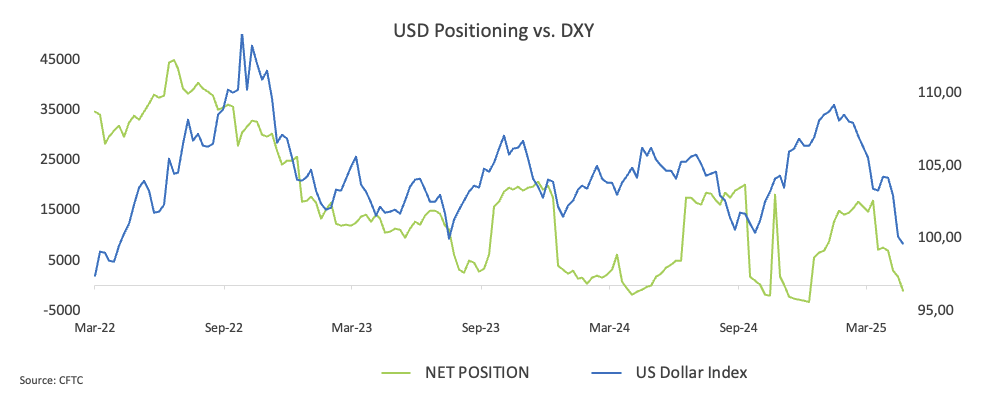
Speculators turned net short on the US Dollar (USD) for the first time since early December 2024, holding just over 1K contracts, amid a decent advance in open interest. Meanwhile, the US Dollar Index (DXY) extended its bearish streak, slipping to fresh lows around the 98.00 mark, where some initial signs of support have started to emerge.

Speculative net longs in the Euro (EUR) fell to a two-week low, holding just above 65K contracts. Commercial players, meanwhile, kept their net short positions virtually unchanged near 118K contracts, marking multi-month highs. Open interest climbed to around 719.2K contracts, the highest in six weeks. Over the reporting period, EUR/USD extended its multi-week rebound, reaching the 1.1570 area for the first time since November 2021.

Net longs in the Japanese Yen (JPY) continued to build, reaching fresh highs near 178K contracts, alongside a rise in commercial players' net shorts to almost 201K contracts. The correction in USD/JPY gathered momentum, fueled by tariff-driven demand for safe-haven assets, pushing the pair below the key 140.00 support level for the first time since September 2024.

Non-commercial net longs in the British Pound (GBP) picked up momentum, rising to a three-week high near 20.5K contracts alongside another increase in open interest. GBP/USD extended its uptrend, breaking above the 1.3400 barrier while maintaining a constructive outlook above the key 200-day SMA at 1.2835.
Author

Pablo Piovano

Born and bred in Argentina, Pablo has been carrying on with his passion for FX markets and trading since his first college years.


More from Pablo Piovano
Share:

Editor's Picks

AUD/USD flatlines near 0.6965 as less hawkish RBA counters USD weakness

AUD/USD holds steady above a two-week low, trading near 0.6965 in the Asian session on Wednesday as early midterm election results heighten political uncertainty and weigh heavily on the US Dollar. Moreover, reviving safe-haven demand triggers a fresh leg down in US bond yields, offsetting Fed hike bets and exerting additional pressure on the buck. However, a less hawkish RBA caps the Aussie.

USD/JPY declines below 158.00 as USD weakens on midterm election results

USD/JPY comes under heavy selling pressure on Wednesday, dropping below 158.00 during the Asian session as the US Dollar slumps to a one-month low amid heightened political uncertainty after early US midterm vote counts. Moreover, the prospect of gridlock in Washington drives safe-haven flows, triggering a fresh leg down in US bond yields and further weighing on the buck.

Gold surges past $4,000 as USD falls in reaction to US midterm election results

Gold catches aggressive bids on Wednesday, surging past the $4,000 psychological mark heading into the European session as the US midterm election results heighten political uncertainty and weigh heavily on the US Dollar. Moreover, softer US bond yields counter Fed hike bets and contribute to driving flows to the non-yielding bullion.

Bitcoin tests critical support, Ethereum struggles below resistance, XRP extends losses
Bitcoin (BTC), Ethereum (ETH) and Ripple (XRP) remain under pressure on Wednesday as bearish momentum continues to weigh on prices. BTC approaches key support around $76,466, and a decisive close below could open the door to deeper losses. Meanwhile, ETH struggles below key resistance while XRP faces rejection at the upper trendline of a falling channel pattern, all hinting at deeper losses.
US Dollar Index dives to late September lows near 101.25 on US election results

The US Dollar Index, which tracks the Greenback against a basket of currencies, comes under intense selling pressure during the Asian session on Wednesday, dropping to its lowest level since late September as early US midterm election results heightened political uncertainty.

The 2% inflation target came from a throwaway remark. It now moves trillions
The Federal Reserve's 2% inflation goal grew out of an off-the-cuff remark by a New Zealand politician in 1988. Bond investors still price long-term US debt as if 2% holds, so a change in how the Fed measures inflation would move markets.