CFTC Positioning Report: Bearish bets persisted around the US Dollar


Currency traders aren’t backing down from their bearish bets on the US dollar. According to the latest CFTC data for the week ending July 22, speculative positioning remained firmly negative—even as trade tensions continued to ease and fresh data reinforced the resilience of the US economy. That said, the US Dollar’s lack of traction comes despite a macro backdrop that might normally offer support. But the Federal Reserve’s cautious tone has kept markets guessing, with policymakers showing little urgency to shift gears. That stance is expected to hold steady for now, even as President Trump renews pressure for lower rates—reviving public clashes with Fed Chair Jerome Powell that have become a familiar sideshow to the main policy narrative.
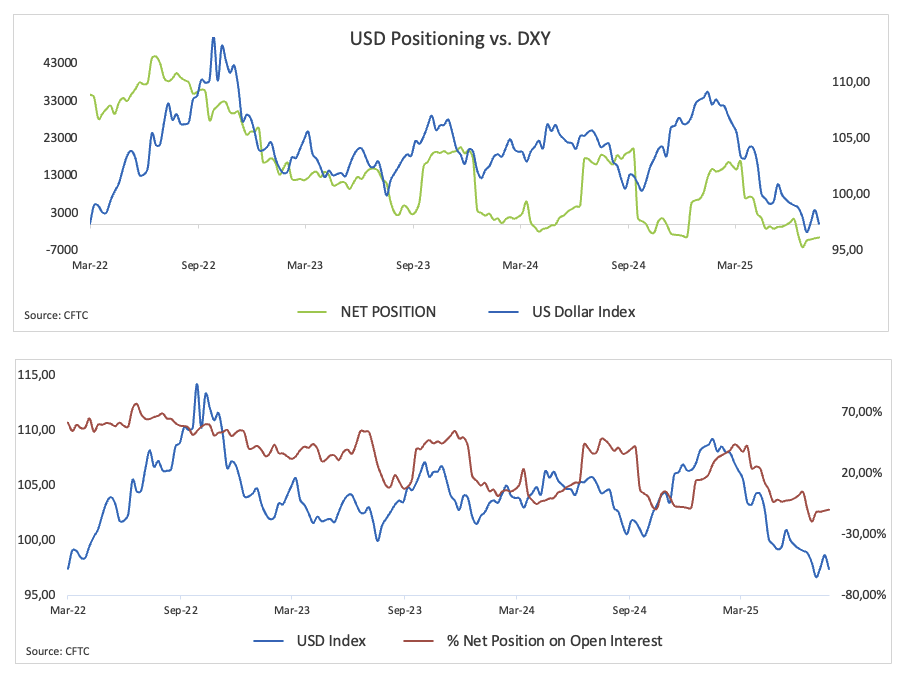
Speculators dialled back their bearish positions on the US Dollar (USD) last week, cutting net shorts to their lowest level in three weeks—down to just under 3.5K contracts. The shift came as open interest picked up, climbing to a three-week high of around 35.7K contracts. After briefly flirting with the 99.00 mark, the US Dollar Index (DXY) has slipped into a correction. And while it’s shown signs of recovery since the June’s lows, the index is still hovering near multi-year lows.
Speculative appetite for the Euro (EUR) pulled back last week, with net long positions slipping to around 125.5K contracts—a two-week low. Commercial players also pared their net short exposure, bringing it down to roughly 177.7K contracts, the lowest level in a similar timeframe. Open interest climbed for the fifth consecutive week, reaching nearly 843.5K contracts. That renewed focus came as EUR/USD staged a firm rebound, surging more than two cents to trade near the 1.1760 zone, shaking off the prior week’s lows and reigniting bullish momentum.
Non-commercial traders extended their net long positions to slightly over 106.6K contracts, or two-week tops. On the other hand, institutional investors increased their short positions, bringing their net bearish bets up to around 117.4K contracts, also a two-week high. In addition, open interest retreated to just over 313K contracts. USD/JPY hit multi-week highs just past the 149.00 hurdle before easing toward the 146.00 zone.
Speculators sharply cut their bullish positions on the British pound last week, with net longs plunging to just under 600 contracts—the lowest level since mid-January. At the same time, open interest rose to a six-week high of around 195.5K contracts.The British Pound came under pressure during a multi-day correction that dragged GBP/USD down to the 1.3370 zone before spot managed to mount a decent rebound. Looking ahead, the outlook for sterling remains shaky. The currency faces mounting headwinds from a deteriorating economic picture and a fragile fiscal backdrop—risks that could continue to weigh on sentiment in both the short and medium term.
Speculative net longs in Gold have gone up again, this time to levels last seen in mid-March, little over 253K contracts. Open interest, in the same direction, has hit three-month highs of around 489.4K contracts. Gold prices stayed in their multi-week range, although they did momentarily go over the important $3,400 mark per troy ounce in response to steady trade worries.
Non-commercial players have increased their net shorts in the Australian Dollar (AUD) to around 81.2K contracts, the highest level since April 2024. At the same time, open interest has climbed to multi-week peaks at nearly 161.4K contracts. During the period, AUD/USD managed to regain upside impulse, bouncing off monthly lows in the mid-0.6400s to the proximity of the 0.6560 region. Looking at the longer run, the Aussie should remain closely linked to the fortunes of China while carefully monitoring trade developments from the White House.
Author
Pablo Piovano
FXStreet
Born and bred in Argentina, Pablo has been carrying on with his passion for FX markets and trading since his first college years.

















