Capitalizing on potential: Exploring buying opportunities in NZD/USD


The NZDUSD pair is currently under the spotlight in the forex market, driven by pivotal actions from the Federal Reserve and the Reserve Bank of New Zealand, alongside key economic indicators. Technically, the pair has seen notable movements, crossing crucial resistance and support levels. These trends are deeply influenced by the Fed's interest rate decisions and mixed US economic data, as well as New Zealand's economic health, reflected in its latest inflation and employment figures. This blend of technical and fundamental factors is essential for understanding the NZDUSD dynamics and upcoming trading opportunities.
Technical analysis
The daily timeframe reveals significant price movements as the NZDUSD pair broke through a key resistance zone around the 0.6070 level, pushing into the 0.62 handle. This breakthrough is pivotal, indicating a bullish trend in the short term. Traders should consider the following points in their technical analysis:
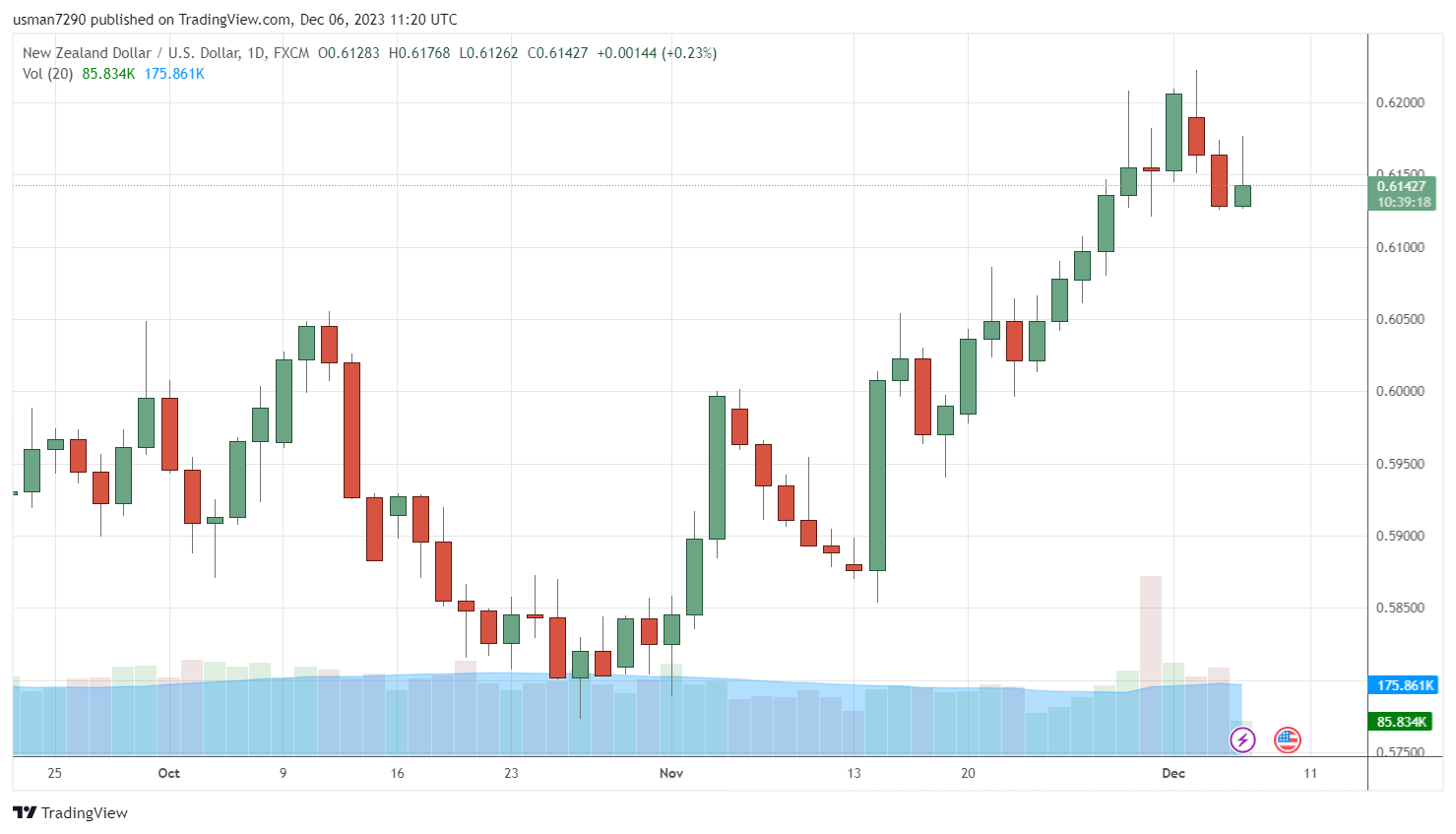
Key Resistance Turned Support: The previous resistance at 0.6070 is now acting as support. A pullback to this level could provide a good entry point for buyers.
Fibonacci Retracement and Moving Average Confluence: The 38.2% Fibonacci retracement level aligns with the red 21-day moving average, reinforcing the support around the 0.6070 level.
Target for Buyers: The next resistance target is around the 0.64 handle. This presents a clear risk-reward scenario for traders considering entering long positions.
The current technical landscape suggests that as long as NZDUSD stays above the 0.6070 support, the bullish momentum might continue, offering potential upward movement opportunities for traders.
Fundamental analysis
-
USD Fundamentals:
-
Interest Rates and Fed Policy: The Fed's decision to leave interest rates unchanged and the shift of hawkish members to a more neutral stance indicate a cautious approach towards policy tightening. This could lead to a less aggressive stance on rate hikes in the future.
-
Economic Indicators: The US Core PCE aligning with forecasts and a disinflationary trend may ease pressure on the Fed. However, the weakening labor market, with rising Continuing Claims and disappointing NFP reports, alongside a contraction in the ISM Manufacturing PMI, suggests economic slowdown concerns.
-
Market Expectations: The market anticipates the Fed to start reducing rates as early as Q1 2024, reflecting a potential shift in monetary policy.
-
-
NZD Fundamentals:
-
RBNZ Stance: The RBNZ’s decision to maintain its official cash rate, along with the projection of declining demand growth, suggests a cautious approach. The missed inflation targets and labor market slowdown align with this stance.
-
Economic Data: The contraction in both Manufacturing and Services PMI indicates potential economic challenges for New Zealand, reducing the likelihood of further rate hikes.
-
Market Outlook: The market does not expect the RBNZ to increase rates further, which could lead to a relatively dovish monetary environment.
-
Trade idea
Given the technical and fundamental analyses, a potential trade idea could be to consider a long position in NZDUSD, capitalizing on the technical bullish trend and the supportive fundamental backdrop. Key considerations for this trade would include:
-
Entry Point: A pullback to the 0.6070 support level, aligning with the 38.2% Fibonacci retracement and the 21-day moving average, would be an ideal entry point.
-
Target: Aim for the next resistance around the 0.64 level.
-
Risk Management: It’s crucial to set a stop loss below the 0.6070 level to mitigate potential losses if the trend reverses.
This trade idea hinges on the notion that the USD might face headwinds due to economic slowdown concerns and a potentially less hawkish Fed, while the NZD, despite its challenges, may find some stability given the RBNZ's current policy stance.
Author
Usman Ahmed
Forex92
Usman Ahmed is a currency trader and financial market analyst with more than a decade of active trading experience.

















