|

Biggest drop since March 2020

Six days ago, USD bears were hurting badly. At the close of that day, I warned against excessive USD-optimism based on a few factor. Today, DXY sustains its biggest weekly drop since March 2020. The Bank of England made the predictable decision to raise rates by 25 bps, but 4 of the 9-member Committee made the unpredictable decision to vote for 50-bps (Mann, Haskel, Ramsden and Saunders). The idea of 50-bps must NOT have been a total surprise. The ECB followed 45 mins later, fuelling expectations of a rate hike this year as well as a ending bond-buying possibly in H2. Lagarde had no other choice but to dwell on surging inflation as the EU grapples with cost of living crisis. I did warn against excessive dovish expectations from Lagarde on here last night. The chart below resurrects the relationship between German-US 10 yr yield spread and EURUSD, highlighted by a 60-day correlation of 0.37, but growing from a low of zero just 2 mths ago. The high was 0.60 as recently as last summer. 
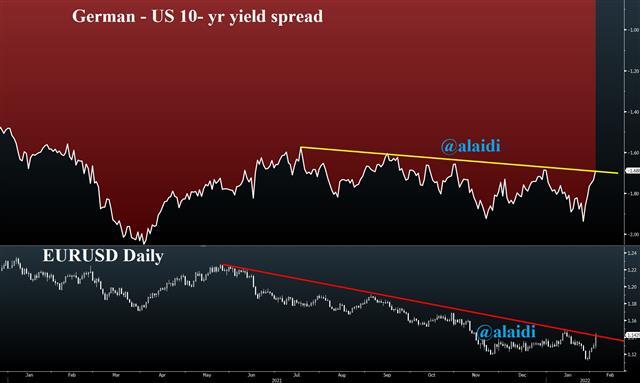
Moving on, EURUSD is on its way to regain 1.17 this month, when it successfully closes above 1.1440s this week, which coincides with the May trendline resistance, the 100-DMA and the summer channel top in the Bund-Treasury spread. 

All of the above is considered "cheap talk" when you read it after-the-fact. Yet, we've reiterated to our WhatsApp Broadcast Group to stay long GBPUSD since Friday, with the right shoulder support at 1.3350, paving the way for 1.37 into BoE week. And that's where we're heading.

Yes, we have NFP and all that noise tomorrow. We could see a very ugly number (near -20K instead of +150K) due to Omicron absenteeism, but that should have a limited USD impact.   

Author

Adam Button

Adam Button

AshrafLaidi.com

Adam Button has been a currency analyst at Intermarket Strategy since 2012. He is also the CEO and a currency analyst at ForexLive.


More from Adam Button
Share:

Editor's Picks

AUD/USD eyes 0.7150 barrier nine-day EMA

AUD/USD inches higher after registering modest losses in the previous day, trading around 0.7130 during the Asian hours. The technical analysis of the daily chart indicates that the pair is moving sideways within the rectangle pattern, suggesting a consolidation as neither the bulls nor the bears have enough momentum to take control of the market.

USD/JPY trades below 160.00 intervention threshold; bullish bias intact

The USD/JPY pair attracts some sellers during the Asian session amid fears that authorities will step in again to prop up the Japanese Yen. Furthermore, the Israel-Lebanon truce prompts some profit-taking around the US Dollar and exerts downward pressure on the currency pair.

Gold meets contention near $4,420…for now

Gold extends its recovery past the $4,500 mark per troy ounce on Thursday. The yellow metal’s advance comes amid the resurgence of some selling interest around the, improving risk sentiment, and declining US Treasury yields across the curve.

Bitcoin’s massive storm is back: Why the sell-off is far from over

Bitcoin price action over the last few weeks has felt less like a normal, healthy correction and more like a slow grinding crash that continues to wreak havoc on holdings and trading accounts. And everything suggests that the dramatic crash isn’t over.

Nonfarm payrolls: Testing the limits of Fed policy patience

The upcoming nonfarm payrolls report for May will provide the final update on the US labor market before Kevin Warsh attends his first policy meeting as the new Fed Chair later this month.

Recession on paper: What really moves the Canadian Loonie now?

Statistics Canada handed the headline writers a gift and the analysts a headache. Real GDP shrank 0.1% on an annualized basis in the first quarter, and with the fourth quarter of 2025 revised down to a 1.0% contraction, that is two negative quarters in a row, the textbook definition of a technical recession and Canada's first since the pandemic.

Biggest drop since March 2020