|

Biden dominates Super Tuesday returns but nomination remains elusive

  • Biden leads in states won and delegates awarded.
  • Leading candidates Biden and Sanders are far from winning nomination.
  • Warren fades and Bloomberg remains a second tier candidate.

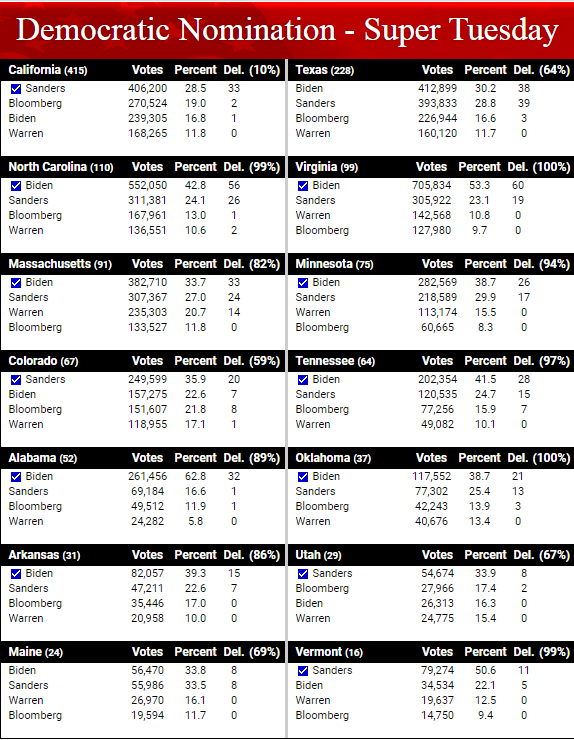
Former Vice-President Joe Biden revived his campaign to be the Democratic nominee against incumbent Donald Trump in November winning at least eight of 14 primary contests but the count in the remaining six, including the two largest California and Texas, will likely ensure that neither man reaches the July convention with enough pledged delegates to win on the first ballot. 

At just after midnight in New York Biden had a total of 383 delegates and Sanders 300 of the 1991 needed for the nomination.  Only two states, Texas and Maine, had not been called with Sanders narrowly leading in Maine and Biden in Texas..  

In the Democratic Party nomination process candidates are awarded delegates in proportion to the percentage of their vote. The winner in each state matters less than the margin of victory.  For instance in Texas as of this writing  with 64% reporting Biden leads with 30.2% to Sanders 28.8% but because of  the delegate award system Sanders has 39 delegates and Biden 38. 

In order to make up his deficit in delegates Sanders needs to dominate in California.  Though the state has been called for Sanders leading 28.5% over second place Michael Bloomberg with 19.0%, only 10% of the districts have reported results and Sanders has 33 delegates to Bloomberg's 2. 

Despite spending upwards of $400 million of his own money, former New York Mayor Michael Bloomberg seems to have made little headway with the Democratic primary electorate, garnering  just 27 delegates for an average cost of $15 million apiece.  Massachusetts Senator Elizabeth Warren came in third in her own state at 20.7% of the vote behind the winner Biden with 33.7% and Biden at 27.0%. 

RealClearPolitics
Author

Joseph Trevisani

Joseph Trevisani began his thirty-year career in the financial markets at Credit Suisse in New York and Singapore where he worked for 12 years as an interbank currency trader and trading desk manager.


More from Joseph Trevisani
Share:

Editor's Picks

AUD/USD falls to near 0.7100 after slipping below 50-day EMA

AUD/USD depreciates after registering minor gains in the previous day, trading around 0.7120 during the Asian hours. The technical analysis of the daily chart shows the pair consolidating sideways within a rectangle pattern, as neither bulls nor bears gain control. The AUD/USD pair is holding a slight bearish tone however as it sits beneath both the nine-day and 50-day EMAs.

160.00: USD/JPY back near intervention territory after upbeat US jobs report

US Nonfarm Payrolls beat expectations by a wide margin in May, with 172K jobs added. The US Dollar rebounds after the release, helping USD/JPY recover from its intraday lows. Warnings from Japanese authorities continue to limit upside potential near the 160.00 threshold.

Gold targets $4,300 amid stronger Dollar

Gold faces increasing selling interest and navigates the area of three-month lows near the $4,300 mark per troy ounce on Friday. The precious metal’s decline comes as traders assess the stronger-than-expected NFP, while the bid bias in the Greenback and higher US Treasury yields also collaborate with the retracement.

Cardano hits five-year low even as Hoskinson clarifies "break" isn't an exit

Cardano (ADA) price is down 10% at press time on Friday, extending losses over 30% so far this week amid Charles Hoskinson's clarification that "break" isn't an exit.

Week ahead – Fed countdown begins amid US inflation data and geopolitical risks

Fed Chair Warsh’s first meeting approaches as key US inflation data could reshape expectations. Oil prices remain elevated as US-Iran talks continue; tariffs also return to the spotlight. ECB is expected to hike; will it be a one-off move or is July live?

The US economy defies the rules: 100 days into the Oil shock and the recession signal is still missing

More than three months after the start of the Iran war and the resulting disruption to global energy markets, the US economy continues to display remarkable resilience. The conflict has triggered a sharp rise in Oil prices, reignited inflationary pressures and fueled widespread concerns about a potential economic slowdown.