Bank of Canada Preview: QE reduction to continue later in 2021
- Bank of Canada is not expected to make any changes to policy settings.
- Additional QE reduction is likely before the end of the year.
- USD/CAD continues to trade within a touching distance of multi-year lows.

The Bank of Canada (BoC) is widely expected to keep its policy rate unchanged at 0.25% following its June policy meeting. In April, the BoC announced that it reduced the weekly net purchases of Canadian government bonds, quantitative easing (QE) program, to a target of C$3 billion from C$4 billion. Commenting on this decision, "adjustment of the QE program reflects what we've seen in the economy to date, households and businesses have been impressively resilient,” BoC Governor Tiff Macklem said.
Although the BoC could opt out for additional reductions in its QE program before the end of the year, investors don’t see the bank announcing that decision when there is no press conference to deliver additional details.
In an interview with the Wall Street Journal on May 24, Macklem reiterated that tapering was the right move for the Canadian economy but added that “a considerable amount of monetary support” was still needed. Regarding the Canadian dollar’s valuation, Macklem noted earlier in May that there would be implications on the BoC’s outlook and policy settings if the currency were to move a lot higher.
As the first major central bank to take a hawkish step, the BoC is likely to continue to move away from the ultra-loose policy as the economy gathers momentum. Meanwhile, the latest inflation data from Canada revealed that the Consumer Price Index (CPI) jumped to 3.4% on a yearly basis in April from 2.2% in March, suggesting that increasing price pressures are also allowing the central bank to remain on the tightening path. According to a recently conducted Reuters poll, 16 of 17 economists that took part see the BoC tapering again in the third quarter of the year. Additionally, the poll consensus points to a total of 25 basis points rate hike by the fourth quarter of 2022.

To summarize, there have been no developments in the Canadian economy to force the BoC to change its stance since the decision to adjust the QE in April. The June policy meeting is unlikely to deliver a surprise policy decision and the BoC’s hawkish stance is already apparent.
USD/CAD technical outlook
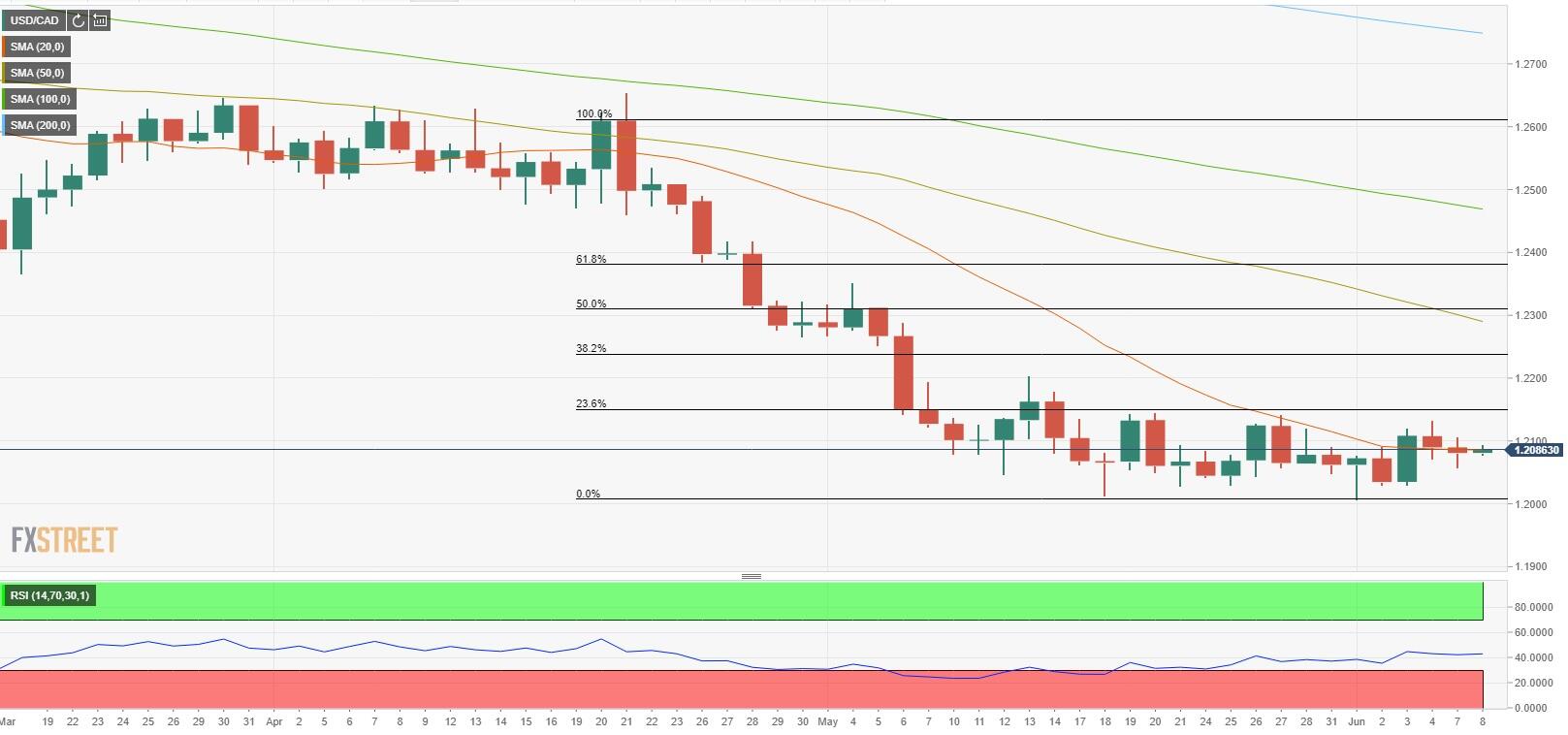
On the daily chart, the USD/CAD pair seems to have bottomed out near 1.2000 (psychological level) at the end of the downtrend that started following the BoC’s April decision. Currently, the Relative Strength Index (RSI) indicator on that chart is moving sideways a little below 50, suggesting that the pair is struggling to make a decisive move in either direction. In fact, the pair has been fluctuating in a 150-pip range since mid-May, confirming the consolidation phase.
On the downside, 1.1920 (May 14, 2015, low) could be seen as the next target if the pair manages to turn 1.2000 into a resistance. On the other hand, additional gains are likely if USD/CAD makes a daily close above 1.2150 (upper limit of the three-week-old range, 23.6% Fibonacci retracement of the latest downtrend). 1.2200 aligns as the next hurdle before 1.2240 (Fibonacci 38.2% retracement).
Author

Eren Sengezer
FXStreet
As an economist at heart, Eren Sengezer specializes in the assessment of the short-term and long-term impacts of macroeconomic data, central bank policies and political developments on financial assets.