Australian Dollar Price Forecast: Ready for a rally, or stuck in neutral?
- AUD/USD faded part of the recent bull run to the vicinity of the 0.6700 hurdle.
- The Federal Reserve is expected to trim its interest rates by 25 basis points.
- Focus in Oz will be on the release of the jobs report for the month of August.


The Australian Dollar (AUD) came under renewed downside pressure on Wednesday, with AUD/USD slipping away from recent multi-month highs near 0.6680 and drifting back toward 0.6660.
The move came as the US Dollar (USD) regained some traction. The US Dollar Index (DXY) managed to lift off multi-week lows around 96.50, helped by another uneven session in US money markets.
Stubborn inflation keeps pressure on the RBA
Inflation in Australia is proving harder to tame than hoped. July’s Monthly Consumer Price Index (Weighted Mean) jumped to 2.8% from 1.9% in June. At the same time, Q2 CPI rose 0.7% QoQ and 2.1% over the last twelve months
That stickiness explains the Reserve Bank of Australia’s (RBA) cautious tone. That said, policymakers remain reluctant to cut rates too aggressively while inflation is still running above comfort levels.
Australian economy shows surprising resilience
Despite global uncertainty, the domestic economy is holding up better than expected. August’s final Manufacturing PMI printed at 53.0, while Services reached 55.8, both in expansion territory.
Retail sales climbed 1.2% in June, and July’s trade surplus widened to A$7.3 billion. On the investment side, private capital expenditure in Q2 edged up 0.2%. GDP surprised to the upside as well, expanding 0.6% in the April-June period and 1.8% on a yearly basis.
The next big test comes with Thursday’s labour market report for August, which will give investors a clearer read on hiring trends.
RBA keeps it data-driven
Earlier in September, the RBA trimmed the Official Cash Rate (OCR) by 25 basis points to 3.60% and cut its 2025 growth forecast. Governor Michele Bullock pushed back against calls for deeper easing, emphasising that policy decisions will remain firmly data-dependent.
Minutes from the latest meeting underscored this stance: The RBA could move faster if the labour market weakens, but if the economy stays resilient, it will take things more slowly.
Markets currently expect the OCR to remain unchanged at the September 30 meeting, though pricing still implies about 30 basis points of easing by year-end.
China’s recovery remains the wild card
Australia’s economic fortunes remain closely tied to China. Q2 GDP there grew 5.2% YoY, with industrial production up by the same margin. But retail sales missed expectations, posting a 3.4% annual growth in August.
The latest PMI readings were mixed: manufacturing slipped into contraction at 49.4, while services edged up to 50.3. Deflation worries also linger, with August CPI down 0.4% on the year.
The People’s Bank of China (PBoC) left Loan Prime Rates (LPR) unchanged in August, the One-Year at 3.00% and the Five-Year at 3.50%, and is expected to keep policy steady at this week’s meeting.
AUD/USD technical outlook: still range-bound
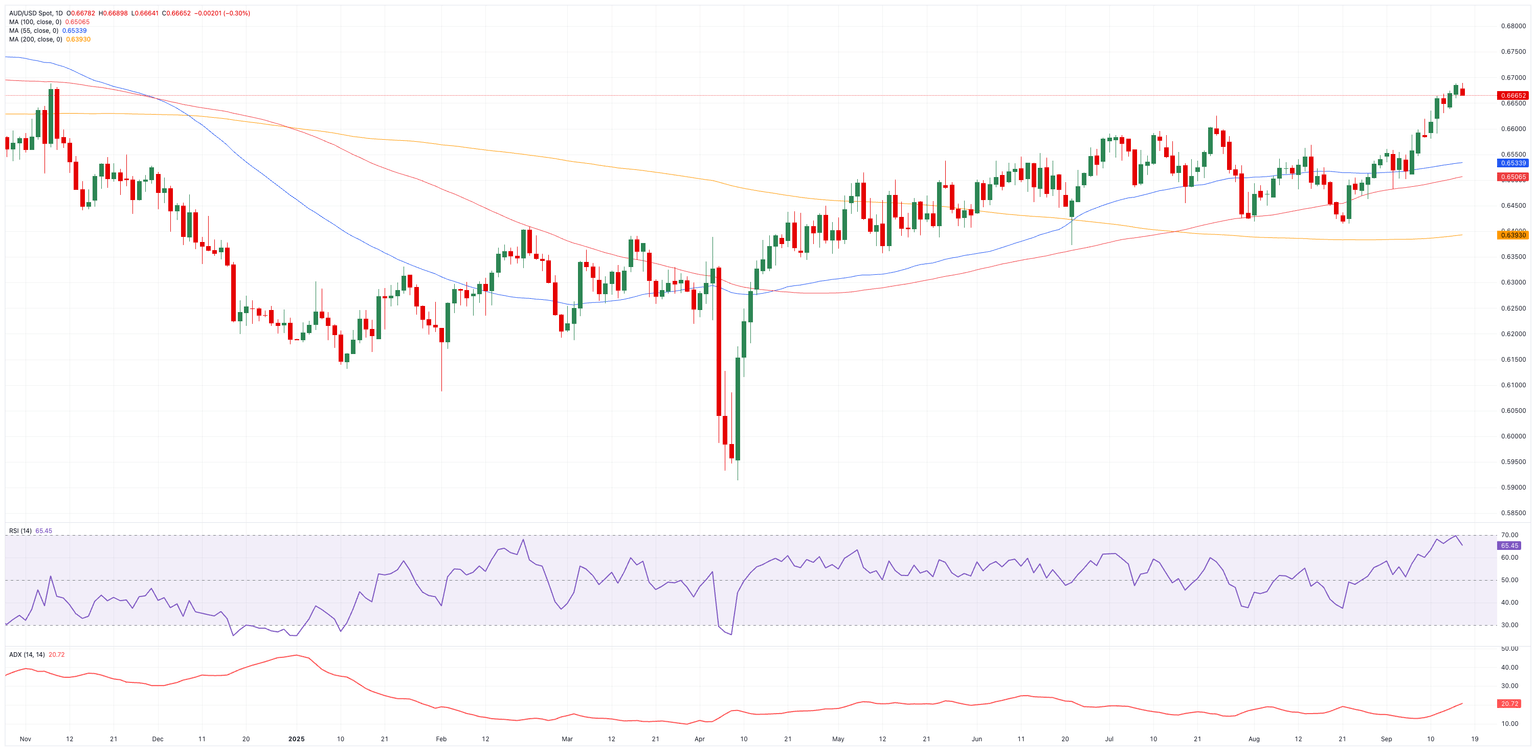
AUD/USD continues to challenge its upper end of the consolidative range.
On the upside, resistance is defined by the 2025 ceiling at 0.6679 (September 16). If buyers manage to push through this level, the November 2024 peak at 0.6687 (November 7) comes into focus, with the psychological 0.7000 yardstick looming further ahead.
On the other hand, decent contention emerges at the August low at 0.6414 (August 21), prior to the key 200-day SMA at 0.6393 and the June trough at 0.6372 (June 23).
In addition, momentum signals remain on the positive side: The Relative Strength Index (RSI) is hovering near 66, pointing to further upside potential. Meanwhile, the Average Directional Index (ADX) around 21 suggests that the trend, though still modest, is starting to build momentum.
AUD/USD daily chart
Short-term outlook
In the near term, AUD/USD looks stuck in its familiar range. Breaking out convincingly would probably require one of three things: stronger data out of China, a shift in the Federal Reserve’s (Fed) stance, or an unexpected move from the RBA.
Employment FAQs
Labor market conditions are a key element to assess the health of an economy and thus a key driver for currency valuation. High employment, or low unemployment, has positive implications for consumer spending and thus economic growth, boosting the value of the local currency. Moreover, a very tight labor market – a situation in which there is a shortage of workers to fill open positions – can also have implications on inflation levels and thus monetary policy as low labor supply and high demand leads to higher wages.
The pace at which salaries are growing in an economy is key for policymakers. High wage growth means that households have more money to spend, usually leading to price increases in consumer goods. In contrast to more volatile sources of inflation such as energy prices, wage growth is seen as a key component of underlying and persisting inflation as salary increases are unlikely to be undone. Central banks around the world pay close attention to wage growth data when deciding on monetary policy.
The weight that each central bank assigns to labor market conditions depends on its objectives. Some central banks explicitly have mandates related to the labor market beyond controlling inflation levels. The US Federal Reserve (Fed), for example, has the dual mandate of promoting maximum employment and stable prices. Meanwhile, the European Central Bank’s (ECB) sole mandate is to keep inflation under control. Still, and despite whatever mandates they have, labor market conditions are an important factor for policymakers given its significance as a gauge of the health of the economy and their direct relationship to inflation.
Premium
You have reached your limit of 3 free articles for this month.
Start your subscription and get access to all our original articles.
Author
Pablo Piovano
FXStreet
Born and bred in Argentina, Pablo has been carrying on with his passion for FX markets and trading since his first college years.