Australian Dollar Price Forecast: Further gains remain on the cards
- AUD/USD lacks clear direction and gyrates around the 0.7000 region.
- The US Dollar manages to regain some balance and reverse the recent drop.
- Next of relevance in Oz is the labour market report due on July 23.

The Aussie Dollar ‘s recovery appears to have met some resistance, with the upside momentum in AUD/USD struggling to surpass the 0.7000 threshold in a convincing fashion for now. In the meantime, the pair’s constructive outlook remains unchanged while above its critical 200-day SMA around 0.6880. Looking at the broader picture, the RBA’s cautious stance also supports the Aussie during occasional bouts of weakness.
The Australian Dollar (AUD) faces some fresh downside pressure in the latter part of the week, prompting AUD/USD to surrender part of its recent two-day recovery and challenge once again its key 0.7000 threshold.
The pair’s mild retracement comes in tandem with a decent bounce in the US Dollar (USD), with the US Dollar Index (DXY) leaving behind part of the recent deep sell-off. The Greenback’s rebound comes in the wake of solid data releases from the labour market despite some loss of momentum in consumer demand and shrinking bets of a Fed rate hike, particularly in response to cooling inflationary pressure.
Solid foundations, softer momentum
The Australian economy does look healthy and stable altogether and, honestly, in much better shape than many of its G10 peers.
This performance appears underpinned by a solid domestic demand and pretty decent figures when it comes to economic growth. The spectre of sticky inflation seems to justify the cautious and data-dependent stance from the Reserve Bank of Australia (RBA), particularly following the latest meeting, where it raised rates to 4.35%, broadly in line with market expectations.
Supporting the above, the final data from the June Purchasing Managers’ Index (PMI) showed Manufacturing at 51.5 (from 50.7) and Services at 50.5 (from 48.7).
Removing some shine from the domestic fundamentals, the latest trade balance figures showed a A$3.018 billion deficit in May, reversing April’s A$1.383 billion surplus. In addition, Gross Domestic Product (GDP) data disappointed expectations after the economy expanded by 0.3% QoQ in Q1 2026 (from 0.9%) and 2.5% YoY (from 2.5%), with both prints coming in short of expectations.
Meanwhile, the labour market remains healthy. Indeed, the Unemployment Rate ticked lower to 4.4% in May (from 4.5%), and the Employment Change increased by 40.6K individuals (from the revised 40.7K drop seen in the previous month).
Regarding inflation, May data was far from telling after the Consumer Price Index (CPI) ticked lower to 4.0% from a year earlier (from 4.2%), while the Trimmed Mean and the Weighted Median rose to 3.6% over the last twelve months (from 3.4%). The pace of disinflation remains weak, although the direction is still broadly correct. Somehow reinforcing that view, the latest Melbourne Institute’s Consumer Inflation Expectations eased to 4.7% in July (from 5.5%).
For the RBA, that means the job is still incomplete, as policymakers continue to signal that inflation may only return to target around mid-2028, keeping the focus firmly on patience rather than any imminent pivot.
Looking ahead, investors expect the central bank to maintain its current stance at its August meeting, while they now anticipate just over 14 basis points of tightening by year-end.
China remains stable, but no longer leads
China now looks more like a stabilising force than the tailwind it usually provides to the Australian economy.
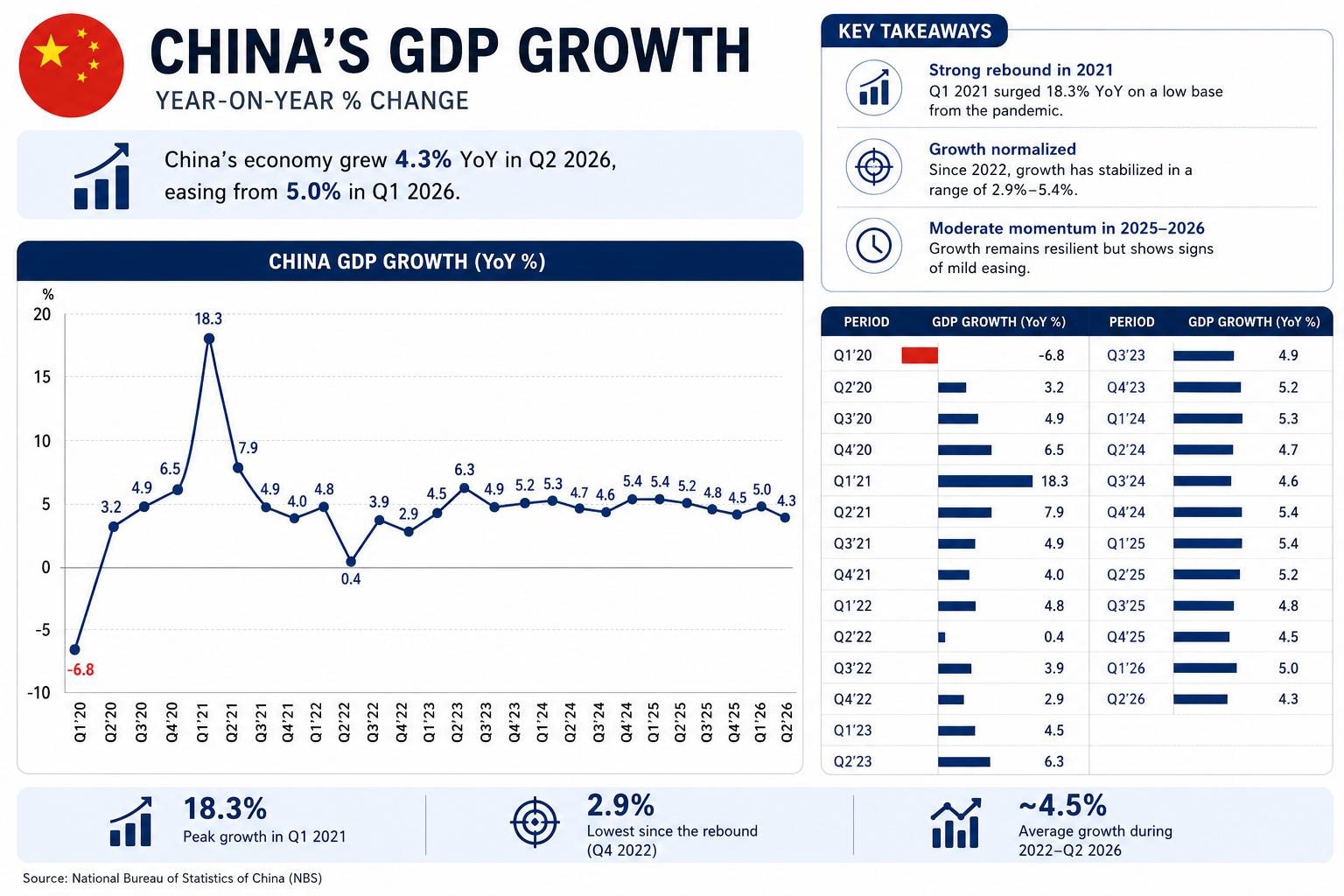
Let’s see some numbers: the economy expanded by 4.3% YoY in the April-June period, while Retail Sales gained 1% in the year to June. In addition, Industrial Production kept its strong pace and expanded by 5.3% over the last twelve months.
Of note is the strong recovery of the trade balance, with June’s surplus widening to $125.62 billion from $105.4 billion in the previous month, and both imports and exports expanding markedly.
In the same line, business activity seems to be regaining traction after the National Bureau of Statistics (NBS) reported the Manufacturing PMI at 50.3 in May (from 50) and Services at 50.2 (from 50.1). In addition, private gauges like RatingDog remained in expansionary territory in June, as Manufacturing came in at 51.7 and Services at 54.1.
The disinflationary trend in China seems to have re-emerged after the CPI disappointed expectations, rising by 1.0% in the year to June (from 1.1%). On a monthly basis, prices dropped by 0.1%, while Producer Prices gained 4.1% over the last twelve months, exceeding the 3.9% annual gain recorded in the previous month.
Regarding monetary policy, the People’s Bank of China (PBoC) is widely anticipated to keep its hand steady next week, leaving its Loan Prime Rates (LPR) unchanged at 3.00% for the one-year tenor and 3.50% for the five-year tenor.
In summary, China is no longer pushing growth higher, but it is not dragging it down aggressively either. It is simply keeping things steady.
The RBA keeps its options open
As widely expected, the Reserve Bank of Australia (RBA) left its Official Cash Rate unchanged at 4.35% at its June 16 gathering.
While the accompanying statement retained a hawkish tone, policymakers appeared a little more comfortable with the progress made on inflation. The Board repeated that price pressures remain too high and that further tightening could still be required if inflation proves more persistent, while higher energy costs and geopolitical tensions are pointed to as key upside risks.
Governor Michele Bullock struck a more balanced tone in her press conference. Although she refused to rule out another rate increase, she noted that incoming data had broadly evolved as expected, the economy is not heading into recession, and the labour market remains relatively resilient. In other words, there was no urgency to tighten policy again.
The Minutes echoed that message. Policymakers agreed that leaving rates unchanged while maintaining a restrictive policy stance offered the best balance between bringing inflation back to target and preserving the gains in the labour market. The door to another hike remains open, but for now the RBA appears willing to give previous rate increases more time to work through the economy.
The road back above 0.7000
Base case
While above its key 200-day SMA, around 0.6880, the pair’s outlook is expected to remain tilted to further advances. However, for such a scenario to materialise, it needs a strong catalyst to emerge and is heavily dependent on the broader backdrop: without a sustained improvement in risk sentiment or continued US Dollar weakness, the probability of extra gains could start to lose momentum.
Bull case
Further conviction is needed. If risk appetite picks up serious pace, spot should first meet the psychological 0.7000 barrier, then the 0.7200 yardstick, before reaching the 2026 peak near 0.7280, just ahead of the minor 0.7300 barrier. Further up, the 2022 ceiling at 0.7593 is still in place. Speculative positioning seems to be leaning toward this scenario for now.
Bear case
In the current volatile context, we should not rule out the loss of further momentum. If sentiment deteriorates, the Greenback gains extra momentum, or Chinese data continue to disappoint, spot could recede further and initially challenge its critical 200-day SMA around 0.6880.
The eventual recovery appears more distant in the current context, and it seems market participants are taking notes of these developments.
Positioning points to fading pessimism
Speculative positioning on the AUD dropped further in the week ending July 7, with net positioning decreasing to -24.7K contracts from -17.7K a week earlier. The latest Commodity Futures Trading Commission (CFTC) data shows a third week of rising net shorts, which represents the correction from the bullish excesses earlier this year.
Indeed, net positioning fell by an additional 7.0K contracts, while open interest shrank to 204.8K contracts from 215.8K. This latter reduction indicates that investors are mostly closing out positions rather than actively taking up new negative bets.
That said, the overall picture is somewhat less negative. Net positioning improved to -42.8K contracts from -59.5K over the 4-week period, suggesting that the rate of liquidation is starting to decrease. Meanwhile, the Net Position and Speculative Exposure percentiles are still high at 74 and 75, respectively, which suggests positioning is still quite positive on a historical basis.
The new numbers collectively suggest a loss of optimism for the Aussie, rather than outright bearishness. Furthermore, investors continue to pare positions, but a wave of big selloffs witnessed in recent weeks seems to be fading, leaving some potential for their positions to shift further if the macro backdrop deteriorates.
The next catalyst
In the near term, the US Dollar, global risk sentiment, and geopolitics remain the main focus. Those remain the key drivers of price action. In the meantime, investors will closely follow next week’s interest rate decision by the PBoC, while the publication of the jobs report should be the salient event Down Under.
Key risks include a sharper slowdown in China, a persistently cautious Fed, a change in investors' risk sentiment, or any shift in the RBA’s stance. Any of these could quickly destabilise the Australian currency in the near term.
Technical levels
In the daily chart, AUD/USD trades at 0.6995, maintaining a mildly bearish near-term bias as it holds beneath both the 55-day and 100-day simple moving averages (SMAs) clustered around 0.7067–0.7062, while the 200-day SMA at 0.6884 offers a deeper layer of trend support below. Momentum has improved, with the Relative Strength Index (RSI) at 52.5 edging into positive territory and the Average Directional Index (ADX) near 28.6 suggesting a moderate, but not aggressive, directional phase, hinting that bearish pressure is softening rather than fully reversing.
On the topside, initial resistance is seen at the 100-day SMA at 0.7062, followed by the 55-day SMA at 0.7067 and the horizontal barrier at 0.7079, forming a dense cap that bulls must clear to open the way toward 0.7278 and 0.7283, with a more distant ceiling at 0.7661. On the downside, immediate support lies near the current level, with firmer demand emerging at the horizontal line at 0.6833 and the 200-day SMA at 0.6884, while a break below that zone would expose the lower supports at 0.6660, 0.6593, 0.6414 and 0.6373.
(The technical analysis of this story was written with the help of an AI tool. Know more.)
Bottom line
The Aussie remains constructive on the bigger picture, but the path higher is getting tougher. Australia's domestic background continues to compare favourably with that of many advanced economies, and the RBA is in no rush to abandon its mildly hawkish bias. However, that support is being offset by a resilient US Dollar, lingering geopolitical tensions and a Chinese economy that is stabilising rather than accelerating.
For now, the 200-day SMA around 0.6880 remains the key zone. Holding above that level keeps the broader bullish structure intact, but a convincing break above 0.7000 will likely require a sustainable road downwards of US inflation, a more dovish turn from the Fed, or a meaningful improvement in global risk appetite.
Until then, expect the AUD to be more driven by outside forces than domestic fundamentals.
Interest rates FAQs
Interest rates are charged by financial institutions on loans to borrowers and are paid as interest to savers and depositors. They are influenced by base lending rates, which are set by central banks in response to changes in the economy. Central banks normally have a mandate to ensure price stability, which in most cases means targeting a core inflation rate of around 2%. If inflation falls below target the central bank may cut base lending rates, with a view to stimulating lending and boosting the economy. If inflation rises substantially above 2% it normally results in the central bank raising base lending rates in an attempt to lower inflation.
Higher interest rates generally help strengthen a country’s currency as they make it a more attractive place for global investors to park their money.
Higher interest rates overall weigh on the price of Gold because they increase the opportunity cost of holding Gold instead of investing in an interest-bearing asset or placing cash in the bank. If interest rates are high that usually pushes up the price of the US Dollar (USD), and since Gold is priced in Dollars, this has the effect of lowering the price of Gold.
The Fed funds rate is the overnight rate at which US banks lend to each other. It is the oft-quoted headline rate set by the Federal Reserve at its FOMC meetings. It is set as a range, for example 4.75%-5.00%, though the upper limit (in that case 5.00%) is the quoted figure. Market expectations for future Fed funds rate are tracked by the CME FedWatch tool, which shapes how many financial markets behave in anticipation of future Federal Reserve monetary policy decisions.
Author

Pablo Piovano
FXStreet
Born and bred in Argentina, Pablo has been carrying on with his passion for FX markets and trading since his first college years.

















