Australian Dollar Price Forecast: Focus now shifts to 0.6600
- AUD/USD adds to Wednesday’s uptick, approaching the key 0.6600 barrier.
- The US Dollar keeps its weekly downtrend in place, hitting fresh monthly lows.
- Australia’s labour market report came in on the strong side, helping AUD.
The Australian Dollar (AUD) faces some extra upside impulse on Thursday, motivating AUD/USD to briefly revisit the 0.6580 region, or multi-day highs, leaving behind its provisional 100-day and 55-day SMAs.
Extra gains in spot follow another bearish day for the US Dollar (USD), which relegates the US Dollar Index (USD) to monthly lows amid steady bets for further Fed rate cuts and investors’ assessment of a deal to end the US shutdown.
Australia’s economy: holding on for now
Australia’s economy isn’t exactly firing on all cylinders, but it’s proving sturdier than many had assumed. The October PMIs told a mixed story: manufacturing slipped back under the 50 mark to 49.7 (down from 51.4), while services crept higher to 53.1 (from 52.4).
Retail Sales rose 1.2% in June, and the September trade surplus jumped to A$3.938 billion. Business investment also improved in Q2, helping GDP grow 0.6% QoQ and 1.1% YoY, not dazzling by any means, but steady enough.
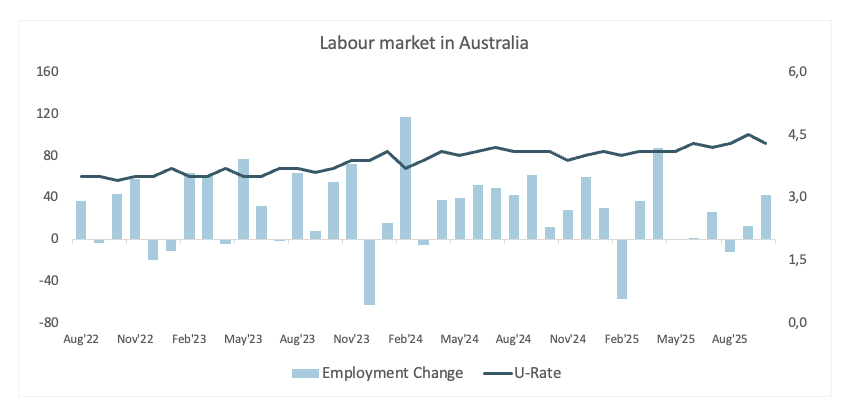
The labour market added to the sense of resilience: October’s Unemployment Rate dipped to 4.3% from 4.5%, and Employment Change beat expectations with a 42.2K increase. After a softer patch the previous month, the jobs data suggest things may be firming up again.
RBA sitting tight for now
The Reserve Bank of Australia (RBA) held rates at 3.60% for a second straight meeting in early November, no shock there. The message was measured: no rush to adjust policy in either direction.
The RBA acknowledged that inflation is still a bit sticky and the labour market remains tight, even with that slight lift in unemployment. Governor Michele Bullock described the current stance as “pretty close to neutral,” implying little appetite to either hike or cut.
She also stressed that the 75 basis points of easing already delivered haven’t fully fed through the system yet. Policymakers want to see how demand evolves before deciding what comes next.
Markets aren’t expecting much movement anytime soon: just over 1 basis point of cuts priced by the 9 December meeting, and only around 10 basis points by June 2026.
China remains the big swing factor
Australia’s fortunes are still closely tied to what happens in China. Chinese GDP expanded 4.0% YoY in Q3, and Retail Sales climbed 3.0%. The RatingDog Manufacturing PMI eased to 50.6, while Services dipped to 52.6 in October, both hinting that the recovery may be losing a bit of steam.
Trade data also showed the surplus narrowing from $103.33 billion to $90.45 billion in September. On the upside, consumer prices moved back into positive territory in October thanks to holiday spending: headline CPI rose 0.2% YoY, beating expectations and rebounding from September’s –0.3%. n addition, the core CPI strengthened to 1.2%, matching its February high.
Meanwhile, the People’s Bank of China (PBoC) kept its Loan Prime Rates (LPR) unchanged in October at 3.00% for the one-year and 3.50% for the five-year, in line with forecasts.
Technical landscape
AUD/USD picks up pace and seems to be heading toward the resistance area around 0.6600 in the short-term horizon, provided that the current marke mood remains in place.
Immediately to the upside comes the October high of 0.6629 (October 1), ahead of the 2025 ceiling of 0.6707 (September 17). Further up sits the 2024 peak at 0.6942 (September 30), seconded by the 0.7000 round level.
Alternatively, there is an initial contention at the key 200-day SMA at 0.6453, prior to the October floor at 0.6440 (October 14). The loss of the later could put the August vally at 0.6414 (August 21) back on the radar seconded by the June base of 0.6372 (June 23).
Furthermore, momentum indicators regain some appeal: the Relative Strength Index (RSI) bounces to around 54, suggesting some incipient bullish tone, while the Average Directional Index (ADX) around 14 indicates a trend that lacks muscle for now.
-1763050443371-1763050443372.png)
Bottom line
AUD/USD is still trapped in its familiar 0.6400–0.6700 corridor. A breakout likely needs a catalyst, whether that’s fresh Chinese data, signals from the Fed, a shift in the RBA’s tone, or a broader turn in US–China sentiment.
Employment FAQs
Labor market conditions are a key element to assess the health of an economy and thus a key driver for currency valuation. High employment, or low unemployment, has positive implications for consumer spending and thus economic growth, boosting the value of the local currency. Moreover, a very tight labor market – a situation in which there is a shortage of workers to fill open positions – can also have implications on inflation levels and thus monetary policy as low labor supply and high demand leads to higher wages.
The pace at which salaries are growing in an economy is key for policymakers. High wage growth means that households have more money to spend, usually leading to price increases in consumer goods. In contrast to more volatile sources of inflation such as energy prices, wage growth is seen as a key component of underlying and persisting inflation as salary increases are unlikely to be undone. Central banks around the world pay close attention to wage growth data when deciding on monetary policy.
The weight that each central bank assigns to labor market conditions depends on its objectives. Some central banks explicitly have mandates related to the labor market beyond controlling inflation levels. The US Federal Reserve (Fed), for example, has the dual mandate of promoting maximum employment and stable prices. Meanwhile, the European Central Bank’s (ECB) sole mandate is to keep inflation under control. Still, and despite whatever mandates they have, labor market conditions are an important factor for policymakers given its significance as a gauge of the health of the economy and their direct relationship to inflation.
Author

Pablo Piovano
FXStreet
Born and bred in Argentina, Pablo has been carrying on with his passion for FX markets and trading since his first college years.

















