USD/JPY: Bank of Japan hike boosts Yen

The Bank of Japan’s decision to raise its policy rate to 0.75% (from 0.50%), while in line with market forecasts, marks a clear step towards monetary tightening and has pushed yields higher on Japanese assets. For the USD/JPY pair, this typically exerts downward pressure – supporting the yen’s appreciation and weighing on the exchange rate.
The underlying mechanism is straightforward: a higher interest rate in Japan boosts the relative appeal of yen-denominated investments and narrows the yield differential with the US. This, in turn, reduces the incentive for the classic carry trade – borrowing in low-yielding yen to purchase higher-yielding assets abroad – thereby increasing structural demand for the yen.
As the decision was widely anticipated, the immediate market reaction may be relatively contained. However, beyond the rate itself, the tone of the BoJ’s forward guidance will be critical. Should the central bank signal that further hikes are on the table, sustained pressure on USD/JPY is likely. Conversely, an emphasis on caution and the gradual pace of policy normalisation could limit the move to a more short-term correction.
Technical analysis: USD/JPY
H4 chart:
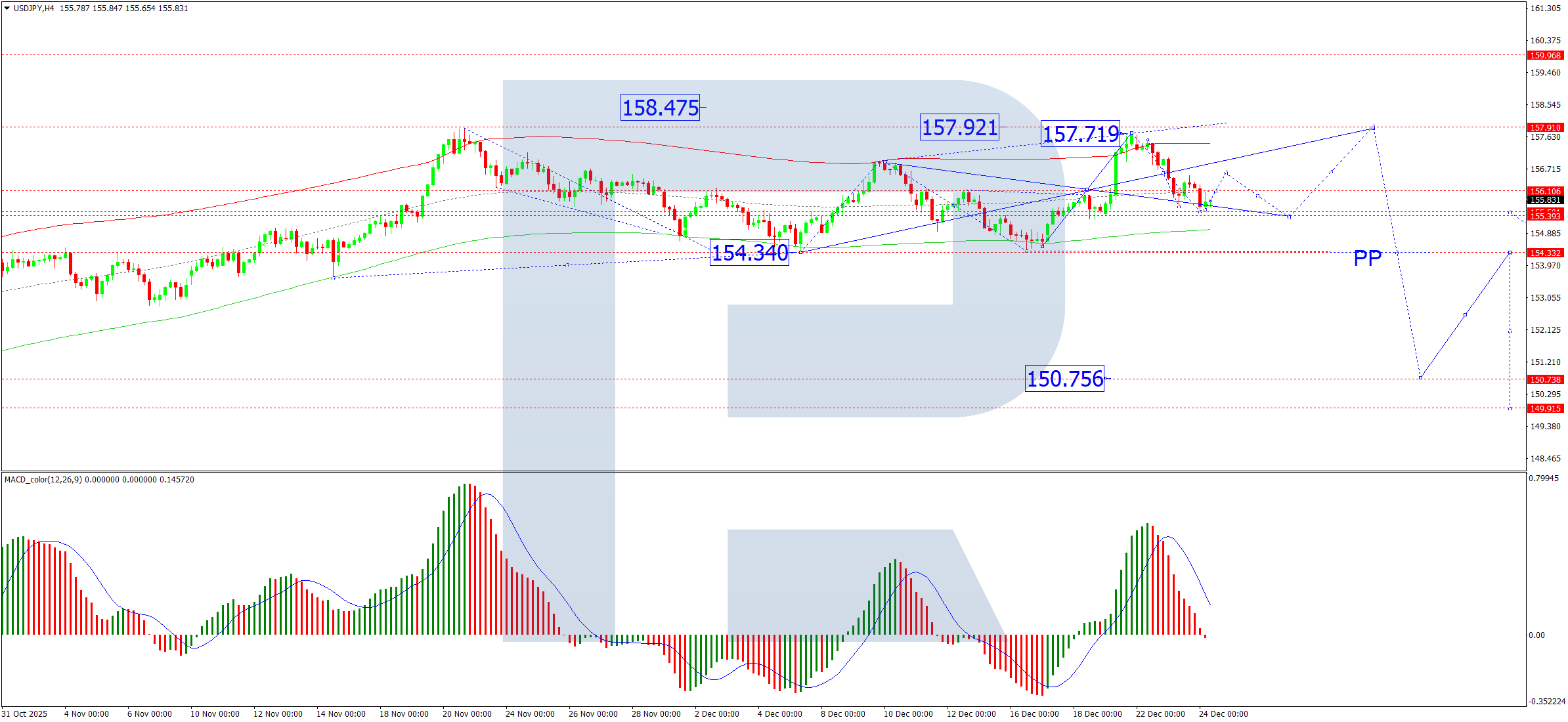
On the H4 chart, the market reached a local bullish target at 157.72 before correcting to 155.55. We expect this corrective phase to conclude around the 155.50 level, with the potential for a consolidation range to form thereafter. A break below this range would open the path towards 155.12, while an upward exit could see a renewed advance towards 157.92.
This outlook is supported by the MACD indicator, whose signal line is currently above zero but pointing firmly lower, suggesting a loss of bullish momentum in the near term.
H1 chart:
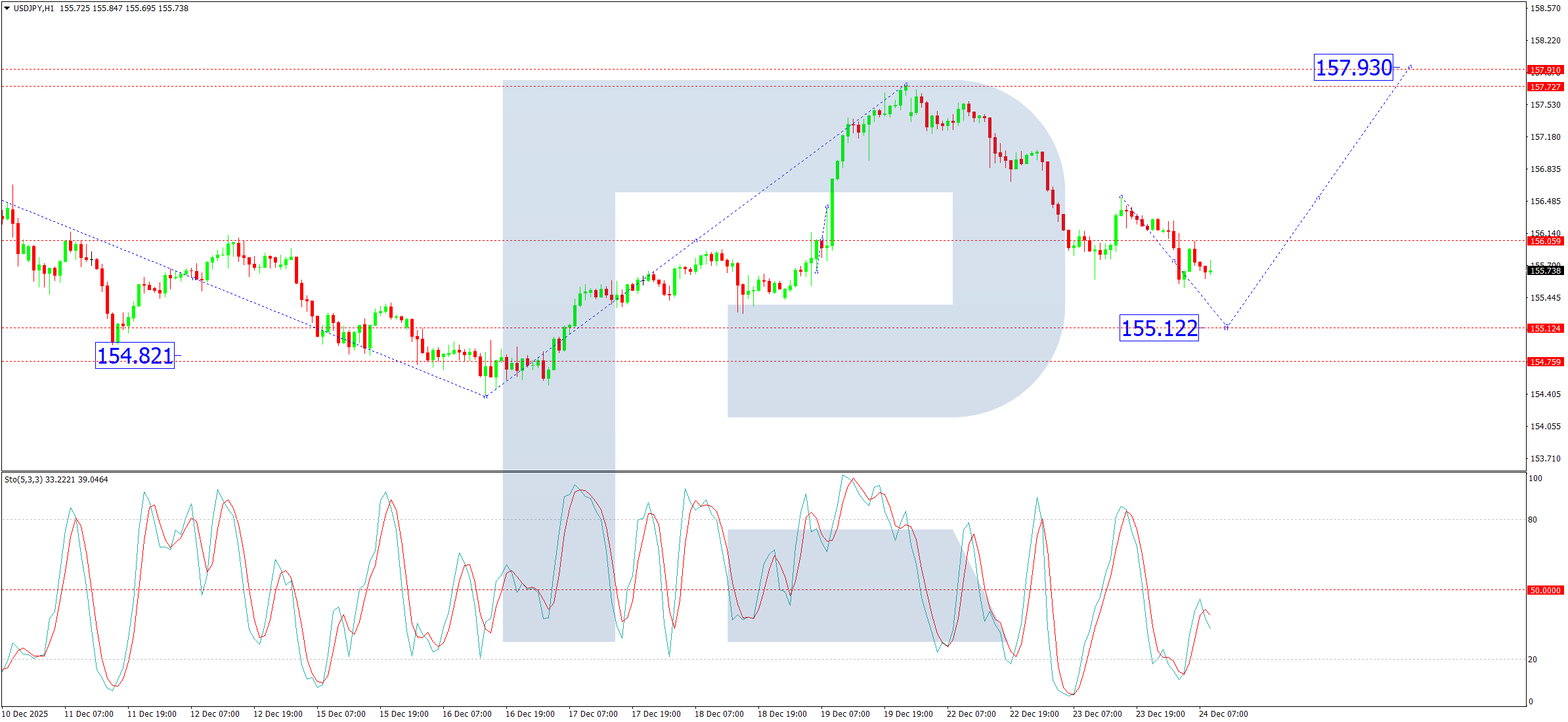
On the H1 chart, the pair is trading within a consolidation range around 156.06. A downside break would target a decline towards 155.12, whereas an upside resolution could initiate a move towards 157.92.
This view is further validated by the Stochastic oscillator, whose signal line is below 50 and trending downward towards the 20 level, indicating continued near-term selling pressure.
Conclusion
The BoJ’s rate hike has shifted the fundamental backdrop towards yen strength, though the extent of the move will hinge on the central bank’s future signalling. Technically, USD/JPY is entering a critical consolidation phase, with a break below 155.50 likely to accelerate the correction, while a hold above could see the pair attempt to retest recent highs.
Author

RoboForex Analysis Department
RoboForex
RoboForex Analysis Department provides timely market insights, expert technical analysis, and actionable forecasts across forex, commodities, indices, and equities.

















