Australian Dollar Price Forecast: Data, China, and RBA hold the keys
- AUD/USD added to Monday’s gains and reclaimed the 0.6600 hurdle and above.
- The US Dollar navigated an inconclusive range ahead of Chief Powell’s speech.
- The Australian flash S&P Global PMIs are seen losing impulse in September.


The Australian Dollar (AUD) extended Monday’s modest gains, with AUD/USD climbing toward two-day highs near 0.6620 on turnaround Tuesday. The move helped the pair recover some composure after slipping to two-week lows the day before, as the US Dollar (USD) continued its choppy back-and-forth.
The US Dollar Index (DXY) inched higher too, clawing back some of Monday’s losses as traders looked ahead to Chair Powell’s speech and digested a weaker run of September PMIs.
Stubborn inflation keeps the RBA cautious
Australia’s inflation problem hasn’t gone away. July’s Monthly CPI Indicator (Weighted Mean) accelerated to 2.8% from 1.9% in June, while Q2 CPI rose 0.7% QoQ and 2.1% YoY.
That’s why the Reserve Bank of Australia (RBA) is holding the line. With prices still running hotter than target, policymakers are reluctant to cut too quickly. Policymakers must strike a balance between supporting growth and preventing inflation from escalating.
Domestic economy holding up better than feared
Even with global uncertainty swirling, Australia’s economy looks more resilient than expected. Early reads for September suggest Manufacturing PMI may ease to 51.3 and Services to 52.0, but both remain comfortably in expansion territory.
Other data have been firmer too: Retail Sales rose 1.2% in June, the trade surplus widened to A$7.3 billion in July, and business investment ticked higher in Q2. GDP also surprised, up 0.6% QoQ and 1.8% YoY.
The labour market is showing a few cracks, though. Unemployment held steady at 4.2% in August, but total employment dropped by 5.4K.
RBA sticks to data-driven path
Earlier this month, the RBA trimmed the Official Cash Rate (OCR) by 25 basis points to 3.60% and cut back its 2025 growth forecast. Governor Michele Bullock has since underlined that deeper cuts aren’t on the table, making clear that policy will stay data-dependent.
The Minutes reinforced the point: if jobs weaken further, the RBA could accelerate cuts. But if the economy stays steady, easing will be gradual.
Speaking to the House Economics Committee, Bullock described both growth and inflation as being in a “good place”, reinforcing that there's no urgency to shift policy. For now, markets expect the RBA to hold steady at next week’s meeting, with pricing implying about 26 basis points of easing by year-end.
China still the swing factor
Australia’s outlook is still tied to China’s fortunes. Q2 GDP grew 5.2% YoY, but August retail sales undershot at 3.4%. PMIs were mixed: Manufacturing slipped into contraction at 49.4, while services barely stayed in growth territory at 50.3. Deflation worries linger too, with CPI down 0.4% YoY in August.
The People’s Bank of China (PBoC) kept its Loan Prime Rates (LPR) unchanged in September: 3.00% for the One-Year and 3.50% for the Five-Year, matching expectations.
Speculators pare back AUD shorts
CFTC data for the week ending (September 16) showed speculators trimming bearish AUD bets, with net shorts dropping to 51.2K contracts, the lowest since May. Still, total open interest fell sharply to about 154K, suggesting traders have cut back exposure overall.
Technical landscape
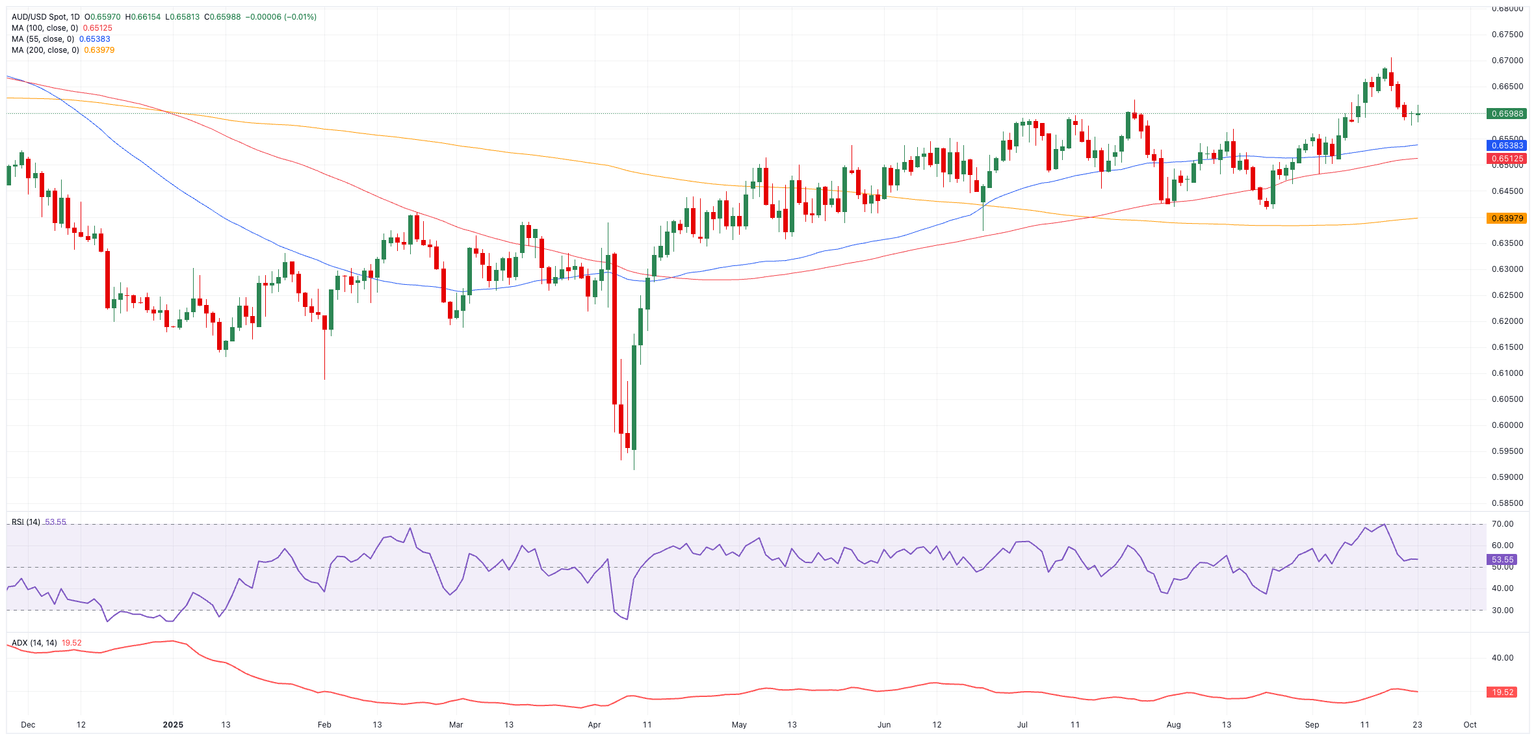
From a technical perspective, if buyers stay in control, AUD/USD could make another run at the 2025 ceiling at 0.6707 (September 17). A clean break above that would bring last year’s high at 0.6942 (September 30) into view, just under the psychological 0.7000 mark.
On the downside, initial support lies at the 55-day and 100-day Simple Moving Averages (SMAs), at 0.6537 and 0.6511. A drop below there would put the August low at 0.6414 (August 21) back in play, followed by the 200-day SMA at 0.6397 and the June trough at 0.6372 (June 23).
Momentum indicators are sending mixed but mildly constructive signals. The Relative Strength Index (RSI) has bounced to 54, hinting at growing bullish momentum, while the Average Directional Index (ADX) near 20 suggests the ongoing trend is gathering some colour.
AUD/USD daily chart
Short-term view
For now, AUD/USD’s push through the 0.6400–0.6600 band still feels tentative. A more decisive breakout may require a bigger catalyst, whether that’s firmer Chinese data, a dovish tilt from the Federal Reserve (Fed), or the RBA sticking to a tougher stance.
Australian Dollar FAQs
One of the most significant factors for the Australian Dollar (AUD) is the level of interest rates set by the Reserve Bank of Australia (RBA). Because Australia is a resource-rich country another key driver is the price of its biggest export, Iron Ore. The health of the Chinese economy, its largest trading partner, is a factor, as well as inflation in Australia, its growth rate and Trade Balance. Market sentiment – whether investors are taking on more risky assets (risk-on) or seeking safe-havens (risk-off) – is also a factor, with risk-on positive for AUD.
The Reserve Bank of Australia (RBA) influences the Australian Dollar (AUD) by setting the level of interest rates that Australian banks can lend to each other. This influences the level of interest rates in the economy as a whole. The main goal of the RBA is to maintain a stable inflation rate of 2-3% by adjusting interest rates up or down. Relatively high interest rates compared to other major central banks support the AUD, and the opposite for relatively low. The RBA can also use quantitative easing and tightening to influence credit conditions, with the former AUD-negative and the latter AUD-positive.
China is Australia’s largest trading partner so the health of the Chinese economy is a major influence on the value of the Australian Dollar (AUD). When the Chinese economy is doing well it purchases more raw materials, goods and services from Australia, lifting demand for the AUD, and pushing up its value. The opposite is the case when the Chinese economy is not growing as fast as expected. Positive or negative surprises in Chinese growth data, therefore, often have a direct impact on the Australian Dollar and its pairs.
Iron Ore is Australia’s largest export, accounting for $118 billion a year according to data from 2021, with China as its primary destination. The price of Iron Ore, therefore, can be a driver of the Australian Dollar. Generally, if the price of Iron Ore rises, AUD also goes up, as aggregate demand for the currency increases. The opposite is the case if the price of Iron Ore falls. Higher Iron Ore prices also tend to result in a greater likelihood of a positive Trade Balance for Australia, which is also positive of the AUD.
The Trade Balance, which is the difference between what a country earns from its exports versus what it pays for its imports, is another factor that can influence the value of the Australian Dollar. If Australia produces highly sought after exports, then its currency will gain in value purely from the surplus demand created from foreign buyers seeking to purchase its exports versus what it spends to purchase imports. Therefore, a positive net Trade Balance strengthens the AUD, with the opposite effect if the Trade Balance is negative.
Premium
You have reached your limit of 3 free articles for this month.
Start your subscription and get access to all our original articles.
Author
Pablo Piovano
FXStreet
Born and bred in Argentina, Pablo has been carrying on with his passion for FX markets and trading since his first college years.