AUD/USD Price Forecast: The 0.6300 region holds the downside, for now
- AUD/USD extended its leg lower and retested the 0.6300 zone.
- The US Dollar staged a noticeable rebound following recent lows.
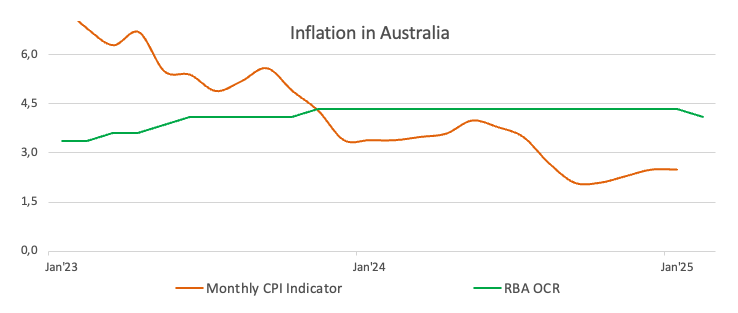
- The RBA’s Monthly CPI Indicator held steady at 2.5% in January.

On Wednesday, the US Dollar (USD) regained some balance and managed to bounce off two-month lows when tracked by the US Dollar Index (DXY).
Meanwhile, the Australian Dollar (AUD) remained under pressure and prompted AUD/USD to challenge the key contention zone around 0.6300. The pair is down for the fourth day in a row so far, hurt by the likelihood of further announcements of United States (US) tariffs in the near term.
Lingering trade disputes
Trade tensions remain a pivotal factor in currency markets, with risk-sensitive currencies like the Aussie struggling to hold onto gains. Earlier this month, US President Donald Trump briefly lifted market spirits by delaying a planned 25% tariff on Canadian and Mexican goods for one month, although he recently argued that those tariffs remain as planned, with the deadline on March 4. However, optimism quickly faded when the US floated the idea of a 10% tariff on Chinese imports, sparking fears of retaliatory measures from Beijing. Since China is Australia’s biggest export destination, any escalation in tariffs could curb demand for Australian commodities.
The Fed, the RBA and inflation
Despite the Greenback’s recent fluctuations, investors are still wary of additional trade conflicts that might stoke inflation and keep the Federal Reserve (Fed) leaning toward tighter policy.
In Australia, the Reserve Bank of Australia (RBA) lowered its policy rate by 25 basis points to 4.10% in February. Officials maintain that this move does not mark the start of a broader easing cycle. The bank now expects underlying inflation to hover around 2.7%, while stronger-than-anticipated employment data led to a downward revision of its unemployment forecast to 4.2%.
Governor Michele Bullock noted that further rate cuts remain on the table if inflation continues to ease, though she emphasized a data-dependent approach. Deputy Governor Andrew Hauser added that market expectations—pricing in fewer than 50 basis points of rate reductions over the next year—might be overly optimistic.
Meanwhile, the latest Monthly CPI Indicator (Weighted Mean CPI) gauged by the RBA held steady at 2.5% in January, a tad below consensus.
Commodities treading carefully
Australia’s outlook is closely tied to its commodity exports, leaving the economy vulnerable to any slowdown in Chinese demand. On Wednesday, both copper prices and iron ore prices seem to have lost momentum, receding from recent peaks.
Key technical levels
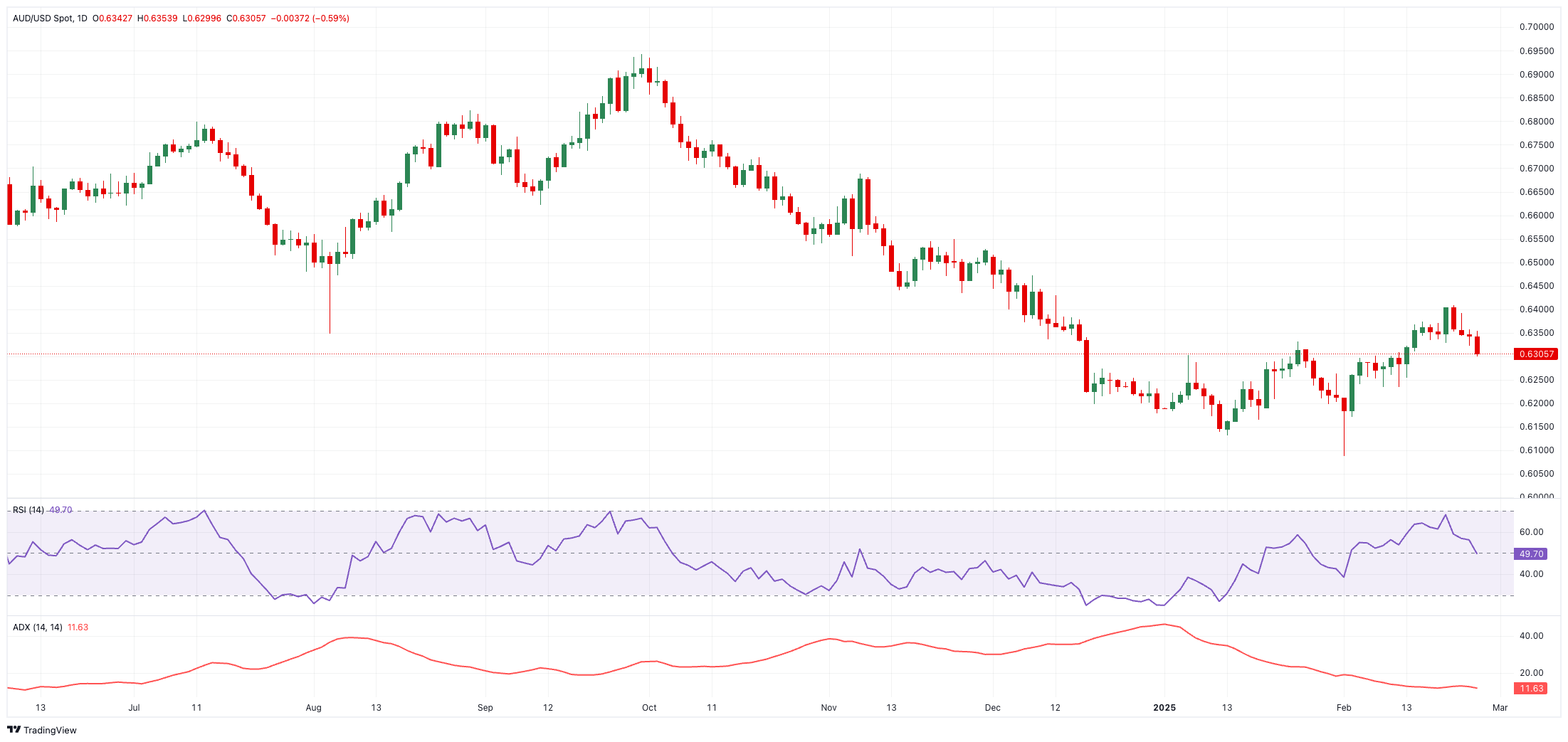
The immediate hurdle for AUD/USD is the 2025 high of 0.6408 (February 21), an area propped up by the transitory 100-day Simple Moving Average (SMA). Beyond that, the next challenge is the November 25 top of 0.6549, near the 200-day SMA.
In case sellers regain control, there is initial support at the interim 55-day SMA at 0.6270, followed by the 2025 bottom of 0.6087, and ultimately the psychological 0.6000 level.
Looking at the broader picture, the Relative Strength Index (RSI) has dipped below the 50 threshold, suggesting a marked loss of momentum, while the Average Directional Index (ADX) approaching 12 points to a weak overall trend.
AUD/USD daily chart
Looking ahead
All eyes now turn to the RBA’s Monthly CPI Indicator and Construction Done data on February 26. The following day brings quarterly Private Capital Expenditure (Q4) figures, with Housing Credit and Private Sector Credit reports closing out the week.
Author

Pablo Piovano
FXStreet
Born and bred in Argentina, Pablo has been carrying on with his passion for FX markets and trading since his first college years.














