AUD/USD Price Forecast: Some consolidation appears likely near term
- AUD/USD failed once again to extend the uptick past the 0.6440 area.
- The US Dollar maintained its constructive view on positive tariff headlines.
- Australia’s Manufacturing and Services PMIs eased a tad in April.


The Australian Dollar (AUD) managed to recoup part of Tuesday’s losses, prompting AUD/USD to regain upside impulse and flirt once again with the area of yearly highs near 0.6440, although slipping back below 0.6400 as the day progressed.
The pair’s recovery came despite extra gains in the US Dollar (USD), although it most likely reacted positively to news that the White House might be planning on reducing tariffs on Chinese goods.
Indeed, prospects of a global trade war appears temporarily alleviated, although they remain ages away from abated. It is worth recalling that the Australian economy is deeply intertwined with China’s, leaving the Aussie especially vulnerable to each escalation in trade tensions.
Central banks in holding pattern
Monetary policy signals from both the Fed and the Reserve Bank of Australia (RBA) continue to suggest a cautious stance. In March, the Fed kept rates steady at 4.25%–4.50%, with Chair Jerome Powell reiterating the priority of anchoring inflation expectations—even amid risks that rising tariffs could stall growth and stoke stagflation. He later emphasised that stable prices are critical to sustainable employment, adding that any future rate adjustments will be data dependent.
Meanwhile, the Reserve Bank of Australia (RBA) held its benchmark rate at 4.10% earlier this month. Governor Michele Bullock cited persistent inflation and tight labour conditions as reasons to hold off on easing. Markets are currently pricing in around a 70% chance of a rate cut at the RBA’s May meeting.
Speculative positioning: Hopes of a bounce?
The latest CFTC data points to a retreat in bearish sentiment on the Aussie. Net short positions fell to a five-week low of around 59K contracts in the week to April 15, alongside a decline in open interest—suggesting some speculative traders are stepping back from outright downside bets.
Technical perspective
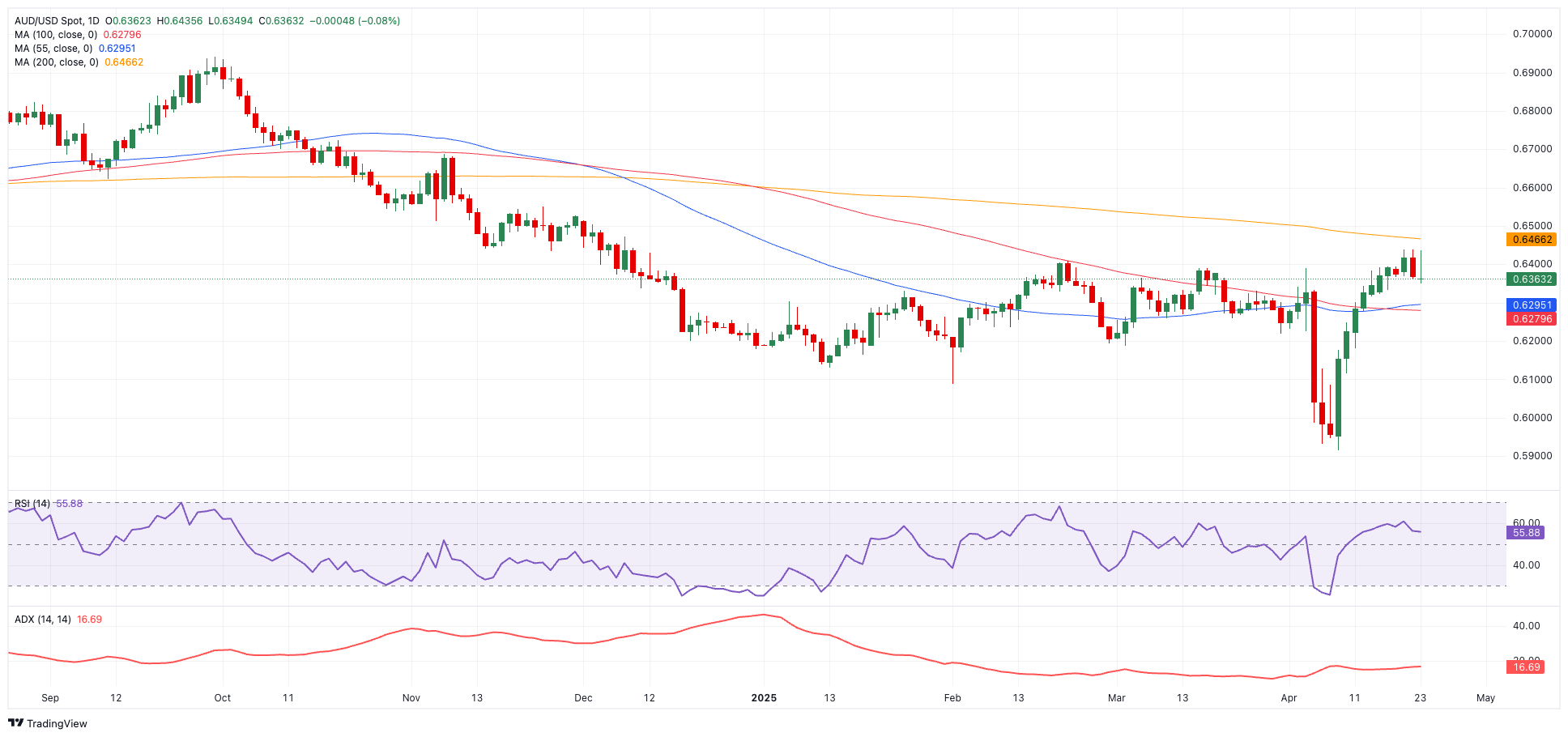
Technically, the pair remains capped below its 200-day simple moving average (SMA), currently at 0.6470. A break above would put the 2025 high of 0.6439 (April 22) back in focus, followed by the November 2024 top of 0.6687 (November 7).
To the downside, failure to hold the 2025 bottom of 0.5913 (April 9) could leave the March 2020 pandemic trough of 0.5506 exposed.
Momentum signals are mixed. The Relative Strength Index (RSI) hovers near 56, suggesting scope for further gains, while the Average Directional Index (ADX) around 17 hints the recent rally may lack strength.
AUD/USD daily chart
Volatility set to linger
With fresh tariff headlines and economic data releases continuing to whipsaw sentiment, the path forward for AUD/USD remains highly sensitive to developments in Washington, Beijing, and central bank guidance. Until clearer signals emerge, volatility looks set to remain a defining feature of the pair.
Author
Pablo Piovano
FXStreet
Born and bred in Argentina, Pablo has been carrying on with his passion for FX markets and trading since his first college years.