AUD/USD Price Forecast: Next up comes the YTD peaks past 0.6300
- AUD/USD rebounds further from multi-year lows in the sub-0.6100 area.
- The US Dollar lost further momentum as traders evaluated tariffs.
- Markets’ focus shifts to China and its retaliatory measures.

The US Dollar (USD) retreated further on turnaround Tuesday, coming under extra downside pressure and eroding the advance to three-week highs near the 110.00 hurdle recorded at the beginning of the week when gauge by the US Dollar Index (DXY).
Meanwhile, the Australian dollar (AUD) managed to claw back some upside momentum and added to the notable recovery from levels last seen in April 2020 below the 0.6100 mark, flirting with multi-day highs in the 0.6250-0.6260 band.
Impact of US tariffs on the Aussie Dollar
While President Donald Trump imposed a 25% duty on goods imported from Canada and Mexico, he eventually agreed on Monday to delay the implementation of those tariffs by a month, bringing some respite to the risk complex and sparking a knee-jerk rally in the Greenback.
Regarding China, the White House announced a 10% levy on imports amid growing market unease over how Beijing might respond. It is worth recalling that China stands as Australia’s powerhouse export market, yet looming tariffs could dampen the strong appetite for its valuable resources.
Furthermore, China has already expressed its intention to challenge the tariffs at the World Trade Organization (WTO).
Despite the corrective price action in the US dollar, the likelihood of a trade war remains high. This scenario could potentially reignite inflationary pressures in the US and prompt the Federal Reserve (Fed) to adopt a more restrictive monetary policy for an extended period.
From brief surge to rate cut rumours: Navigating the AUD's latest moves
While there seems to be no immediate resolution to the situation, it’s worth noting that the AUD experienced a brief rally earlier this month, surpassing the 0.6300 level—a high not seen since the beginning of the year. However, this surge was largely attributed to a decline in the Greenback rather than any significant strength in Australia’s economy. There is growing speculation about the Reserve Bank of Australia’s (RBA) next move, particularly given recent data suggesting that inflationary pressures in Australia are easing.
Recent Q4 Consumer Price Index (CPI) data in Australia supports the case for an RBA rate cut at its February 18 meeting. Headline inflation rose by 2.5% year-on-year, down from 2.8% in the previous quarter. The trimmed mean CPI, a crucial gauge for the RBA, fell to a three-year low of 3.2%, falling short of both expectations and previous forecasts. This softer inflation data has led the market to anticipate a 25 basis point rate cut by the RBA in February, with total easing expected to reach 85 basis points over the next year as confidence grows in a more dovish policy approach.
Commodity support
On the commodities front, weak demand from China continues to pressure Australian exports, such as iron ore and copper, which generally support the AUD. However, iron ore and copper prices maintained a firm recovery on Tuesday, which eventually morphed into extra wings for the Australian dollar.
AUD outlook looks unclear
Looking ahead, the AUD faces significant challenges. A looser monetary policy at home, coupled with a sluggish Chinese economy, could further weaken the Aussie. Conversely, the Fed’s tighter policy stance may widen the gap between the two central banks, potentially putting downward pressure on the Aussie.
Technical Analysis
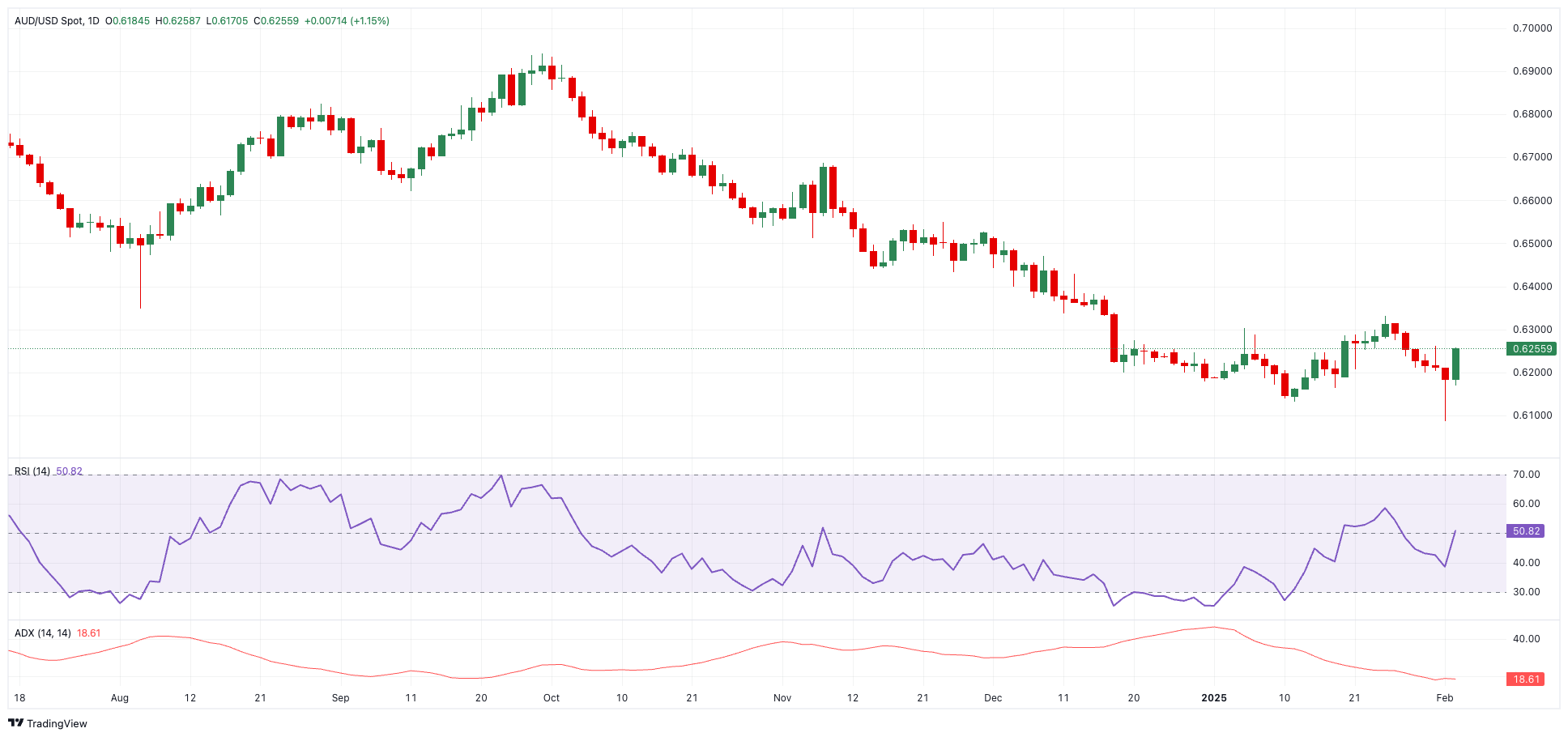
From a technical perspective, caution is advised. Key support for AUD/USD lies at 0.6087—the lowest level for 2025—with a potential break below this level potentially pushing the pair toward the psychological 0.6000 level. On the upside, resistance is seen at 0.6330, the 2025 peak, with further resistance at the weekly high of 0.6549 (November 25).
Meanwhile, momentum indicators look promising. The Relative Strength Index (RSI) has rebounded past the 50 yardstick, suggesting some bullish pressure. The Average Directional Index (ADX) is also near the 21 level, indicating a weakening trend.
AUD/USD daily chart
Key Data to Watch
Moving forward, our attention will be on domestic data, including the final Manufacturing and Services PMIs, the Ai Group Manufacturing Index, and the Balance of Trade results.
Author

Pablo Piovano
FXStreet
Born and bred in Argentina, Pablo has been carrying on with his passion for FX markets and trading since his first college years.

















