AUD/USD Price Forecast: Next target comes at the 200-day SMA
- AUD/USD extended its rally and came closer to the 0.6400 hurdle.
- The US Dollar resumed its downtrend amid steady tariffs jitters.
- Markets’ attention shifts to the release of the jobs report in Australia.


Upside momentum for the Australian Dollar (AUD) picked up extra pace midweek, propelling AUD/USD to the area just shy of the 0.6400 milestone. This upside move followed the resurgence of the downside pressure in the US Dollar (USD), always amid lingering US-China trade effervescence.
Trade jitters dominate sentiment
Recent tariff announcements have injected renewed uncertainty into global markets. President Trump’s decision to levy tariffs between 10% and 50% ignited talk of retaliatory measures, fuelling fears of an all-out trade war. Such developments risk dampening global growth, driving up consumer prices, and complicating central bank policy decisions.
Australia’s close economic ties to China and heavy reliance on commodity exports magnify its exposure to these tensions. AUD/USD plunged to multi-year lows after China introduced its own tariffs, and the situation worsened last week, when President Trump imposed an unprecedented 145% tariff on select Chinese goods.
Central bank perspectives
The Federal Reserve (Fed) opted to keep interest rates at 4.25–4.50% in March, reflecting caution in light of ongoing inflationary pressures and emerging signs of economic deceleration. Chair Jerome Powell acknowledged that evolving trade headlines could significantly impact future monetary policy choices.
The Reserve Bank of Australia (RBA) maintained its Official Cash Rate (OCR) at 4.10%. Governor Michele Bullock highlighted the challenge of bringing inflation back within the 2–3% target. This decision was generally seen as hawkish, reducing the odds of a 25 basis point rate cut at the May 20 meeting from 80% to 70%.
The RBA Minutes underscored policymakers’ reluctance to cut rates. Governor Bullock pointed out that domestic data—showing gradually easing inflation, a tighter-than-anticipated labour market, and a temporary slump in employment—aligned with prior forecasts. On the global front, the RBA noted that ongoing trade-policy uncertainties present balanced risks for inflation, hinging on shifts in overall demand and supply. Taken together, both domestic and international conditions support the RBA’s decision to avoid aggressive monetary easing.
Speculators remain bearish on the Aussie
Recent CFTC data indicates that speculative net-long positions in the AUD have dropped to a four-week low of roughly 63.3K contracts, while open interest has risen to multi-week highs. This environment has contributed to renewed selling momentum, dragging AUD/USD into the 0.5900 region—a level not seen since the first quarter of 2020.
Technical levels to watch
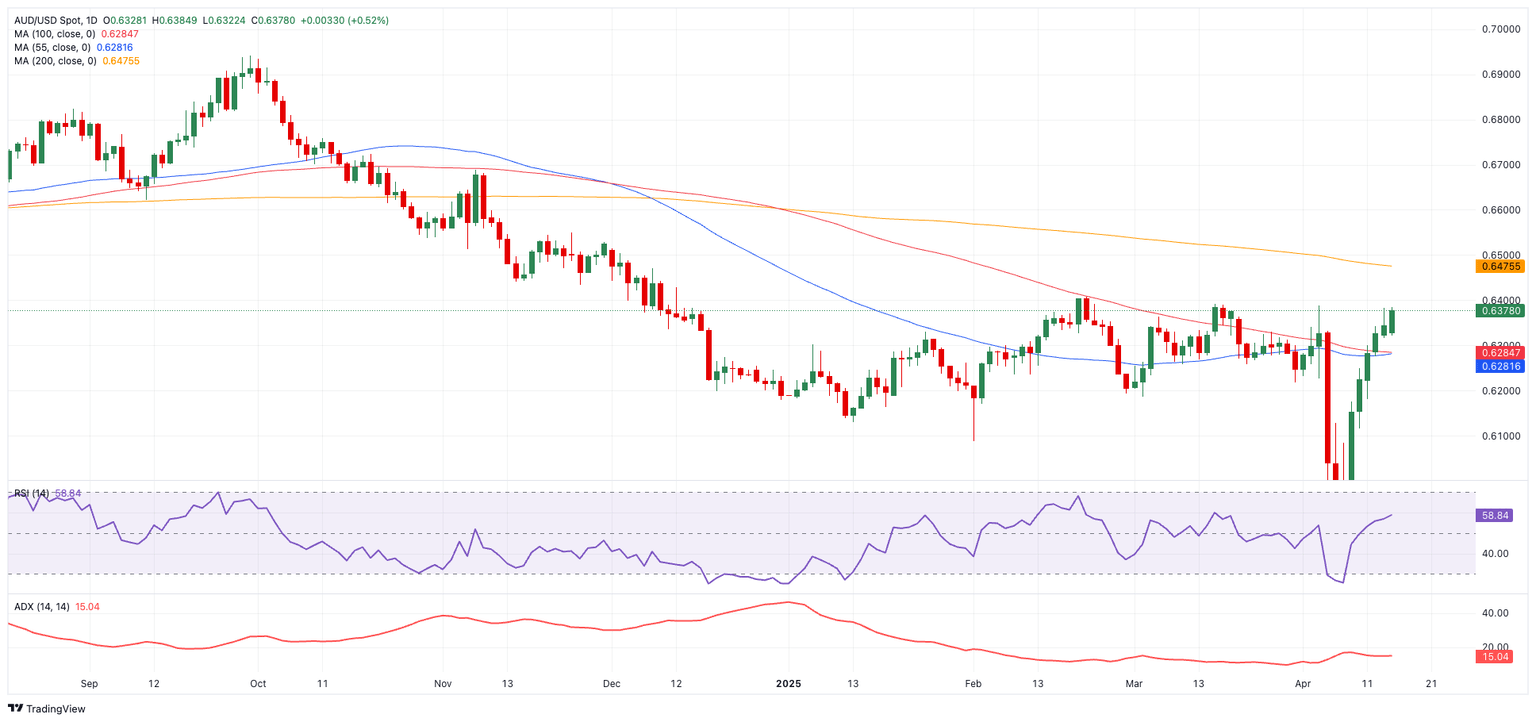
Despite the ongoing rally, the bias remains negative as long as AUD/USD stays below the 200-day Simple Moving Average (SMA) at 0.6479.
Further gains, therefore, should retest the 2025 peak of 0.6408 (February 21), prior to the 200-day SMA, and possibly the November 2024 high of 0.6687 (November 7).
On the other hand, a move below the 2025 floor of 0.5913 (April 8), could pave the way for a deeper decline to, initially, the 2020 bottom of 0.5506.
Furthermore, the Relative Strength Index (RSI) near 59 suggests additional upside impulse, though the Average Directional Index (ADX) around 15 warns of limited rally strength.
AUD/USD daily chart
Upcoming Australian data
Traders will be monitoring the key labour market report slated for April 17.
Final thoughts
With trade conflicts escalating and both the Fed and the RBA remaining vigilant, the Australian Dollar is particularly sensitive to emerging developments in global trade. As the situation evolves, market participants will keep a close eye on economic data and central bank commentary for signs of further volatility.
Premium
You have reached your limit of 3 free articles for this month.
Start your subscription and get access to all our original articles.
Author
Pablo Piovano
FXStreet
Born and bred in Argentina, Pablo has been carrying on with his passion for FX markets and trading since his first college years.

















