AUD/USD Price Forecast: Interim resistance emerges around 0.6330
- AUD/USD reverses three daily advances in a row and drops below 0.6300.
- The US Dollar gives away initial gains and drops to six-week lows.
- Chinese NBS PMIs disappointed expectations in January.


Monday’s saw a broad-based retracement in the US Dollar (USD), which witnessed the US Dollar Index (DXY) confront the key 107.00 neighbourhood and hit new six-week lows.
Surprisingly, the Australian Dollar (AUD) came under renewed downside pressure and returned to the sub-0.6300 region amid poor data from China’s business activity and the scarce trading conditions in response to the Australia’s Day holiday.
What’s behind the Aussie’s recent advance?
After weeks of being weighed down by a dominant US Dollar, the Australian Dollar has shown signs of recovery, hitting a new yearly peak north of 0.6300 the figure during last week. This resurgence has been fueled by a widespread correction lower in the Greenback, which had been riding high since October, thanks to what some call the “Trump trade” narrative.
At the same time, speculation is mounting around the Reserve Bank of Australia (RBA) potentially cutting interest rates at its February meeting. Market odds suggest a 60% chance of a rate cut as the RBA looks to stimulate an economy grappling with slowing growth and softening inflation.
But the path forward for the Aussie is anything but straightforward. Domestically, economic momentum is cooling, consumer and business confidence is shaky, and Australia remains closely tied to China’s sluggish economic recovery. With China being Australia’s largest trading partner, any weakness there is a direct headwind for the AUD.
Speaking about China, business activity as measured by the NBS Manufacturing and Non-Manufacturing PMIs disappointed estimates, sliding to 49.1 and 50.2, respectively, in January.
Commodity markets haven’t offered much of a boost either. Copper prices remain subdued, though stable iron ore markets have provided some measure of support for the currency.
Glimmers of hope in jobs and inflation
There’s a silver lining amidst the challenges. Australia’s December jobs report surprised to the upside in December, with 56,300 new jobs added, even as the unemployment rate edged up slightly to 4.0% from 3.9%.
On the inflation front, consumer expectations have eased. January’s figures showed a drop to 4.0% from December’s 4.2%, hinting at softer price pressures, according to the Melbourne Institute.
RBA takes a prudent stance
In its December meeting, the RBA left interest rates unchanged at 4.35%, adopting a wait-and-see approach. Governor Michele Bullock emphasized that the central bank’s next steps would depend on how incoming data shapes the economic outlook.
The Challenges ahead for AUD/USD
All in all, AUD/USD still faces an uphill battle. The US Dollar is expected to outperform its peers this year, domestic economic signals are mixed, and uncertainties loom over China’s recovery. That said, any indication from the Federal Reserve (Fed) of potential rate cuts could weaken the USD and provide a tailwind for the Aussie.
Technical outlook
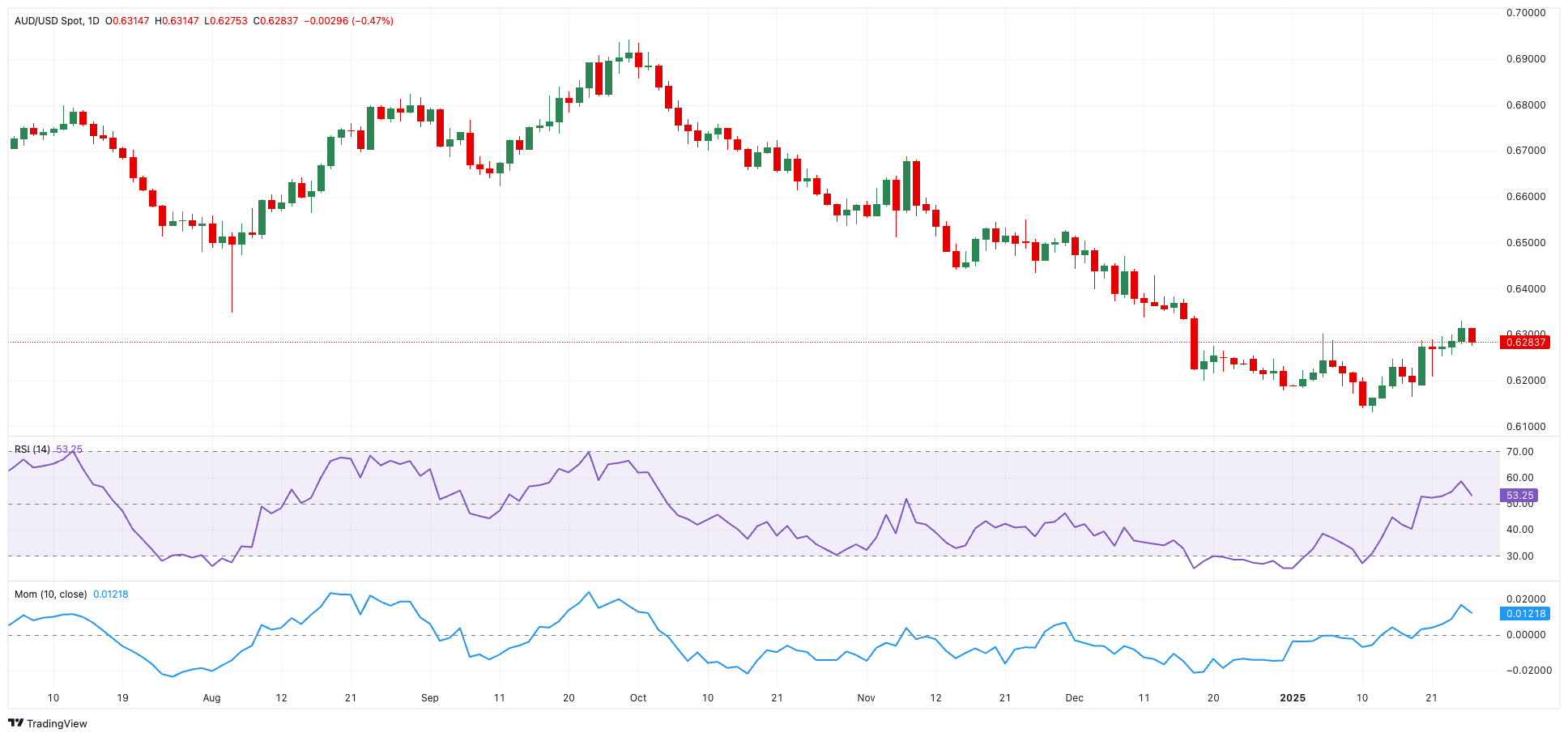
The technical picture for AUD/USD is mixed. On the downside, key support sits at the 2025 bottom of 0.6130—breaking below this level could pave the way for a move toward the psychological 0.6000 mark. On the upside, resistance levels are noted at the YTD peak of 0.6330, followed by the weekly high of 0.6549.
Momentum indicators are sending conflicting signals. The RSI dropped to around 52, suggesting some pause in the bullish momentum, but the ADX, near 24 points to a weakening trend.
AUD/USD daily chart
What’s next?
Australia’s economic calendar is fairly quiet this week, with the NAB Business Confidence index due tomorrow, the quarterly Inflation Rate and the RBA’s Monthly CPI Indicator expected on January 29, Export and Import Prices on January 30, and Producer Prices, Housing Credit and Private Sector Credit all due at the end of the week.
Premium
You have reached your limit of 3 free articles for this month.
Start your subscription and get access to all our original articles.
Author
Pablo Piovano
FXStreet
Born and bred in Argentina, Pablo has been carrying on with his passion for FX markets and trading since his first college years.

















