AUD/USD Price Forecast: Further upside should retarget 0.6400
- AUD/USD’s weekly rebound revisited the 0.6360 region so far.
- The US Dollar remained offered near recent lows amid tariff concerns.
- All the attention is expected to be on Friday’s US NFP.


On Thursday, the US Dollar (USD) faced renewed pressure, breaking below the 104.00 contention zone for the first time since early November, driven by unabated worries over the United States (US) economy and uncertainty around the US trade policies.
In contrast, the Australian Dollar (AUD) extended its recovery this week, reclaiming the critical 0.6300 level and well above. Other than USD weakness, also supporting the Aussie were solid Q4 GDP figures from Australia, showing economic growth of 0.6% QoQ and a yearly rise of 1.3%, thanks largely to robust public and private sector spending.
The Reserve Bank of Australia (RBA) expects growth to moderate toward its longer-term trend rate of around 2% by 2025 and maintains a cautious policy stance—factors currently supporting AUD strength.
Trade tensions remain a major influence
Trade jitters remain a key market driver, particularly affecting risk-sensitive currencies like the Australian Dollar. Recently implemented tariffs—including a 25% tariff on Canadian and Mexican goods and a 20% duty on Chinese imports—are raising concerns about escalating trade conflicts.
Given China’s significance as Australia's primary trading partner, any signs of weakening Chinese demand could negatively impact Australia's commodity exports, subsequently weighing on the Aussie Dollar. Despite some encouraging business activity data from China over the weekend and strong services figures from Caixin, investor sentiment remains cautious.
Still around China, recent news pointing to further stimulus to support the country’s lagging recovery also played in favour of AUD.
Central banks and inflation in focus
Central banks and inflation remain prominent themes. Increased trade tensions risk pushing inflation higher, potentially prompting the Federal Reserve (Fed) to maintain tighter monetary policy for longer.
Meanwhile, the RBA's February decision to cut rates by 25 basis points to 4.10% was accompanied by signals that this may not mark the start of a sustained easing cycle. Governor Michele Bullock indicated that future rate cuts depend heavily on incoming inflation data, while Deputy Governor Andrew Hauser expressed scepticism about market expectations for multiple rate reductions.
Nonetheless, markets anticipate further cuts totalling 75 basis points over the next year, driven by global uncertainties from trade conflicts.
Inflation and interest rate dynamics
Australia’s latest Monthly CPI Indicator came in at 2.5% for January, slightly below market forecasts. Recent RBA minutes revealed internal discussions over whether to hold rates steady or to implement a small rate cut, ultimately opting for the latter while clearly stating this does not necessarily indicate more cuts ahead. Policymakers highlighted Australia’s relatively lower interest rate peak and stronger initial labour market conditions compared to global peers.
Commodities and AUD performance
Commodity markets continue to influence the Australian Dollar significantly. Copper prices extended Wednesday’s rebound, while iron ore prices managed to reverse their previous day’s pullback and printed a decent advance on Thursday.
AUD/USD technical outlook
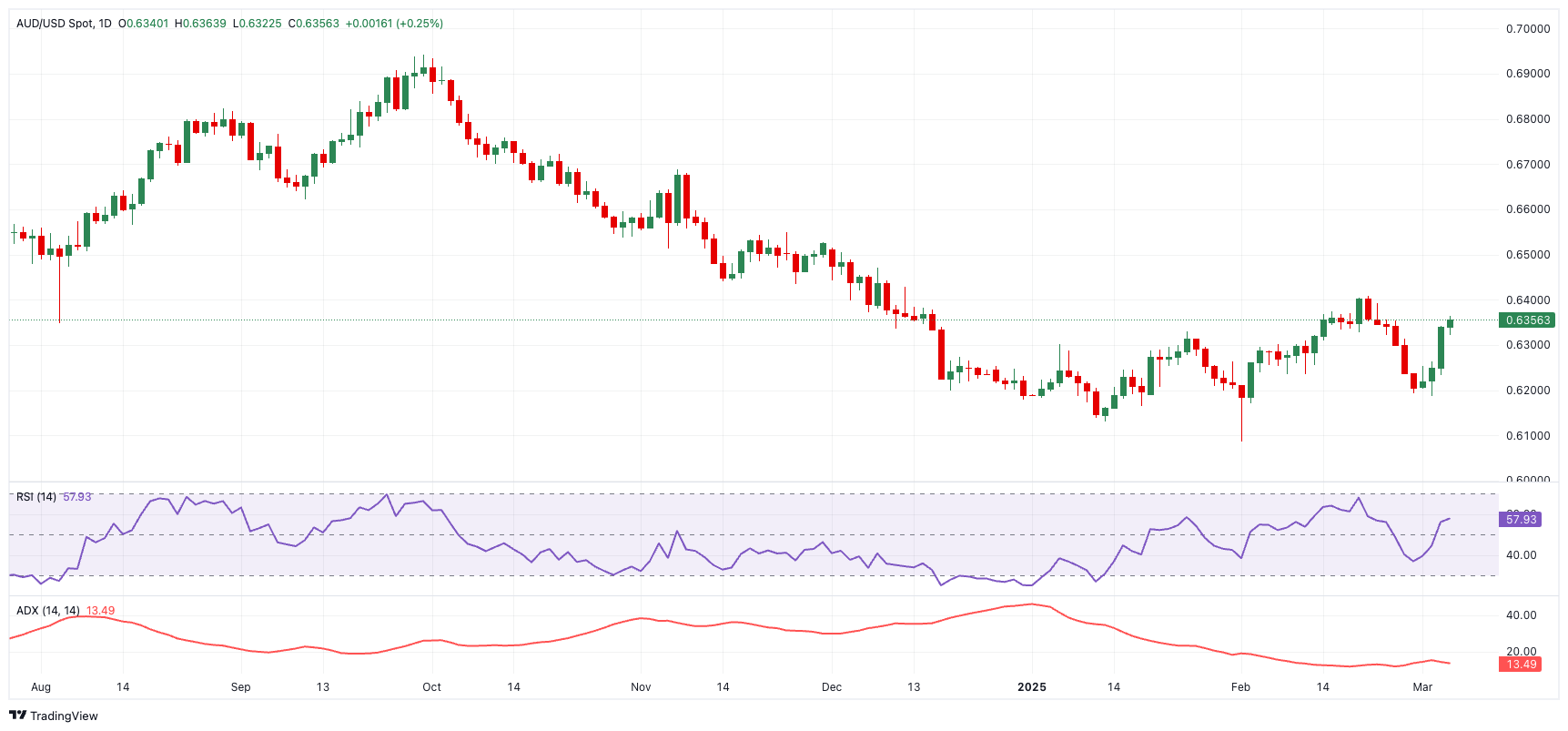
From a technical viewpoint, AUD/USD is approaching a potential retest of its 2025 high at 0.6408 (February 21). A clear break above this level could set up a move towards the next significant resistance at 0.6549, aligning closely with the 200-day Simple Moving Average (SMA).
On the downside, immediate support is seen at the March low of 0.6186 (March 4). Below this, further losses could target the 2025 bottom at 0.6087 and potentially the psychological 0.6000 level.
Momentum indicators currently reflect improving sentiment. The RSI has risen above 55, suggesting modest recovery momentum, though the ADX reading around 14 indicates that the overall trend still lacks significant strength.
AUD/USD daily chart
Economic data to watch
Looking ahead, next data releases include the Westpac Consumer Confidence and the NAB Business Confidence gauges on March 11, seconded by final Building Permits and Private House Approvals, as well as Industrial Production results all on March 13.
Premium
You have reached your limit of 3 free articles for this month.
Start your subscription and get access to all our original articles.
Author
Pablo Piovano
FXStreet
Born and bred in Argentina, Pablo has been carrying on with his passion for FX markets and trading since his first college years.

















