AUD/USD Price Forecast: Extra downside in place below the 200-day SMA
- AUD/USD could not reverse the ongoing multi-day retracement.
- The US Dollar extended further its march south to multi-month lows.
- Trade war fears and risk aversion continued to hurt the Aussie Dollar.

The Australian Dollar (AUD) seesawed between gains and losses on Tuesday, failing to capitalise on the intense sell-off in the US Dollar (USD). That said, steady fears surrounding US tariffs and rising concerns over a potential US recession kept any bullish attempt in the Antipodean subdued.
Against that backdrop, AUD/USD hovered around the 0.6280-0.6270 region following three consecutive daily pullbacks, while the US Dollar Index (DXY) slipped back to the 103.30 region for the first time since early October.
Trade tensions loom large
The spectre of new tariffs—such as a 25% levy on Canadian and Mexican products and a 20% duty on Chinese imports—continues to unnerve investors. For risk-sensitive currencies like the Aussie, these developments heighten the possibility of retaliatory measures and potential extra tariffs, all leading to a broader trade war.
Given China’s status as Australia’s largest trading partner, any slowdown in Chinese demand could dent Australia’s commodity exports, which would, in turn, weigh on the AUD. This is especially relevant as copper prices and iron prices managed to leave behind part of the recent weakness and stage decent rebounds on Wednesday.
Central banks and inflation: The continuing story
With trade disputes threatening to push inflation higher, the Federal Reserve (Fed) may be forced to keep monetary policy tighter for longer, although the rising prospect of a potential slowdown in the US economy might spark a change of plans by the central bank.
In Australia, the Reserve Bank’s (RBA) February rate cut of 25 basis points (to 4.10%) came with the disclaimer that it may not mark the start of a prolonged easing cycle. Governor Michele Bullock reiterated that future rate decisions hinge on incoming inflation data, while Deputy Governor Andrew Hauser tempered expectations for multiple cuts. Nonetheless, many market participants are pricing in up to 75 basis points of additional easing over the next year, given the global uncertainty swirling around trade.
Inflation and rate outlook Down Under
Australia’s January Monthly CPI Indicator landed at 2.5%, slightly below forecasts. The RBA meeting Minutes revealed a lively debate over whether to leave rates unchanged or opt for a small cut—ultimately choosing the latter but clarifying that this did not guarantee a series of cuts. Policymakers also noted that Australia’s interest rate peak remains relatively low and that the labour market is still robust compared to global peers.
AUD/USD technical landscape
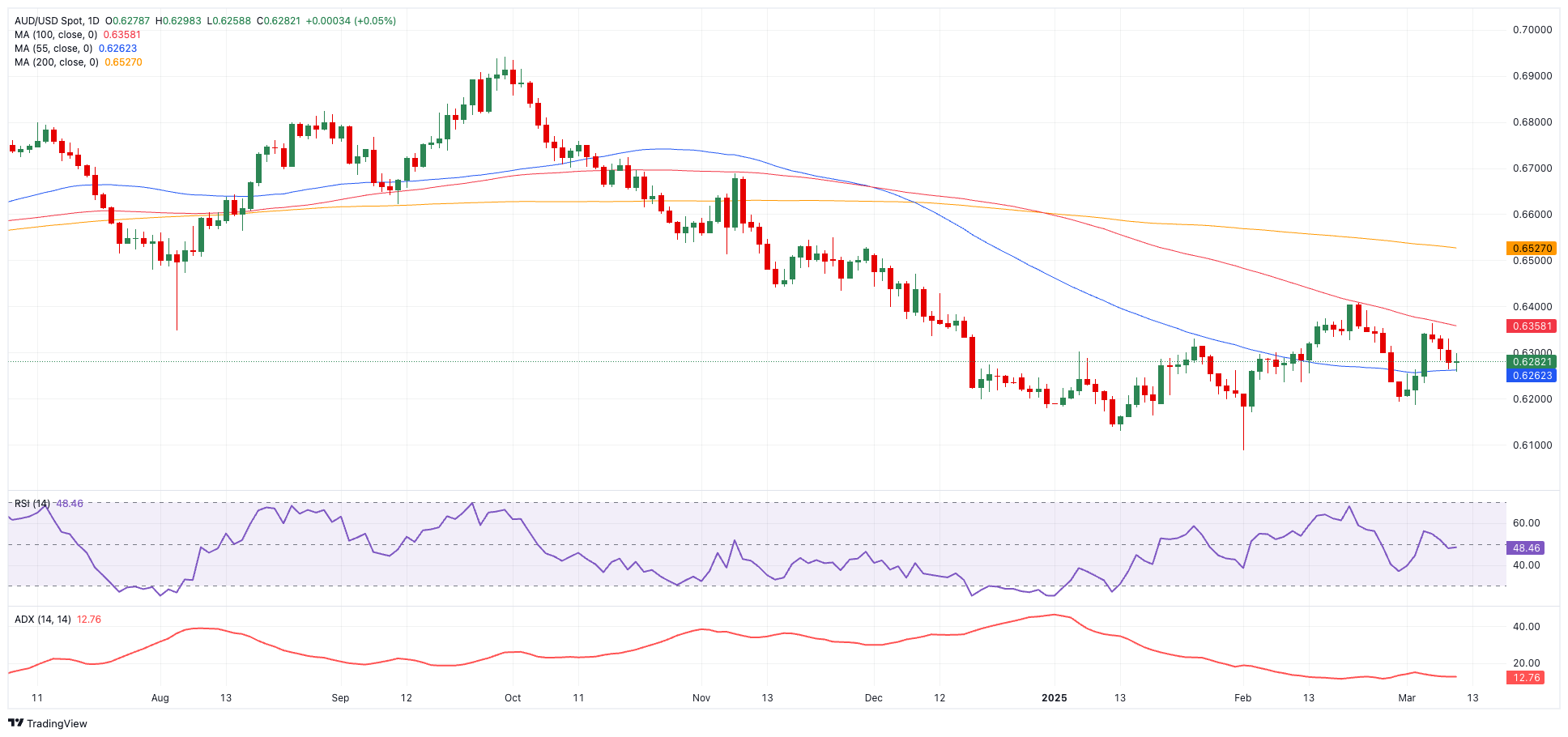
From a technical perspective, once AUD/USD clears the March high of 0.6363 (March 6), it could then retest its 2025 top of 0.6408 (February 21). A decisive break above this level could set the stage for a run at the 200-day Simple Moving Average (SMA) at 0.6530.
On the downside, the first support level sits at the March low of 0.6186 (March 4), with further declines potentially targeting the 2025 bottom at 0.6087, and in a worst-case scenario, the psychological 0.6000 mark.
Momentum indicators lean somewhat bearish, with the Relative Strength Index (RSI) dipping to around 47—suggesting a modest loss of bullish momentum—while the Average Directional Index (ADX) near 13 points to a subdued overall trend.
AUD/USD daily chart
Key data releases ahead
Traders will be keeping a close eye on Australia’s final Building Permits, Private House Approvals, and Industrial Production figures, scheduled for March 13.
Premium
You have reached your limit of 3 free articles for this month.
Start your subscription and get access to all our original articles.
Author
Pablo Piovano
FXStreet
Born and bred in Argentina, Pablo has been carrying on with his passion for FX markets and trading since his first college years.