AUD/USD Forecast: The bearish mood prevails for the time being
- AUD/USD charted its third session in a row of losses.
- Focus shifts to Chinese GDP readings and the Australian jobs report.
- The RBA is likely to keep its OCR unchanged in February.

The selling pressure remained well and sound around the Aussie dollar at the beginning of a new trading week, prompting AUSD/USD to retreat for the third straight session and enter its third consecutive week in negative territory.
Looking at the very near term, dollar dynamics continue to dictate the mood around the pair, although a key week regarding Chinese and Australian data releases should move the dial towards more domestic drivers.
Once again, the continuation of the recovery in the greenback put the risk-associated universe under pressure, paving the way for another negative session in the high-beta currency and the commodity complex.
On the latter, while copper prices managed to reverse Friday’s pullback, iron ore retreated markedly and returned to the sub-$140.00 zone per tonne.
In the broader scenario, market participants are expected to gauge the upcoming publication of the labour market report in Oz (January 18) against the ongoing speculation of an “on-hold” stance by the RBA at its February event, particularly following the softer-than-expected inflation figures in the country tracked by the Monthly CPI Indicator for the month of December.
AUD/USD daily chart
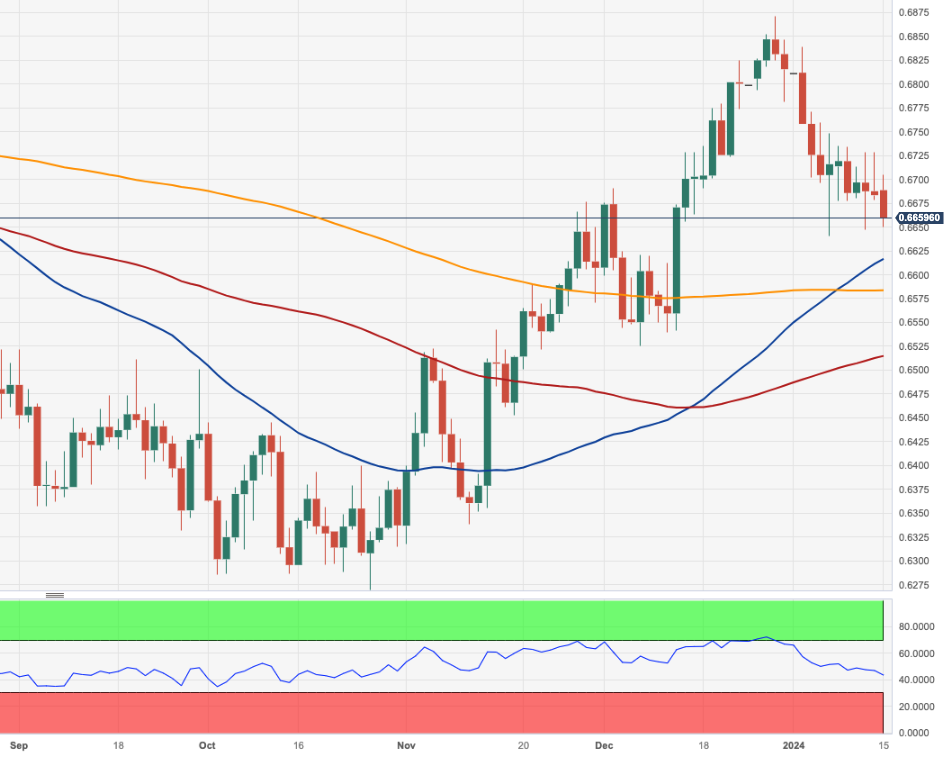
AUD/USD short-term technical outlook
Further AUD/USD falls might reach the 2024 low of 0.6640 (January 5) before the critical 200-day SMA at 0.6581. The loss of this area should find temporary support around the 55-day SMA at 0.6607 before the December 2023 low of 0.6525 (December 7). Further deterioration of the outlook should force the pair to attempt a move to the 2023 low of 0.6270 (October 26). If the bulls recover control, the focus will transfer to the December 2023 high of 0.6871 (December 28), which emerges before the July 2023 top of 0.6894 (July 14) and the June peak of 0.6899. (June 16), all preceding the psychological 0.7000 level will be the next to watch.
According to the 4-hour chart, the significant conflict zone is about 0.6650/40. If this zone is breached, there are no noteworthy disagreement levels until 0.6525 and 0.6452. The MACD remains in the negative zone, while the RSI broke below 40. The bullish trend, on the other hand, may encounter first resistance at the 55-SMA at 0.6776, which is seen as the last line of defense before the previous high at 0.6870.
Author

Pablo Piovano
FXStreet
Born and bred in Argentina, Pablo has been carrying on with his passion for FX markets and trading since his first college years.

















