|

AUD/USD Forecast: Slowly grinding lower

AUD/USD Current Price: 0.6049

  • Australian NAB’s Consumer Confidence plunged to -11 in Q1 from -2.
  • Crude oil prices’ bounce lent temporal support to the commodity-linked Aussie.
  • AUD/USD with the risk skewed to the downside, about to challenge 0.6000.
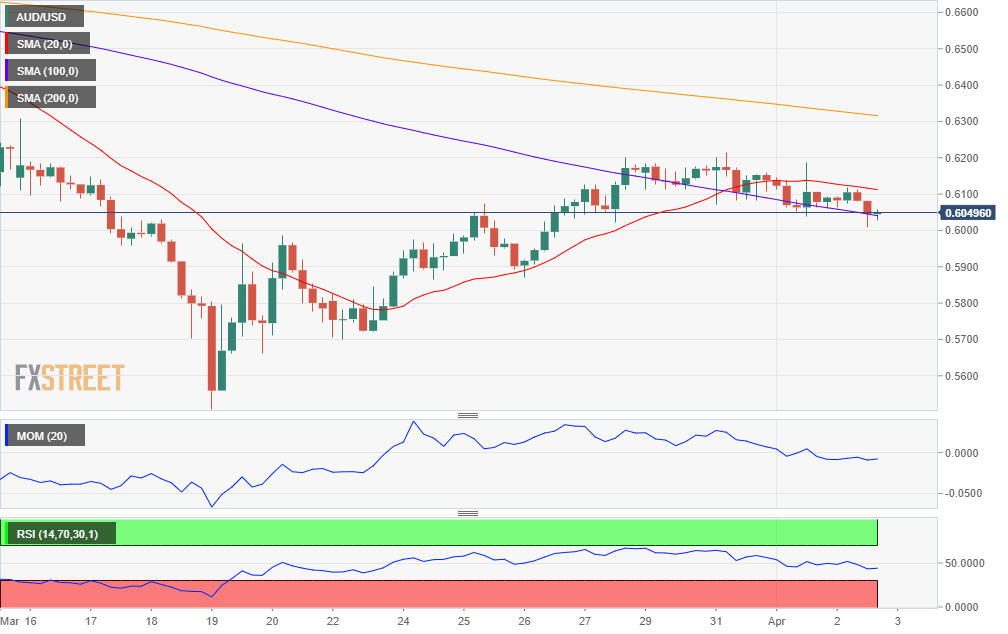
The AUD/USD pair has fallen for a third consecutive day, ending the American session around 0.6040 and having posted a daily low of 0.6006. The pair bounced from the mentioned low amid the strong comeback in oil prices giving temporal support to commodity-linked currencies, although the advance was limited by the prevalent dollar’s demand. Australia released at the beginning of the day the Q1 NAB’s Business Confidence Index, which fell to -11 from -2. During the upcoming Asian session, the country will release the March AIG Performance of Construction Index, previously at 42.7, and the Commonwealth Bank Services PMI, expected to match the preliminary estimate and result at 39.8.

AUD/USD short-term technical outlook

The AUD/USD pair is offering a moderate bearish stance, according to the 4-hour chart, as it continues to trade below its 20 SMA, while around a bearish 100 SMA. Technical indicators in the mentioned chart hold within negative levels, although lacking directional strength. A break below the 0.6000 threshold should open doors for a steeper decline.

Support levels: 0.6035 0.6000 0.5960

Resistance levels: 0.6075 0.6110 0.6150

View Live Chart for the AUD/USD

Author

Valeria Bednarik

Valeria Bednarik was born and lives in Buenos Aires, Argentina. Her passion for math and numbers pushed her into studying economics in her younger years.


More from Valeria Bednarik
Share:

Editor's Picks

AUD/USD sits at three-week highs above 0.7000 on hawkish RBA-speak

AUD/USD holds a positive bias for the fourth straight day, trading above 0.7000 in the Asian session on Wednesday and at three-week highs. RBA Deputy Governor Andrew Hauser's hawkish remarks and inflation concerns underpin the pair. However, the upside appears capped as the US Dollar attracts some buyers amid looming US-Iran uncertainty.

USD/JPY remains confined in a familiar range below 158.50

USD/JPY sees some dip-buying in the Asian session on Wednesday, though it remains confined within a multi-week range near 158.50 as the uncertainty over the timing of the next BoJ rate hike keeps Japanese Yen bulls on the defensive. Meanwhile, hawkish Fed expectations, bolstered by inflation risks stemming from volatile oil prices, underpin the US Dollar. However, looming intervention fears could limit JPY losses and cap the currency pair.

Gold extends losing spree as US bond yields hold ground

Gold extends its losing streak for the fourth trading day on Wednesday, trading 0.2% lower to near $4,115 in the Asian session. The precious metal is under pressure as United States Treasury Yields on the back of significant gains in oil prices in past few weeks.

Zcash's bullish reversal eyes $1,698 peak on NU7 upgrade
Zcash (ZEC) shows signs of bullish recovery above $1,200 on Wednesday, following a 9% rebound the previous day linked to the upcoming NU7 upgrade. Blockworks released a Zcash holders report on Tuesday, highlighting steady network growth. The technical outlook for ZEC is bullish, with bulls eyeing an extended rally toward $1,698.
US – Midterm update: Pre-election tail risk scenarios
With two weeks until the US midterm elections on 3 November, early voting has already opened in more than 40 states. Prediction markets are broadly unchanged since we published our Midterm update, 13 October. The prediction market Polymarket continues to see Democrats winning both chambers as the most likely outcome, with a 62.5% probability.
The US Dollar fell. Gold didn't rally. That tells you everything
Gold (XAU/USD) is struggling to capitalize on a weaker US Dollar (USD), after repeatedly failing to establish itself above the $4,200 level. The precious metal remains confined to a relatively narrow trading range despite a combination of developments that would normally support higher prices.