AUD/USD Forecast: Nothing moves until the lockdown is unlocked
- Risk aversion still the dominant market sentiment.
- President Trump’s plan to restart the US economy provides some support to aussie.
- Australian economy tightly levered to China and US plan could help Chinese exports.
- Uncertainty is high as markets sway between risk and recovery.


Australian Prime Minister Scott Morison has said the country will keep its restrictions on public movement for at least four more weeks. His ruling underlines the difficulties for markets as they attempt to recover from the pandemic instigated economic shutdowns.
Until governments permit at least a partial return to normal activity no amount of potential matters. To a degree impossible to imagine just six weeks ago, economies are hostage to political decisions that may not take recovery as their first order of business.
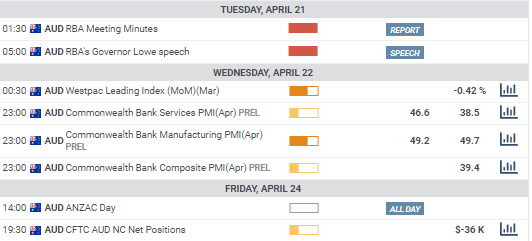
The Australian dollar has returned 16% from its 18 year low against the US dollar of three weeks ago. But its near stationary trading this week, opening on Monday at 0.6347 and closing Friday at 0.6365 may mark the emerging balance between the risk-averse premium of the US dollar and the incipient return to normalcy that would spur the rise of the aussie.
China’s 6.8% decline in first quarter GDPs was the first since modern reports began in 1992. Its minimal impact on the aussie was due partially to it being wholly expected but more to the incipient economic revival underway on the mainland.
Business confidence and conditions in the National Australia Bank’s survey for March at -66 and -21 respectively were the worst in records that go back to 1997. Westpac consumer confidence fell to -17.7% from -3.8% also the lowest in the 46 year history of this series. The March unemployment rate of 5.2% and the addition of 5,900 jobs instead of the loss of 40,000 forecast were discounted because the data only included the first two weeks of the month before the lockdown measures were enacted.
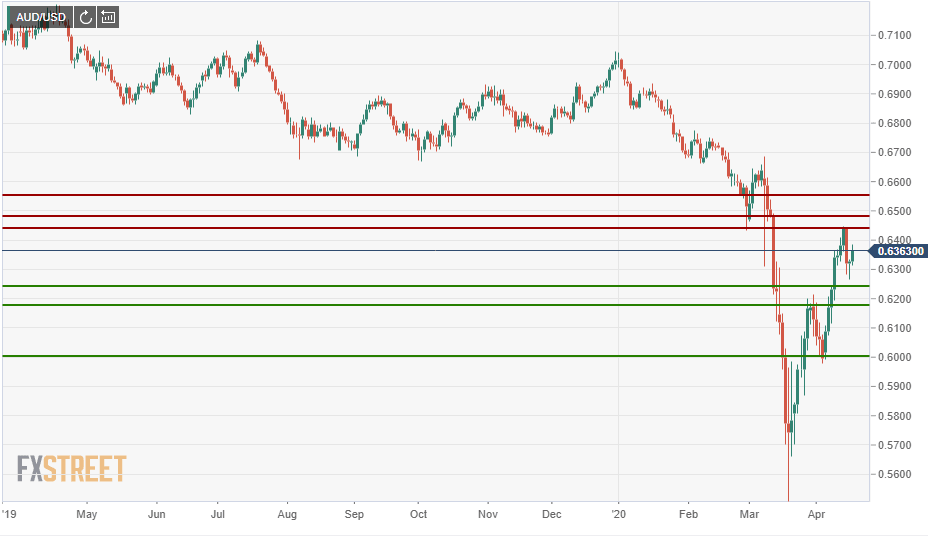
Australian statistics April 20-24
Wednesday
Commonwealth Bank’s manufacturing and services indexes are forecast to remain in recession in April. The services PMI should rise to 46.6 from 38.5 and manufacturing to slip to 49.2 from 49.7.
Australian dollar outlook
If China is truly past the worst of the pandemic and reopening its economy then it will slowly pull the Australian dollar higher even if Down Under remains largely shuttered.
Australian statistics will reflect the dismal state of the global economy but this will matter less than the potential for revival once the closures end.
But the aussie, like all currencies traded against the US dollar, cannot escape the negative attraction of being the other side of the risk-aversion trade. Until that subsides every pulse of fear generated by pandemic news will inhibit the aussie’s recovery.
US statistics April 13-17
Wednesday
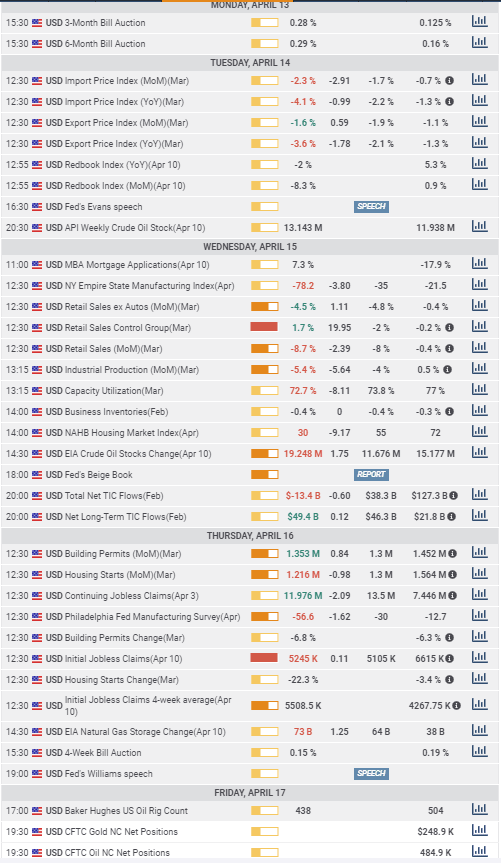
Retail sales in March were down 8.7% on the month below the 8% forecast but a good portion of that was lost automobile purchases as most dealerships in the country were closed. Sales ex-autos were off 4.5% slightly better than the -4.8% prediction. Industrial production fell 5.4% in March in its largest monthly decline on record. Capacity utilization plunged to 72.7% from 77% as many auto plants and other factories are closed. The New York Fed Empire State Manufacturing Survey crashed to-78.2 in March its lowest ever, from -21.5 in February and though New York is no longer a major manufacturing center the reading is another tell for the American economy.
Thursday
Jobless claims remained the centerpiece in chronicling the economic cost of the government ordered pandemic shutdowns. Initial claims rose 5.245 million in the week of April 10 bringing the four week total to 22.03 million more than eight times the next highest total of 2.637 million in March 2009.
US statistics April 20-24
Tuesday
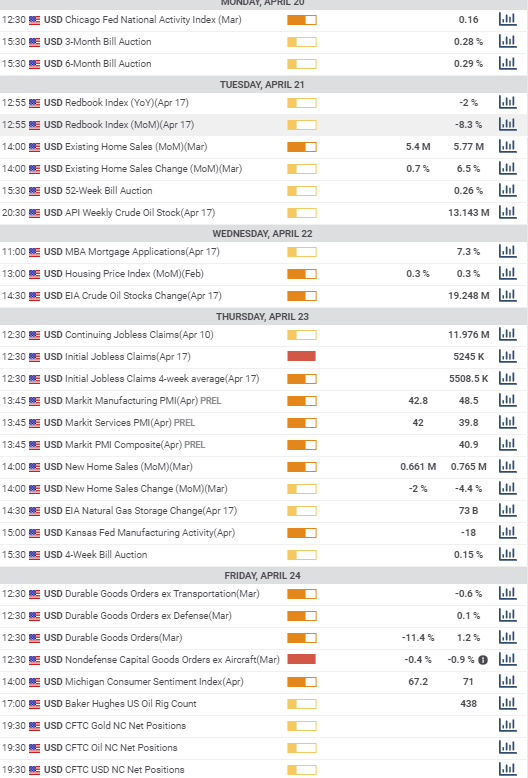
Existing home sales are about 90% of the US market. The forecast for March of an annualized rate of 5.4 million down from 5.77 million in February is probably too optimistic in light of the layoffs and shutdown in the second half of the month.
Thursday
Initial jobless claims have declined 24% in two weeks from 6.867 million (3/27) to 5.245 million (4/10), markets will be watching (and hoping) that this is the start of a trend. Preliminary April purchasing managers’ indexes from HIS Markit are forecast to remain in contraction, dropping to 42.8 in manufacturing from 48.5 and climbing to 42 from 39.8 in services. The Kansas City Fed Manufacturing Activity Index fort April will be released at 10:00 am EDT, March was -18.
Friday
Durable goods orders for March are expected to drop 11.2% after February’s 1.2% gain. Non-defense capital goods orders, the proxy for business spending, to projected to decrease 0.4% following February’s revised 0.9% drop.
The preliminary Michigan consumer sentiment for April is forecast to decrease to 67.2 from 71.
US statistics conclusion
Retail sales confirmed the the huge damage to consumption from the business shutdowns though almost half was due to automoblies. Initial claims moderated but the interest will be if the figures for the April 17 week confirm the downward trend on Thursday. Markit PMI numbers are normally a preliminary for the ISM surveys coming in the first part of May but in the current enviromant may gain trader attention on thier own. Durable goods for March have been superseeded by retail sales but the business investment proxy will provide some new information.
Markets have moved from initial shock of the unemployment claims numbers in the US to a more detailed enumeration of the economic collapse without changing the dire view into the second quarter. Confirmation of that outlook will tend to support the risk trade to the US dollar though with so much bad news already priced in, the oppourtunities for reversal are growing.
AUD/USD technical outlook
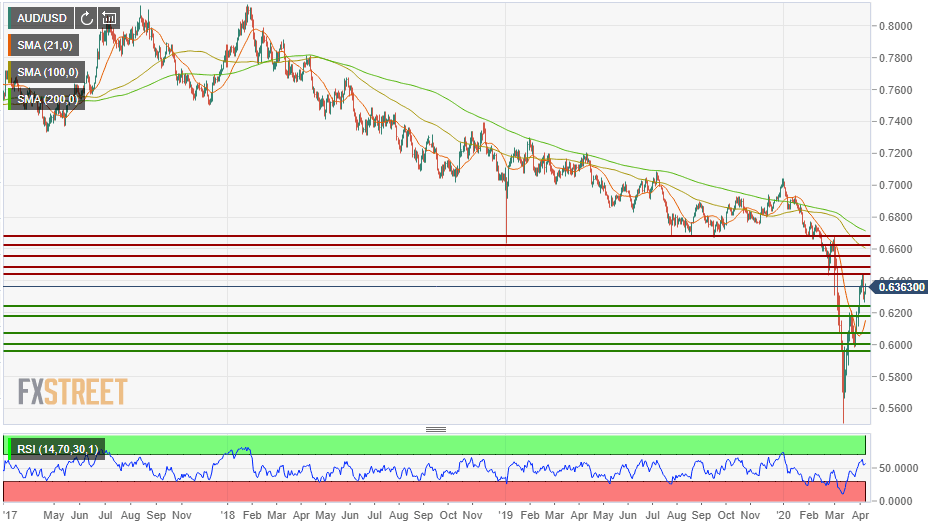
This week's stasis has blunted but not removed the positive position in the relative strength index. The moving averages remain split with the 100-day and 200-day reflecting the two year decline that did end until three weeks ago and the short 21-day average that mirrors that same ascent.
Support: 0.6241; 0.6175; 0.6070; 0.6000; 0.5955
Resistance: 0.6440; 0.6480; 0.6560; 0.6620; 0.6675
AUD/USD sentiment poll
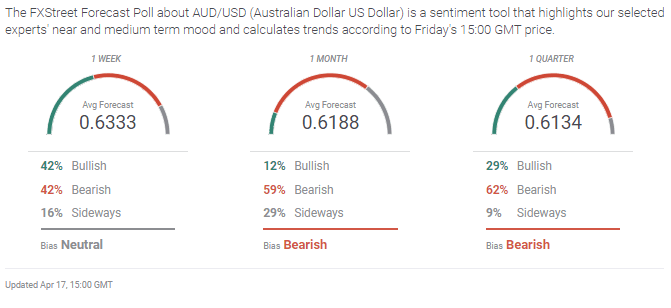
The poll represents very modest improvement in aussie sentiment with the one week view moving to neutral from bearish with an unusual tie at 42% giving the win to neutral at 16%. Last week was strongly bearish at 50% vs 30%. The longer term views at one month and one year are heavily bearish at 59% vs 12% and 62% vs 29% signalling the triple negative for the aussie of a commodity currency that is closely connected the Chinese economy and the other side of the global risk-aversion trade.
Author
Joseph Trevisani
FXStreet
Joseph Trevisani began his thirty-year career in the financial markets at Credit Suisse in New York and Singapore where he worked for 12 years as an interbank currency trader and trading desk manager.

















