AUD/USD Forecast: Extra rangebound remains on the table
- AUD/USD maintains the trade around the 0.6600 region.
- Australia’s Inflation Rate takes centre stage later in the week.
- The FOMC gathering and US NFP are seen as key drivers.

Another day, another erratic performance of AUD/USD, which remains trapped within the multi-session consolidative phase in place since the middle of the current month. This time, however, spot managed to start the week in quite a positive fashion.
The daily strengthening of the Australian dollar contrasts with noticeable gains in the greenback. The resilience of the Australian currency is evident in recent reports indicating additional stimulus measures by the People's Bank of China (PBoC) to bolster China's stock market and ignite economic recovery in the post-pandemic era, which has been slower to materialize thus far.
The influence of China, along with the anticipated decision of the Reserve Bank of Australia (RBA) to maintain its current policy stance next month, continues to be perceived as a factor that will restrict the potential for the pair to rise in the coming weeks. This also suggests that there may be more subdued trading in the short-term future, at least.
Regarding the Reserve Bank of Australia (RBA), the recorded decrease in inflation metrics during December, coupled with the still perceived tight labour market, appears to have strengthened the prevailing consensus among market participants that the central bank will maintain its current interest rates at the upcoming event in February.
Speaking about central banks, the likelihood that the Federal Reserve could extend its ongoing restrictive stance for longer than anticipated should be supportive of extra gains in the US Dollar, and therefore a drag for AUD/USD.
AUD/USD daily chart
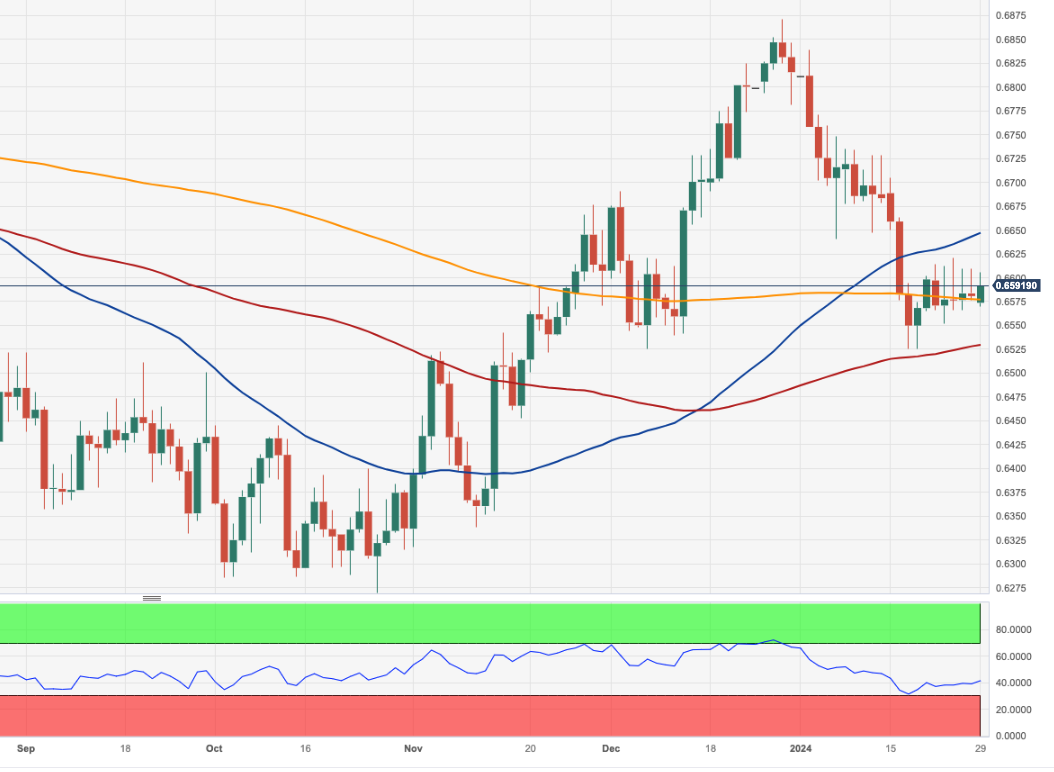
AUD/USD short-term technical outlook
Further losses may cause the AUD/USD to retest its 2024 bottom of 0.6524 (January 17). The loss of this region may cause a drop to the provisional 100-day SMA of 0.6525, an area coincident with the December 2023 bottom (December 7). Down from here come the 2023 low of 0.6270 (October 26) and the round level of 0.6200, all of which are previous to the 2022 low of 0.6169 (October 13). On the contrary, there is a temporary hurdle at the 55-day SMA at 0.6638. The breakout of this zone could motivate the pair to set sails to the December 2023 top of 0.6871 (December 28) ahead of the July 2023 peak of 0.6894 (July 14) and the June 2023 high of 0.6899 (June 16), both of which are just above the important 0.7000 level.
On the 4-hour chart, the pair appears to be consolidating more. On the upside, the 100-SMA is currently at 0.6629, with the 200-SMA at 0.6682. The surpass of this area suggests a potential advance to 0.6728. On the downside, there is preliminary disagreement at 0.6551 prior to 0.6525. If this zone is breached, there is no significant dispute until 0.6452. The MACD flirts with the positive limit, while the RSI eases towards the 50 threshold.
Author

Pablo Piovano
FXStreet
Born and bred in Argentina, Pablo has been carrying on with his passion for FX markets and trading since his first college years.















