AUD/USD Forecast: don't get it wrong, the Aussie is bearish
- Aussie could be recovering some ground, but the long-term picture still skews the risk to the downside.
- Sentiment favors the greenback short-term, but the 0.7000 level still seen as a strong downward limit.

The AUD/USD pair is poised to close the week with gains despite a flash crash on Wednesday, sent it to its lowest in almost a decade. Fears about a global economic downturn have been the main market motor these last few days, with the dollar benefiting temporarily for a run to safety. However, the US government remains in a partial shutdown due to US President Trump refusing to lift it, unless the Congress provides the required funding to build a wall with Mexico, something Trump considers a national security matter. Demand for government bonds amid seek for cover sent US Treasury yields to their lowest in almost a year, while equities seesawed between gains and losses, struggling for direction in a risk-averse scenario.
The short-lived round of panic selling was triggered by Apple, as the company issued a warning downgrading its revenue forecast, later exacerbated by comments from EU economic adviser Hassett, who said that the trade war with China will force many US companies to join Apple in downgrading earnings.
Aiding the Aussie at the end of the week were some positive news about the US-China trade war, as officials from both countries are set to meet next Monday in Beijing for their first round of formal talks ever since the 90-day truce was announced a month ago. Meanwhile, China has announced more stimulus measures for the banking sector, cutting the reserve requirement ratio by a 0.5 percentage point starting Jan. 15. Furthermore, the PBoC announced it will strengthen the guidance of market expectation this year, and work to keep interest rates stable and liquidity "reasonable ample." The positive news, however, can't overshadow the fact that the Chinese economy fell into contraction territory in December, as the official Manufacturing PMI declined to 49.4 in December. Neither talks, not some positive numbers could change the fact that worldwide economies are growing at their slowest pace in years.
Leaning support to commodity-linked currency were oil prices, sharply up on the back of a steep decline in US inventories and the OPEC extending their output cuts.
There were no relevant Australian macroeconomic figures out these days, but there will be several this upcoming week, being the most relevant ones the Trade Balance and Retail Sales. China will release December inflation figures next Thursday, yet for sure, trade war-related headlines will most likely set the tone, alongside US developments related to both, the government partial shutdown and the future of rate hikes.
AUD/USD Technical Outlook
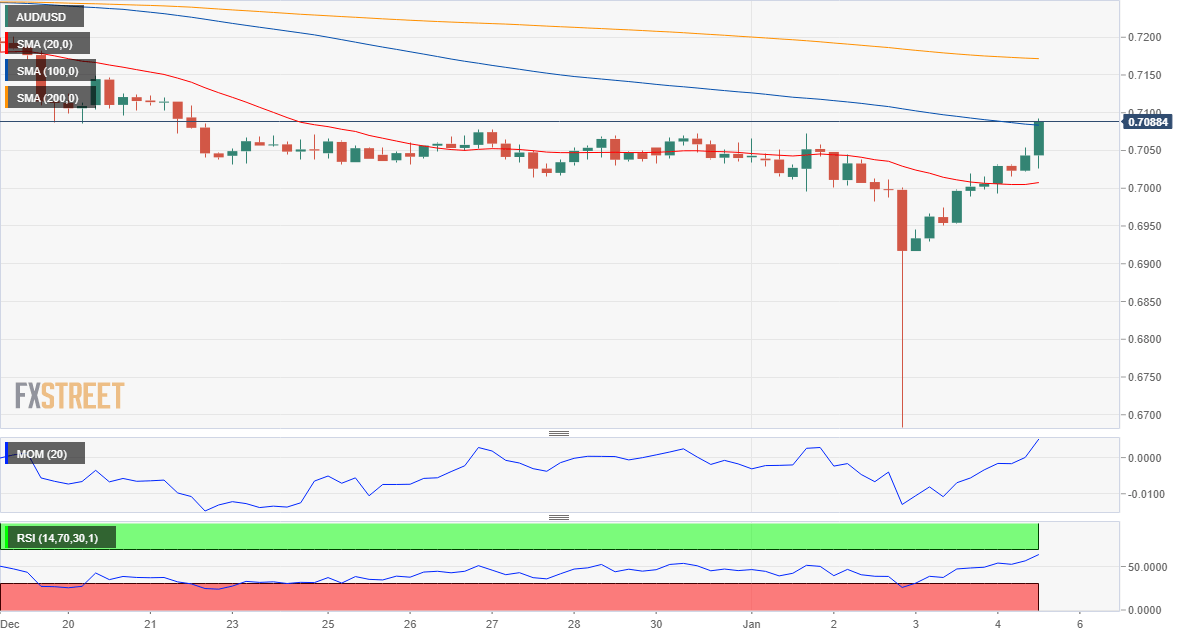
The AUD/USD pair recovered from a weekly low of 0.6775, a level last seen in March 2009 now trading roughly 250 pips above the level, but make no mistake, holding near 2017 low and technically bearish, despite nearing to the 0.7100 level after dovish comments from Fed's head Powell.
In the weekly chart, the pair has plunged below a bearish 20 SMA that provided resistance between November and December, while the 100 and 200 SMA stand over 500 pips above the current level. Technical indicators are recovering modestly from their multi-month lows, still well into negative ground and far from their December peaks around their midlines, all of which indicates that the ongoing recovery could be just corrective.
Daily basis, the 20 DMA heads sharply lower below the larger ones, with the pair now struggling with it, while technical indicators recovered from extreme oversold readings, heading higher within negative ground, rather reflecting these week movements than supporting additional gains. This chart shows that the pair Is back to the comfort zone from mid-December. An immediate support comes at 0.7070, where the pair has topped multiple times these last few days, and a weekly close above it should favor some additional gains during the upcoming sessions. Should the pair advance beyond 0.7100, 0.7150 and 0.7200 come next. Below the mentioned 0.7070, next support comes at 0.6950 followed by the 0.6900 figure.
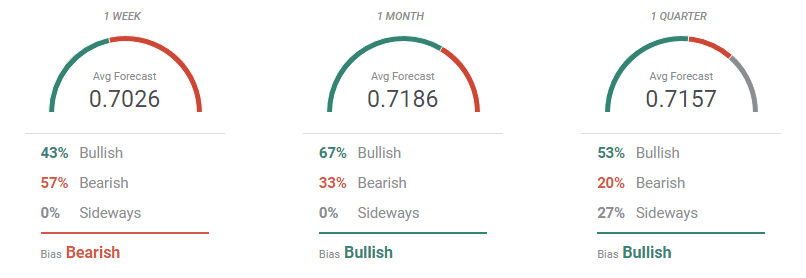
AUD/USD sentiment poll
The FXStreet Forecast Poll shows that sentiment is bearish short-term, with 57% of the polled experts seeing it falling next week, with an average target of 0.7026. In the 1 and 3 months views, bulls are a majority, with the pair seen between 0.71 and 0.72. The Overview chart, however, paints a different picture: the weekly moving average maintains a bearish slope, and while in the monthly view the moving average turns up, there are several sub-0.70 targets, with speculative interest now thinking of 0.6826, the 2016 low. In the 3 months view, the moving average is modestly bearish, with the largest accumulation of targets around 0.7100.
Related content:
EUR/USD Forecast: new year, old jitters
USD/JPY Forecast: The relief may prove temporary
USD/CAD Forecast: After CAD climbed with crude, the BOC is eyed
Author

Valeria Bednarik
FXStreet
Valeria Bednarik was born and lives in Buenos Aires, Argentina. Her passion for math and numbers pushed her into studying economics in her younger years.