AUD/USD Forecast: China smashed bulls' hopes
- AUD/USD little hopes of soon-to-come definitions.
- Chinese key growth figures to be out this upcoming week.

It was a tough week for the Aussie, as hopes for a recovery were smashed by China. The pair aims to end the week as it started it, holding a few pips above the 0.7100 level. Technically, the AUD/USD pair posted a higher high and a higher low when compared to the previous one, which means not all is lost for bulls, but the macroeconomic picture is quite bearish, the main reason why it can't catch directional strength, and holds near its monthly lows. The pair peaked at 0.7206 on the back of an impressive Australian employment report, which showed that the country added 39.1K new jobs in January, largely surpassing the 15.0K expected, while the unemployment rate remained steady at 5%, despite the participation rate rose to 65.7%. Furthermore, the report showed that a whopping 65.4K new full-time positions were created, while part-time employment decreased by 26.3K.
The rally would have continued, as there's no reason to turn long in the greenback, if it weren't by a Chinese announcement that hit the core of the Australian economy: customs at Dalian, one of China's biggest ports has banned imports of Australian coal, and will cap overall coal imports from all sources for this year at 12M tonnes. Despite the ban will only affect a relatively small portion of coal exports, it was enough to take the AUD down, particularly after the latest RBA shift towards a more neutral view on rates.
Fears of a Chinese economic downturn are still high, although there were some shy positive signs. These days we knew that Chinese New Loans surged in January to their highest on record, with credit expansion indicating that BOC measures to stimulate the economy are starting to work. Is a very tiny sign, but sign anyway, that the bottom could be close.
Meanwhile, talks between China and the US continue. Representatives from both countries agreed that progress had been made, with hopes that an agreement in principle will be reached soon.
Next week calendar has little to offer, as the only relevant figure scheduled in Australia is the AIG Performance of Manufacturing Index for February, while China will release the official manufacturing and non-manufacturing PMI for February, and the Caixin Manufacturing Index for the same month.
AUD/USD Technical Outlook
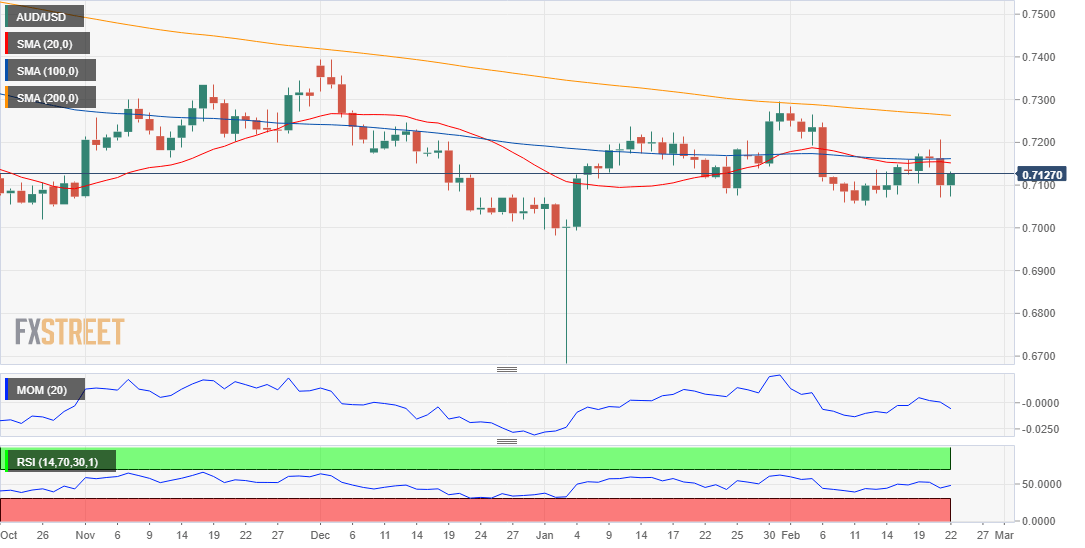
The AUD/USD pair maintains its bearish stance in the weekly chart, as its settling below a flat 20 SMA following an attempt to run beyond it, while the Momentum indicator maintains its bearish slope within negative levels, reaching fresh yearly lows. The RSI in the mentioned chart heads nowhere, hovering around 45 also keeping the risk skewed to the downside.
In the daily chart, the 20 and 100 SMA converge around 0.7160, with the pair unable to settle above it, and technical indicators bouncing modestly but holding within negative levels, leaving a neutral-to-bearish stance.
The pair bottomed for the week at 0.7069, confirming the relevance of the 0.7070 support area. Once below it, a decline toward 0.7000 is likely, while below it, the next probable bearish target comes at 0.6920. To the upside, 0.7200 and 0.7250 are the main resistances and again, seems unlikely the pair could go beyond the latest in the upcoming days.
AUD/USD sentiment poll
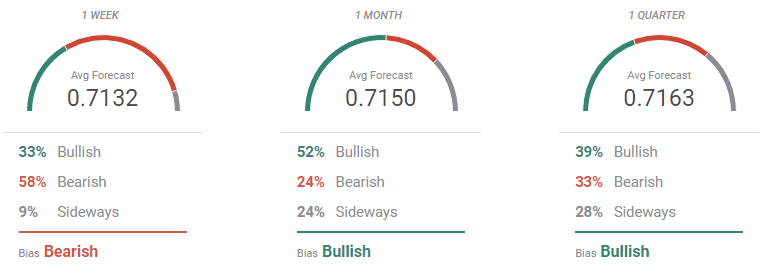
The FXStreet Forecast Poll shows that the AUD/USD pair will remain around the current levels next week, despite market's intentions are on the selling side. Bulls are a bit more convinced in the 1-month perspective, while things turn even in the quarterly view, reflecting the lack of directional conviction around the pair these days.
The overview chart shows that, while in the monthly view the larger accumulation of targets is above the current level, but below it the 3-month view, when the pair is seen closer to the 0.7000 figure.
Related content:
USD/JPY Forecast: Awaiting Powell's power-play to get out of range
USD/CAD Forecast: Can CAD continue higher? CPI and GDP stand out
Bitcoin Price Top Forecast: waiting for another magic trigger
Author

Valeria Bednarik
FXStreet
Valeria Bednarik was born and lives in Buenos Aires, Argentina. Her passion for math and numbers pushed her into studying economics in her younger years.

















