|

AUD/USD Forecast: Bearish ahead of Australian quarterly inflation data

AUD/USD Current Price: 0.6752

  • Australian Q4 inflation seen unchanged yearly basis at 1.7%.
  • Recovering equities prevented the Aussie from falling further.
  • AUD/USD poised to retest the multi-year low of 0.6770.
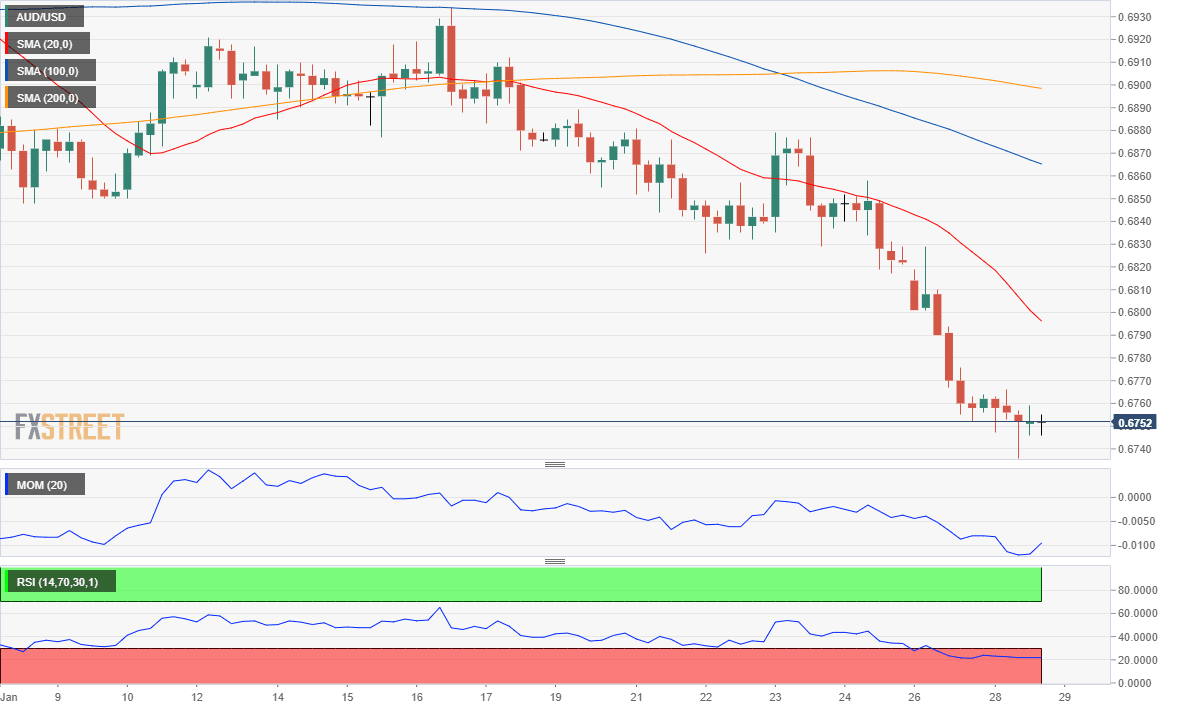
Commodity-linked currencies continued to ease, with AUD/USD falling to 0.6736, to finish the day around 0.6750. The Aussie was undermined at the beginning of the day by persistent weakness among local equities, and the NAB’s Business Confidence Index for December, which resulted in -2 against the 1 expected. Business Conditions met the market’s expectations by printing 3. The pair stabilized during the American session, trapped between the dollar’s strength and the solid performance of Wall Street.

Australia will release  Q4 inflation estimates early Wednesday. Quarterly inflation is expected to have risen by 0.6%, slightly better than Q3 0.5%, while yearly basis,  the CPI is seen unchanged at 1.7%. The RBA Trimmed Mean estimates are seen at 0.4% QoQ and 1.5% YoY, this last down from 1.6%. A worse-than-expected report could exacerbate speculation of a rate cut next week, and send the pair nose-diving toward 0.6670, the multi-year low achieved in 2019.

AUD/USD short-term technical outlook

The AUD/USD pair is stuck in a range but poised to extend its slide, according to technical readings in the 4-hour chart, giving no signs of downward exhaustion. The pair remains below a bearish 20 SMA which accelerated its decline in the mentioned time frame, while technical indicators stand pat near daily lows, lacking directional strength. The fact that it broke and met sellers on approaches to the 0.6770 level, add to the bearish case.

Support levels: 0.6730 0.6700 0.6670

Resistance levels: 0.6770 0.6805 0.6840

View Live Chart for the AUD/USD

Author

Valeria Bednarik

Valeria Bednarik was born and lives in Buenos Aires, Argentina. Her passion for math and numbers pushed her into studying economics in her younger years.


More from Valeria Bednarik
Share:

Editor's Picks

EUR/USD flirts with daily highs, retargets 1.1900

EUR/USD regains upside traction, returning to the 1.1880 zone and refocusing its attention to the key 1.1900 barrier. The pair’s slight gains comes against the backdrop of a humble decline in the US Dollar as investors continue to assess the latest US CPI readings and the potential Fed’s rate path.

GBP/USD remains well bid around 1.3650

GBP/USD maintains its upside momentum in place, hovering around daily highs near 1.3650 and setting aside part of the recent three-day drop. Cable’s improved sentiment comes on the back of the Greenback’s  irresolute price action, while recent hawkish comments from the BoE’s Pill also collaborate with the uptick.

Gold clings to gains just above $5,000/oz

Gold is reclaiming part of the ground lost on Wednesday’s marked decline, as bargain-hunters keep piling up and lifting prices past the key $5,000 per troy ounce. The precious metal’s move higher is also underpinned by the slight pullback in the US Dollar and declining US Treasury yields across the curve.

Crypto Today: Bitcoin, Ethereum, XRP in choppy price action, weighed down by falling institutional interest 

Bitcoin's upside remains largely constrained amid weak technicals and declining institutional interest. Ethereum trades sideways above $1,900 support with the upside capped below $2,000 amid ETF outflows.

Week ahead – Data blitz, Fed Minutes and RBNZ decision in the spotlight

US GDP and PCE inflation are main highlights, plus the Fed minutes. UK and Japan have busy calendars too with focus on CPI. Flash PMIs for February will also be doing the rounds. RBNZ meets, is unlikely to follow RBA’s hawkish path.

Ripple Price Forecast: XRP potential bottom could be in sight

Ripple edges up above the intraday low of $1.35 at the time of writing on Friday amid mixed price actions across the crypto market. The remittance token failed to hold support at $1.40 the previous day, reflecting risk-off sentiment amid a decline in retail and institutional sentiment.













