|

AUD/USD analysis: break below 0.7000 needed to confirm further declines

AUD/USD Current price: 0.7053

  • Chinese Services PMI for September expected at 51.5.
  • Persistent weakness in equities weighed the Aussie lower.
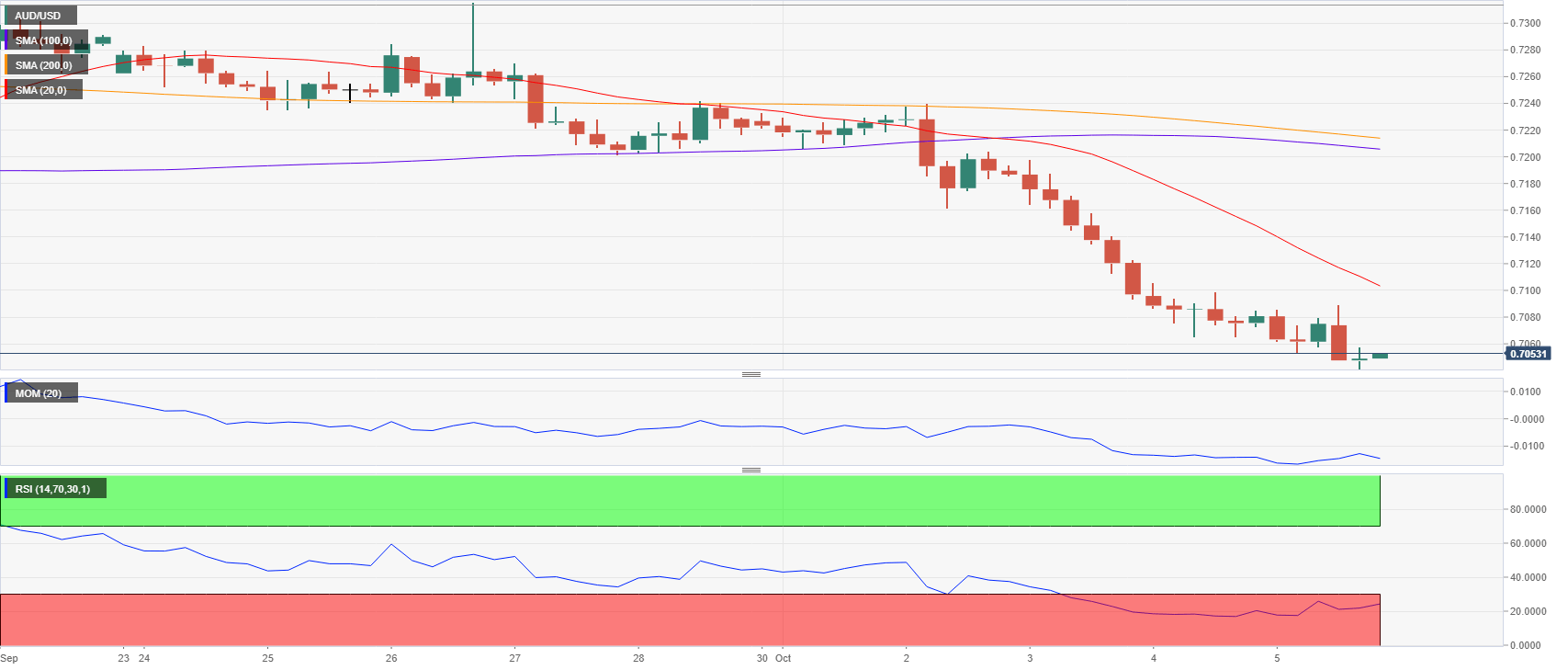
The Australian dollar fell to its lowest in over two years against the greenback this past week, hitting 0.7042 late Thursday, and unable to recover Friday, despite lessening demand for the American currency. The decline was driven by the collapse of worldwide equities and dollar prevalent strength, both a consequence of Fed's Powell comments about the possibility of more rate hikes coming. This last highlights the differences between both central banks, as the RBA has kept the cash rate at record lows for over two years and will maintain them there in the foreseeable future. Australia will open the macroeconomic calendar releasing the ANZ Job Advertisements report for September, hardly a market mover, while China will release the Caixin China Services PMI for September, seen at 51.5, matching the previous reading. This last has more chances of moving the Aussie at the beginning of the week.

The AUD/USD pair is oversold according to the daily chart, but there are no technical signs of a possible change in the dominant bearish trend, as the price has settled far below strongly bearish moving averages, while the Momentum indicator heads south almost vertically and the RSI hovers around 29. Shorter term, and according to the 4 hours chart, technical readings also favor a downward extension, as the pair settled below a strongly bearish 20 SMA, as technical indicators hold directionless within extreme oversold territory. As long as the pair holds below the 0.7100 region, the risk of a steeper decline remains high.

Support levels: 0.7040 0.7000 0.6965

Resistance levels: 0.0.7070 0.7105 0.7150      

View Live Chart for the AUD/USD

Author

Valeria Bednarik

Valeria Bednarik was born and lives in Buenos Aires, Argentina. Her passion for math and numbers pushed her into studying economics in her younger years.


More from Valeria Bednarik
Share:

Editor's Picks

USD/JPY stays below 160.50 as markets assess BoJ decision

USD/JPY fluctuates in a relatively narrow range above 160.00 on Tuesday as markets assess the Bank of Japan's (BoJ) decision to raise the policy rate by 25 at the June meeting. Meanwhile, investors keep a close eye on news coming out of the Middle East, while preparing for the critical Fed meeting.

AUD/USD trades in tight channel near 0.7050 despite hawkish RBA message

AUD/USD trades modestly lower on the day at around 0.7050 on Tuesday as markets adopt a cautious stance amid a lack of details surrounding the US-Iran peace agreement. The Reserve Bank of Australia (RBA) left the door open for possible policy tightening after leaving the interest rate unchanged, as expected, at the June meeting but failed to boost the Australian Dollar.

Gold: $4,000 or $4,500? The Fed may decide Gold’s next big move

Gold now surrenders part of its initial advance and recedes to the vicinity of the $4,350 mark per troy ounce on Tuesday. The early enthusiasm sparked by the US-Iran peace deal has faded somewhat, prompting investors to adopt a more prudent stance as they await further details of the agreement and key guidance from the Fed.

Why a hawkish RBA is no longer enough to lift the Australian Dollar

The Reserve Bank of Australia delivered more than what markets expected: a hawkish hold that should have supported the Aussie. But markets widely ignored it.

BoJ just hiked and US-Iran deal is on the table: Why Japanese Yen is still around 160.00

The Bank of Japan lifted interest rates from 0.75% to 1.00%, its highest level in more than three decades. The landmark move aims to stabilize a sharply weakening Japanese Yen, but by looking at the immediate market reaction, it doesn’t look like it’s going to work.

Why a hawkish RBA is no longer enough to lift the Australian Dollar

The Reserve Bank of Australia delivered more than what markets expected: a hawkish hold that should have supported the Aussie. But markets widely ignored it, focusing instead on slowing economic growth and proving that central bank messaging alone isn’t always enough to drive currencies.

AUD/USD analysis: break below 0.7000 needed to confirm further declines