AUD/USD Analysis: at a brink of a bearish breakout

AUD/USD Current price: 0.7078
- Aussie hit by China's decision to cap imports from Australian coal.
- RBA's Governor Lowe to testify before the House of Representatives' Standing Committee on Economics.
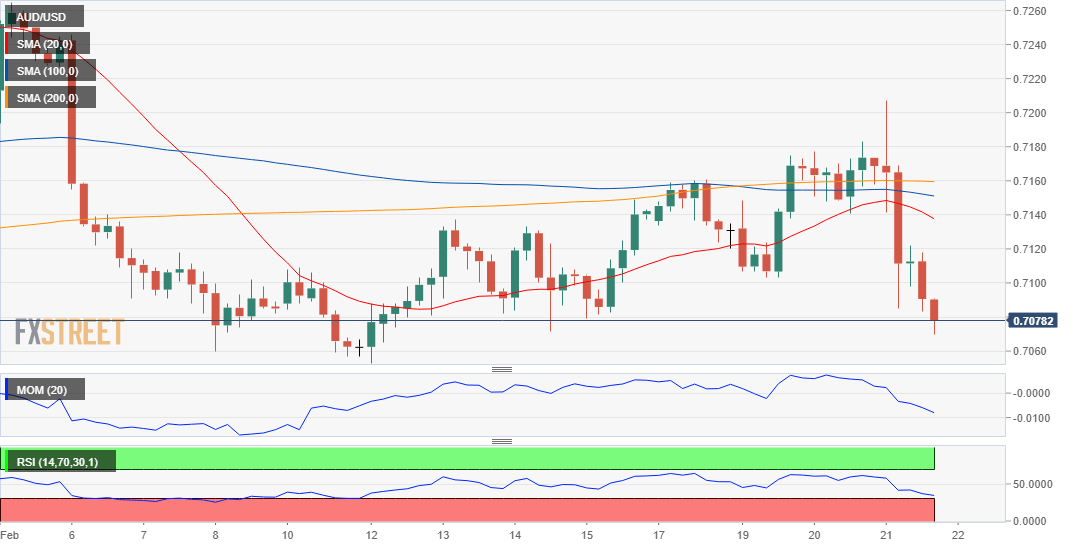
Aussie bulls started the day cheering a solid Australian January employment report, and where caught off guard when China announced a ban to coal imports from the country, resulting in the AUD/USD pair falling from a daily high of 0.7206 to as low as 0.7069, trading at the end of the day a handful of pips above this last. According to official data, the country added 39.1K new jobs in January, largely surpassing the 15.0K expected, while the unemployment rate remained steady at 5%, despite the participation rate rose to 65.7%. Furthermore, the report showed that a whopping 65.4K new full-time positions were created, while part-time employment decreased by 26.3K. Later during the Asian session, news hit the wires announcing that one of China's biggest ports has banned imports of Australian coal, and will cap overall coal imports for this year at 12M tonnes. The poor performance of Wall Street kept the pair at daily lows during the American afternoon. RBA Governor Lowe is due to testify before the House of Representatives' Standing Committee on Economics, in Sydney early Friday, with no other relevant even scheduled in Australia.
The pair is short-term bearish, according to the 4 hours chart, now developing below all of its moving averages and with the 20 SMA accelerating south below the larger ones, all of them over 80 pips above the current level. Technical indicators in the mentioned time-frame head lower within negative levels and at fresh weekly lows, with the downward strength slowing but far from changing. The 0.7070 support area has proved strong in the past, and a break below it could probably result in a test of the 0.7000 figure during the upcoming sessions.
Support levels: 0.7070 0.7035 0.7000
Resistance levels: 0.7100 0.7140 0.7190
Author

Valeria Bednarik
FXStreet
Valeria Bednarik was born and lives in Buenos Aires, Argentina. Her passion for math and numbers pushed her into studying economics in her younger years.