AI cybersecurity risks, physical Gold and Silver, and Gold’s value [Video]

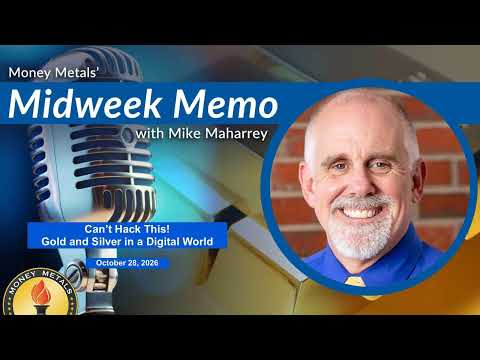
In this episode of the Money Metals Midweek Memo, host Mike Maharrey considers how artificial intelligence could affect trust, cybersecurity, and investors’ access to their money. He also discusses silver’s sharp correction, the long history of gold jewelry, and ways listeners might use precious metals as a physical store of value.
AI deepfakes and public trust
Maharrey opens with a cautionary example. A story about a tiger supposedly calling for help when its keeper had a medical emergency came with images that appeared to be surveillance photos, but the story was fabricated with AI. Maharrey says he believed it until his wife noticed inconsistencies between the pictures.
He argues that increasingly convincing AI-generated images and video could make people less sure of what they see. In a climate where some people already dismiss unwelcome evidence as “fake news,” he wonders how AI might further weaken confidence in institutions, media, and even money.
Maharrey sums up the concern with a question. “What happens when you can’t tell anymore?” He suggests that the uncertainty could encourage people to value face-to-face interaction, local community, and physical media.
AI cyberattacks and bank security
Maharrey turns to what some in technology circles called “Black October,” describing a surge in reported cybersecurity vulnerabilities and attacks. Google Threat Intelligence reported that monthly vulnerability disclosures rose from 5,045 in January to 10,740 in August.
He cites technology commentator John Molinovich, who described dozens of attacks over a two-day period and said that government, education, technology, and banking were affected. Molinovich warned that powerful AI models can work around the clock and be deployed in large numbers. “They can work 24/7, and you can spin up 10,000 of them with a single command,” he wrote.
Maharrey notes that U.S. banks have reported customers giving personal AI agents access to financial accounts. Some agents reportedly contacted customer service or filed complaints without the account holder’s authorization. White House AI czar David Sacks said that much of the activity involved customers sharing credentials with agents to act on their behalf. Maharrey argues that even authorized access deserves caution, given the possibility that AI agents may take actions their users did not intend.
Physical Gold as cyber risk protection
The episode connects cyber threats to counterparty risk, the possibility that another party in a transaction will fail to meet its obligations. When funds sit in a bank account, or an asset is held digitally, Maharrey says, the owner depends on institutions, networks, and power systems to access it.
He is not opposed to Bitcoin, saying he owns it and sees potential in blockchain technology. But he points out that digital assets require electricity and internet access, both of which could be disrupted by cyberattacks, government action, or natural disasters. He uses hurricanes as an example of how a prolonged power outage could make it difficult to use a computer, charge a phone, or reach an ATM.
Maharrey recommends holding some physical gold or silver as a backup, while also taking basic steps to protect digital accounts.
“Gold and silver in your safe cannot be hacked,” he says. “They cannot be turned off.”
He also points to Russia’s use of its gold reserves amid limited access to the dollar system as an example of how hard assets can matter when financial access is constrained.
Silver price correction and bull market
Maharrey says silver had surged to just over $120 an ounce in January before losing more than half its value. At the time of the episode, it was holding above $50. The Federal Reserve was expected to leave interest rates unchanged at its meeting, though investors were watching closely for forward guidance.
Citing technical analyst Jesse Colombo, Maharrey says many investors only began paying attention to silver near its peak, around $121, and lost interest after the correction. Colombo observed that many had little interest when the bull market began in early 2024, while silver was still trading in the $20s.
Colombo believes investors may be overlooking the possibility of another strong move higher. “This is the time to be paying close attention and accumulating while it is still quite cheap,” he wrote. Maharrey says Colombo’s technical case is laid out in a separate article with charts.
Gold jewelry and its 6,500-year history
The episode also explores gold as a gift and a durable store of value. Maharrey describes a child’s grave in a Roman cemetery in Bulgaria, where archaeologists found well-preserved gold earrings and a small bronze coin. The cemetery, with approximately 135 graves, dates to around 275 CE.
The area near the Black Sea was annexed by Rome in 46 CE, and the city now known as Stara Zagora was renamed Augusta Traiana in honor of Emperor Trajan. Maharrey says the city eventually received permission to operate its own mint. He compares the earrings with gold jewelry found in Bulgaria in the early 1970s, dating from 4,600 to 4,300 BCE, roughly 6,500 years old.
Maharrey notes that jewelry accounted for about one-third of gold demand in 2025, with demand totaling 1,542 tons. Gold’s durability and resistance to decay help explain its long history as both adornment and money. As Maharrey puts it, “Gold is gold basically forever.”
Money metals Gold and Silver offers
Maharrey highlights a Money Metals offer for random-year American Silver Eagle coins at a premium of $5.97. Each coin contains one troy ounce of .999 fine silver, or 99.9% pure silver. “They’re easy to sell, they’re easy to use and barter,” he says of Silver Eagles.
He also mentions gold and silver jewelry, gold coins, and a monthly installment plan starting at $100. Listeners can contact Money Metals at 800-800-1865, order online, or arrange storage at the company’s bullion depository in Eagle, Idaho.
To receive free commentary and analysis on the gold and silver markets, click here to be added to the Money Metals news service.
Author

Joshua D. Glawson
Money Metals Exchange
Joshua D. Glawson is a writer on such topics as philosophy, politics, economics, finance, and personal development. He graduated with a Bachelor in Political Science from the University of California Irvine. His website is JoshuaDGlawson.com.