Australian Dollar Price Forecast: Bears are in control, but for how long?
- AUD/USD leaves behind two daily advances in a row; 0.7000 holds the decline.
- The US Dollar comes under extra selling pressure amid falling crude oil prices.
- Markets see the RBA hiking its OCR to 4.85% at its November 3 meeting.
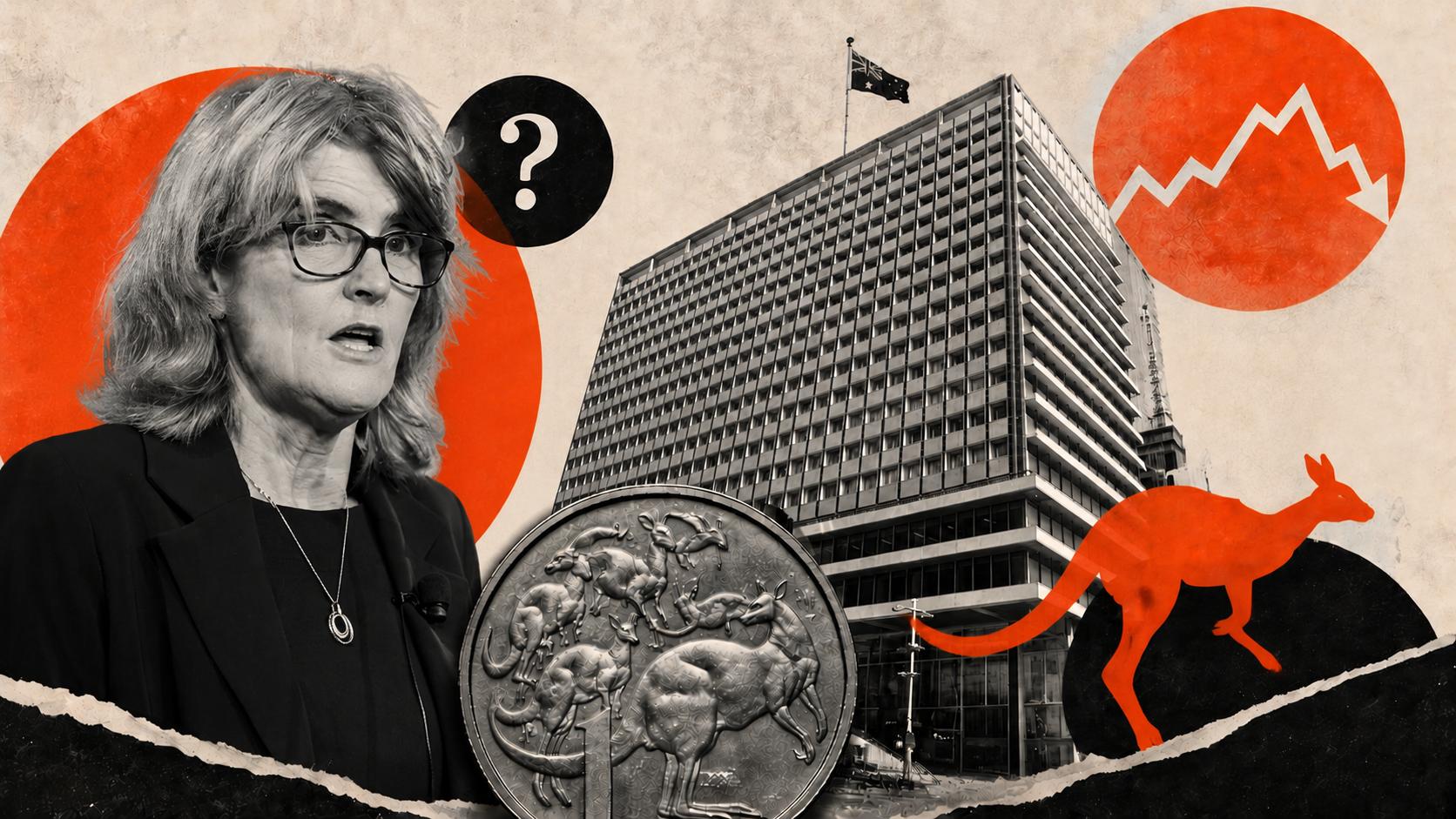
The Australian Dollar (AUD) has faced renewed downside pressure on Thursday, causing AUD/USD to reverse two daily advances in a row and return to the 0.7000 neighbourhood once again.
The resurgence of the bearish mood in spot has re-emerged despite the decent pullback in the US Dollar (USD) at the time when market participants continued to evaluate the ECB event while practically ignoring solid US data releases in the form of flash Q3 GDP figures and inflation tracked by the PCE.
Looking at the broader picture, AUD/USD remains below its key 200-day SMA near 0.7060, with a sustained recovery above that level needed to improve the near-term outlook. Meanwhile, the RBA's hawkish stance and stubborn domestic inflation should help limit the scope for a deeper correction.
Australia holds up, but cracks are showing
Australia’s economy continues to compare favourably with many of its G10 peers, supported by domestic demand and positive economic growth. Persistent inflation also supports the RBA’s cautious, data-dependent policy stance.
However, business activity seems to have lost some momentum after preliminary data showed the Purchasing Managers’ Index (PMI) for Manufacturing improving marginally to 49.5 in September and easing to 47.8 when it comes to Services, from 49.6 and 51.9, respectively.
Trade data provided another positive, albeit humble, signal after August’s trade surplus came in at just A$0.495 billion, adding to the A$1.351 billion surplus registered in the previous month (revised from A$1.923 billion).
Growth figures were less encouraging, however. Indeed, the Gross Domestic Product (GDP) expanded by 0.4% QoQ in the second quarter of 2026, up from 0.3%, while annual growth came in at 2.1%, down from the previous 2.5% yearly expansion.
The labour market, however, disappointed investors in September after the Unemployment Rate held steady at 4.7% (August’s print was revised higher to 4.7% from 4.6%), while the Employment Change shrunk by 39.3K, reversing August’s 29.3K increase (revised from 39.5K).
Inflation seems to have regained some impulse after the latest data showed the most-watched Trimmed Mean CPI came in at 3.7% over the last twelve months in Q3, while the headline CPI held steady at 3.9% from a year earlier.
The Melbourne Institute’s Consumer Inflation Expectations measure reinforced that trend after ticking higher to 5.3% in October.
The figures leave the RBA’s inflation task incomplete. Policymakers expect inflation to return to target only in early 2028, keeping the emphasis on patience rather than an imminent policy pivot.
China offers the Aussie a helping hand
China is providing stability for the Australian economy, but not the growth impulse that has underpinned the Australian Dollar during previous expansions.
The Chinese economy grew 4.5% YoY in the July-September period. Industrial Production grew by 5.5% YoY and 5.3% YDT, regaining the momentum. The latest trade data showed a surplus of $133.53 billion in September, as both imports and exports posted strong gains. Reinforcing this picture, consumer spending remained solid after Retail Sales expanded by 1.1% over the last twelve months.
In addition, business surveys presented a promising picture: the National Bureau of Statistics reported that the Manufacturing PMI improved to 50.1 in September (from 49.8), while the Services PMI improved to 50.2 (from 49.0). In the same direction, private measures like RatingDog remained in expansionary territory, with Manufacturing at 52.1 (from 51.5) and Services at 51.6 (from 51.4).
Disinflationary pressures seem to have taken a breather in September, with the CPI gaining 0.9% from a year earlier, up from 0.8%, while prices rose by 0.2% on a monthly basis. Producer Prices rose more than initially estimated by 5.0% over the previous twelve months, up from the 3.8% increase recorded in the previous month.
As widely anticipated, the People’s Bank of China (PBoC) kept its Loan Prime Rates (LPR) unchanged at 3.00% for the one-year tenor and 3.50% for the five-year tenor.
Taken together, the latest Chinese data offer some encouragement for Australia and the Aussie, although the recovery has yet to develop the kind of momentum that could provide the currency with a more lasting boost.
Bullock keeps the pressure on inflation
At her speech at the Senate Economics Legislation Committee on Tuesday, RBA Governor Michele Bullock said policymakers must assess whether the tightening delivered so far will be sufficient to return inflation to target within a reasonable timeframe. She acknowledged that higher rates are difficult for households but stressed that the RBA cannot allow elevated inflation to persist.
Bullock said monetary policy works with a lag, meaning the full impact of recent rate increases has yet to be felt in domestic activity. Household spending is moderating only gradually, while aggregate demand will need to remain subdued for longer to reduce capacity pressures.
The inflation outlook has nevertheless deteriorated. Oil and related prices have risen sharply again and are expected to add materially to inflation, while short-term expectations remain elevated. Bullock also said that inflation continues to reflect domestic capacity pressures, with the labour market appearing somewhat tighter than previously judged.
The message was hawkish but not an explicit signal of an immediate rate increase. The RBA remains committed to price stability and full employment and will need to determine whether existing restraint is sufficient or whether further tightening will be required.
Markets are currently pricing in a 25-basis-point increase at the November 3 meeting, although the decision will ultimately depend on whether policymakers believe the tightening delivered so far is sufficient to contain inflation.
AUD/USD struggles to find its next catalyst
Baseline outlook
A further sidelined mood should not be ruled out in the short-term horizon. In the meantime, and looking at the broader picture, the pair should face a steady chance of further declines while below the 200-day SMA around 0.7060.
The resumption of the bullish bias will likely require a strong catalyst, namely a sustained improvement in risk appetite trends or renewed and persistent weakness in the Greenback.
Upside scenario
A sustained improvement in risk appetite could help AUD/USD regain the 200-day SMA near 0.7060. Beyond that, the weekly top at 0.7140 (September 21) would emerge as the next hurdle, ahead of the 2026 peak around 0.7280 (May 6).
Downside scenario
In case bears regain control of sentiment surrounding the Aussie, there should be initial support at the October valley of 0.6894 (October 15). A breach below this level would increase the likelihood of a retest of the June bottom near 0.6860 (June 30).
Bears double down despite the recovery
AUD bearish positioning intensified further in the week ending October 20, according to the latest Commodity Futures Trading Commission (CFTC) report. Non-commercial net shorts widened to nearly 127.3K contracts, although the weekly increase of almost 10K contracts was smaller than the previous week's deterioration.
The four-week change deteriorated to around -80.5K contracts, confirming that the broader bearish trend remains firmly established.
Open interest fell to just over 333K contracts. Net shorts increased, with bearish exposure rising and total market activity contracting in the latest move. The aggregate figures alone, however, cannot establish how much of the change came from long liquidation versus fresh short-building.
Speculative exposure became more negative at -38.2%, while its historical percentile slipped to 24.7. The Net Position Percentile remained at 0.0, indicating that the absolute net-short position is still at an extreme historical level, even though the speculative exposure percentile is less extreme.
Options improve, but conviction is still missing
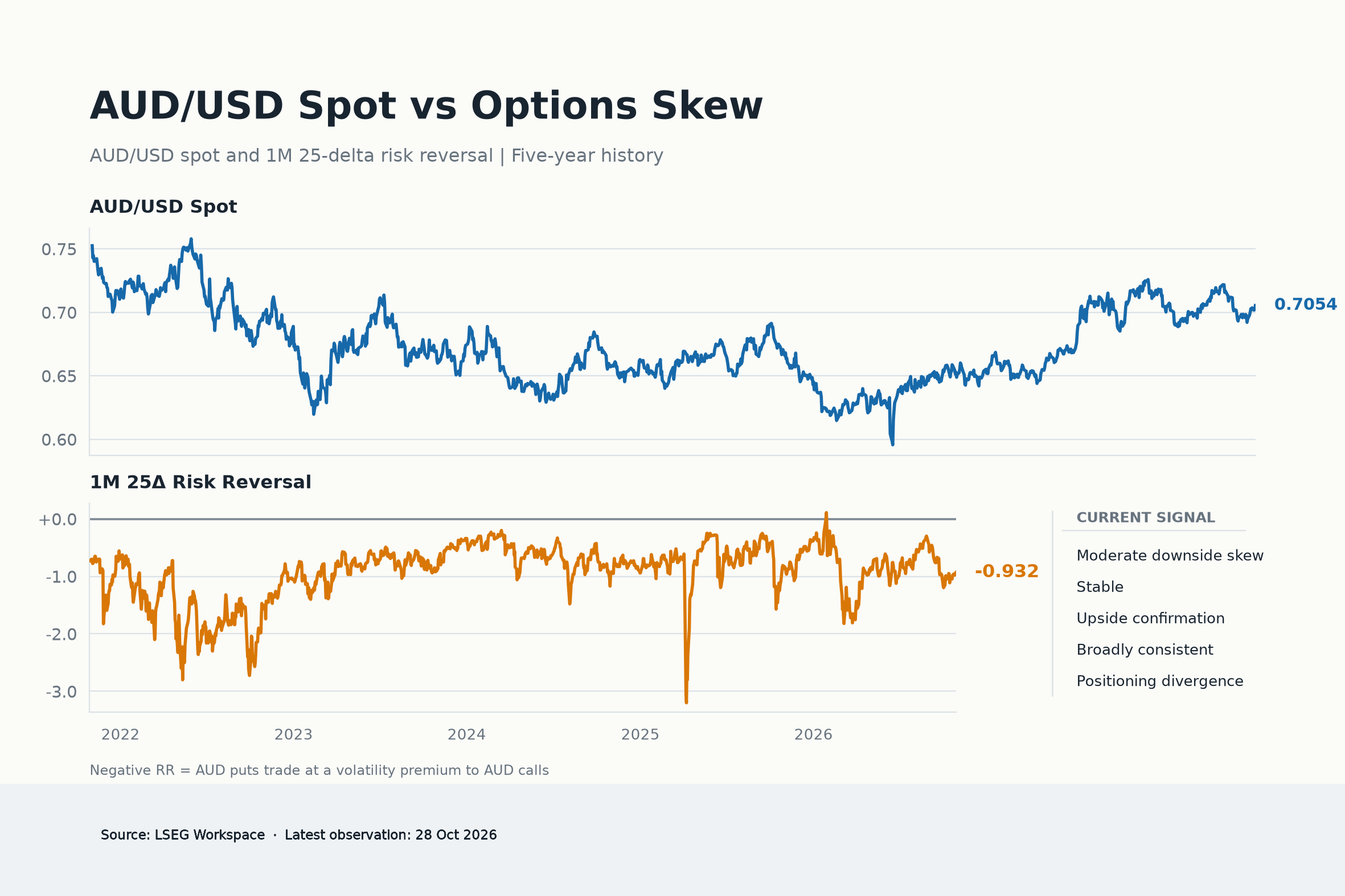
The relationship between spot and options gives us additional insight into the nature of this improvement.
AUD/USD was up almost 1.0% over the past month, and Risk Reversals improved 0.098 volatility points. Based on their historical relationship, a spot advance of this magnitude would normally suggest an improvement of about 0.095 volatility points.
The 0.003 volatility point positive deviation is at the 51.7th percentile of the rolling out-of-sample distribution.
That’s suggesting that options pricing is acting almost perfectly in line with recent moves in the currency. In other words, the improvement in sentiment represents upside confirmation rather than an unusually strong bullish repricing.
However, the longer-term picture is less rosy. The 3-month change in Risk Reversal is -0.302 volatility points, which is at the 21.7th percentile of its historical distribution. This indicates that the recent stabilisation has yet to fully offset the deterioration in options sentiment over the preceding months.
Crowded shorts leave bears exposed
The divergence between speculative positioning and options pricing is becoming more and more difficult to ignore. Futures traders are still largely on the bearish side, but the recent bounce in the Aussie has not seen renewed demand for downside protection. This is hardly a sign of a decisive bullish reversal, but it does show that the current bearish trade is being done in a less comfortable environment.
Spot remains vulnerable to a short-covering rally with speculative shorts at historical extremes should sentiment improve or if developments catch sellers off guard. But the negative Risk Reversal and the continuing weakness in longer-term options momentum suggest that a sustained bullish reversal is still some way off.
RBA decision puts the Aussie back in focus
US Dollar dynamics, global risk sentiment, and geopolitical developments remain the main near-term drivers of AUD/USD.
Event-wise, all the attention is expected to be on November 3, where the RBA is expected to discuss a potential rate hike, which would take the OCR to 4.85%.
Beyond that, the main risks are expected to emerge from China, a persistently cautious Fed, a deterioration in investor risk appetite or a change in the RBA’s current policy stance.
Any of these developments could quickly alter the outlook for the Australian currency.
Technical landscape
In the daily chart, AUD/USD trades at 0.7030, holding below the 100-day simple moving average (SMA) at 0.7033 and the 200-day SMA at 0.7057, which keeps the broader tone capped despite the recovery from recent lows. The 55-day SMA at 0.7072 adds to the overhead supply, while the Relative Strength Index (14) around 52 suggests mildly constructive momentum within a still bearish-biased structure as price struggles to reclaim these medium-term averages.
On the topside, initial resistance appears at the 100-day SMA near 0.7033, followed by the 200-day SMA at 0.7057 and the 55-day SMA at 0.7072, ahead of a horizontal barrier at 0.7079. Further up, the 0.7278/0.7283 band forms a broader resistance zone before the more distant hurdle at 0.7661. On the downside, first notable support is seen at 0.6833, with deeper floors at 0.6660 and 0.6593, while 0.6414 and 0.6373 mark more substantial medium-term basing levels if selling pressure resumes.
(The technical analysis of this story was written with the help of an AI tool. Know more.)
All in all
The AUD remains caught between a RBA that is still wrestling with stubborn inflation and an external environment that offers little room for complacency. Australia's relatively resilient economy and encouraging signs from China provide some support, although the Greenback and broader risk sentiment are likely to have the final say on the currency's near-term direction.
What makes the current picture particularly interesting is the positioning backdrop. Speculative shorts remain historically stretched, yet the Aussie's recent recovery has received some confirmation from options markets, even if bullish conviction remains far from convincing. That leaves sellers increasingly exposed to a short-covering rebound, rather than pointing to a decisive change in trend.
The next meaningful catalyst may be at the RBA meeting on November 3. Another rate rise would boost the bank's hawkish credentials and perhaps provide some support to the Aussie.
However, the near-term outlook remains cautiously neutral with a slight downside bias as the broader recovery struggles to gain traction. A more convincing rebound is likely to need a friendlier US Dollar and improvement in global risk appetite.
Inflation FAQs
Inflation measures the rise in the price of a representative basket of goods and services. Headline inflation is usually expressed as a percentage change on a month-on-month (MoM) and year-on-year (YoY) basis. Core inflation excludes more volatile elements such as food and fuel which can fluctuate because of geopolitical and seasonal factors. Core inflation is the figure economists focus on and is the level targeted by central banks, which are mandated to keep inflation at a manageable level, usually around 2%.
The Consumer Price Index (CPI) measures the change in prices of a basket of goods and services over a period of time. It is usually expressed as a percentage change on a month-on-month (MoM) and year-on-year (YoY) basis. Core CPI is the figure targeted by central banks as it excludes volatile food and fuel inputs. When Core CPI rises above 2% it usually results in higher interest rates and vice versa when it falls below 2%. Since higher interest rates are positive for a currency, higher inflation usually results in a stronger currency. The opposite is true when inflation falls.
Although it may seem counter-intuitive, high inflation in a country pushes up the value of its currency and vice versa for lower inflation. This is because the central bank will normally raise interest rates to combat the higher inflation, which attract more global capital inflows from investors looking for a lucrative place to park their money.
Formerly, Gold was the asset investors turned to in times of high inflation because it preserved its value, and whilst investors will often still buy Gold for its safe-haven properties in times of extreme market turmoil, this is not the case most of the time. This is because when inflation is high, central banks will put up interest rates to combat it. Higher interest rates are negative for Gold because they increase the opportunity-cost of holding Gold vis-a-vis an interest-bearing asset or placing the money in a cash deposit account. On the flipside, lower inflation tends to be positive for Gold as it brings interest rates down, making the bright metal a more viable investment alternative.
Author

Pablo Piovano
FXStreet
Born and bred in Argentina, Pablo has been carrying on with his passion for FX markets and trading since his first college years.