ADP Employment Preview: Moderating but healthy
- Private sector job creation to weaken in May
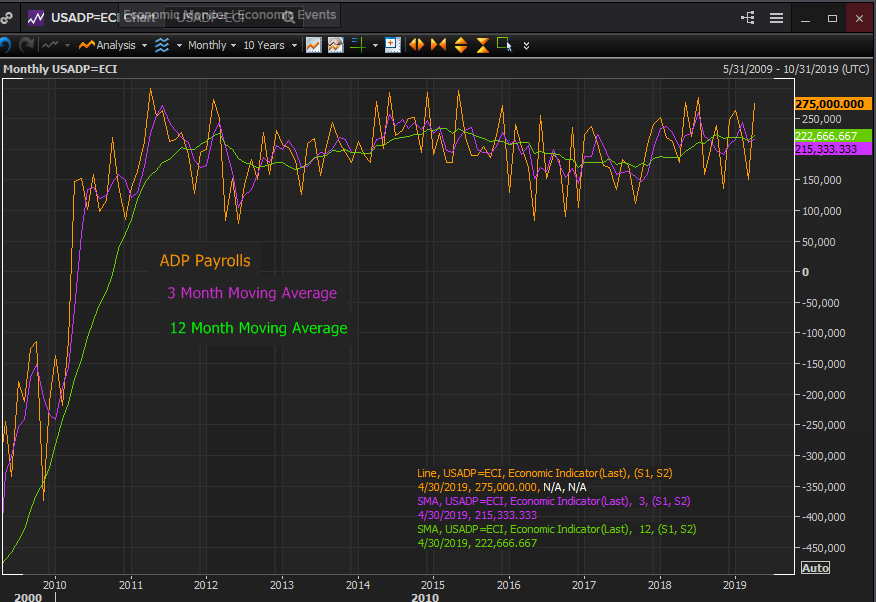
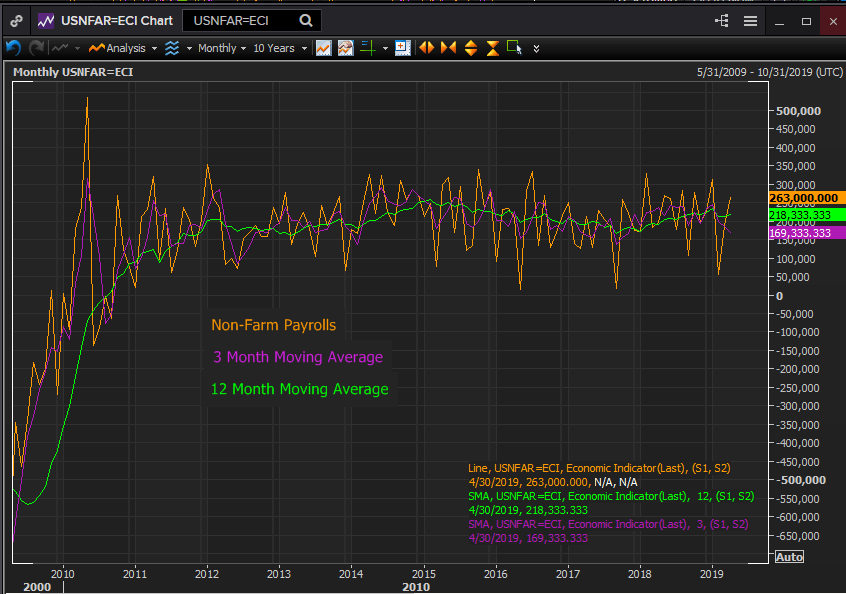
- April's 275,000 ADP was matched by 263,000 in NFP
- Business confidence may curtail hiring

Automatic Data Processing the private payroll company will issue its National Employment Report on Wednesday June 5th at 8:15 am EDT, 12:15 pm GMT.
Forecast
The US clients of ADP are predicted to increase their payrolls by 183,000 in May following April's addition of 275,000 new employees.
ADP and NFP
The ADP report is the lead for the Bureau of Labor Statistics Employment Situation Summary more often called non-farm payrolls, payrolls or simply NFP for its best known statistic. The report for May will be released this Friday June 7th at 8:30 am EDT, 12:30 pm GMT.
Reuters
The NFP report provides the most complete and up to date analysis of the US labor market available. It includes well know data on job creation, unemployment rates and compensation and lesser known information on labor force participation, average work week, hours worked and other topics. It divides the employment statistics into numerous categories--private and government payrolls, type of employment, age, racial and gender differentiated unemployment rates and many others. In all the BLS report contains 25 different tables of employment statistics.
Reuters
The data for the report is solicited at the most four weeks before the issuance making it one of most timely of government statistics. It is the best known and most widely traded US economic statistic.
There is a directional correlation between the private ADP figures and the non-farm payroll numbers. The two numbers generally move in the same direction each month though the amount of the rise or fall is not well correlated. April was a good example, ADP jumped to 275,000 and NFP to 263,000 both well above trend.
ADP and NFP: Part and Whole
The ADP report on the payrolls of its clients is seen as an accurate if partial map to the government job report issued two days later.
There are two main differences between the reports. The ADP information covers only its own clients, the 411,000 US firms that employ its payroll processing and accounting services. The BLS report cover the entire economy including government employment at local, state and federal levels.
The second difference is that ADP includes only actual employees whose paychecks are produced by the company. The NFP figures from the BLS include a monthly estimate for the number of jobs created by newly formed companies that have not yet been reported to the government for tax purposes. This estimated number is later compared to the actual tax rolls and the NFP figures are adjusted each year to correct for variation.
The Labor Market and the US Economy
The US economy expanded at a 3.1% annualized pace in the first quarter, a surprise acceleration from the 2.2% rate in the final three months of 2018. The Atlanta Fed’s GDPNow model for the second quarter is showing a marked slowdown at 1.3% through May 31st.
The ADP three month moving average has not been below 200,000 since last November’s 191,000; the 12-month moving averge since May 2018 at 196,000.
Non-farm payrolls have been more circumspect, the 3-month moving average has been below 200,000 since January. The 12-month however has been above the 200,000 mark for a year.
The unexpected NFP February drop to 56,000 has been more than compensated for by the by the 226,000 average of the subsequent two months and the 312,000 result in January.
The ADP figure fell to 151,000 in March, under recent averages but it reverted to form with 275,000 in April.
The recent modest declines in the three month averages, to 215,333 in April from 244,667 in February for ADP and to 169,333 in April from 245,000 in January for NFP, probably reflect some of the caution that is found in the PMI employment indexes from the Institute for Supply Management.
Employment PMI
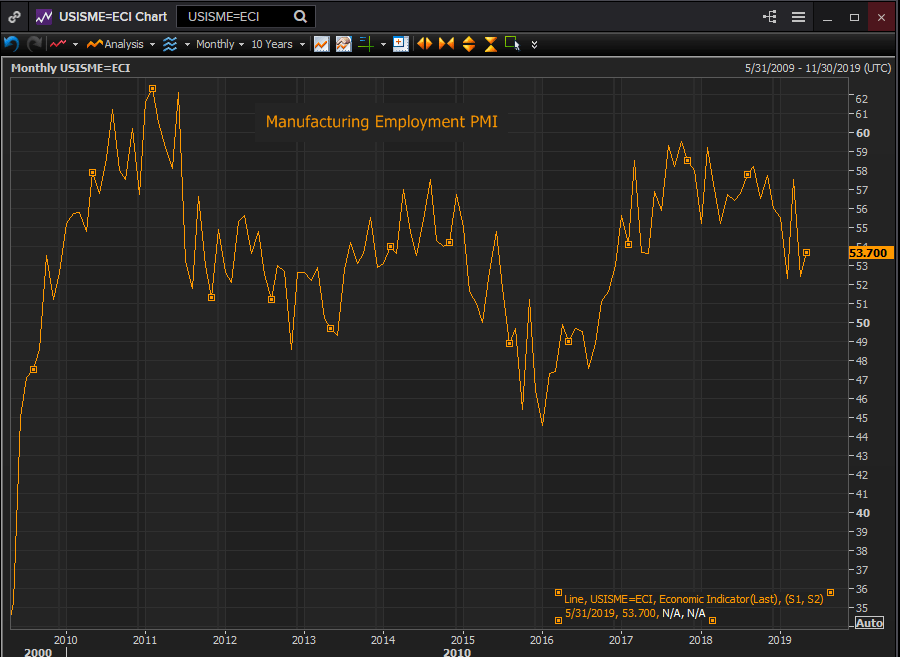
The purchasing managers’ employment index for the manufacturing sector rose slightly in May to 53.7 but it has declined from 58.2 last September and despite the volatility around the government shutdown in January, 52.3 in February followed by 57.5 in March, the trend over the past 18 months has been lower.
Reuters
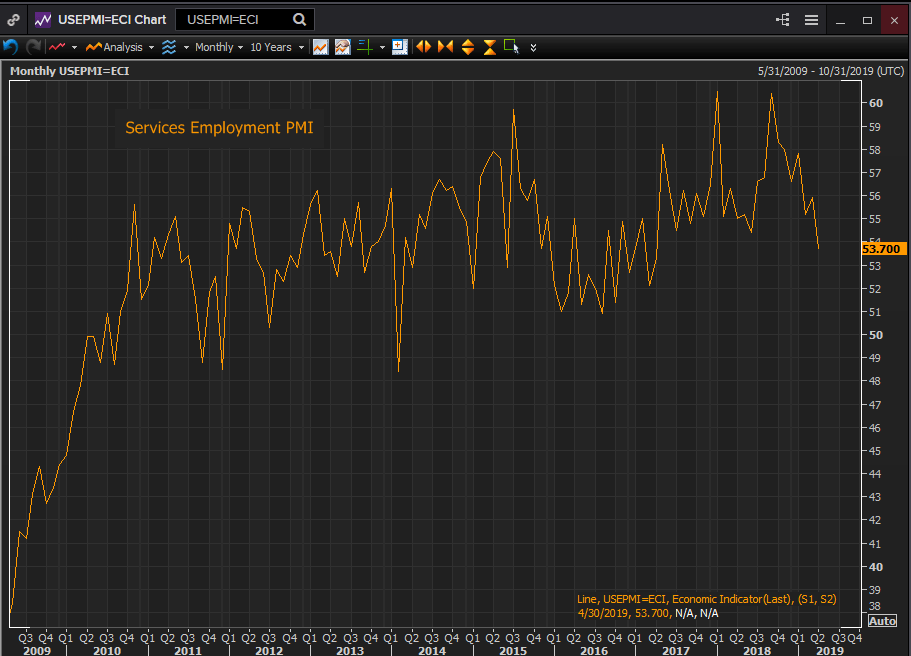
Services employment shows a similar path though the fall-off has been more recent. From 60.4 in September 2018, one-tenth below the post-recession high in January last year, the index fell to 55.2 in February and then 53.7 in April. The May score will be issued on Wednesday June 5th at 8:30 am EDT.
Reuters
Though there has been an appreciable decline in business plans for hiring both indexes remain well above the 50 division between expansion and contraction. After two years of
the best manufacturing growth in a generation fatigue is understandable particularly when accompanied by 18 months of escalation in the trade dispute with China.
Initial Jobless Claims
Countering the moderate retreat in PMI employment levels initial jobless claims, one of the most reliable indicators of the labor market, remain near historic lows. The 4-week moving average in the last week of May at 216,750 is a level that has not been seen in the United States in five decades. In 1969 the US population was 203 million, 38% below its current 328 million.

Reuters
Conclusion
The performance of the US labor market in creating employment over the past two and a half years shows no indication of faltering. If there is a modest drop in job creation as predicted for ADP and NFP in May it will only slide to levels that in other times would be considered excellent.
Author

Joseph Trevisani
FXStreet
Joseph Trevisani began his thirty-year career in the financial markets at Credit Suisse in New York and Singapore where he worked for 12 years as an interbank currency trader and trading desk manager.
















