|

5 reasons AUD/JPY is heading lower

As you may well already know, i am bearish on the likes of the Australian and New Zealand dollar. Back on the 26th October we wrote an article saying to sell the bounce in NZD/USD. Here’s a little excerpt from that article:

“I expect this to be a short-term bounce and will look to re-initiate shorts a little higher up, perhaps close to the 0.7000 handle. A break of the 0.6800 level is expected to bring another momentum move lower”.

That has worked out very nicely indeed. Today I have another potential trade idea for you guys to consider. This time we’re looking to short AUD/JPY.

 From a fundamental standpoint we see AUD lower for many reasons:

  • Weaker-than-expected employment growth. Only 3,700 jobs were added last month compared to 17,800 expected.
  • Wage data remains subdued.
  • AUD has demonstrated an inverse correlation to the US 2year yield, and the stabilising of US core CPI in October will probably lead to a higher core PCE reading next week, adding to AUD weakness.
  • High level of household debt that will put pressure on household spending should the RBA raise interest rates.
  • Positioning in AUD is still long leaving plenty of room for a move lower. We see the 0.77 level as a key support to watch in AUD/USD.

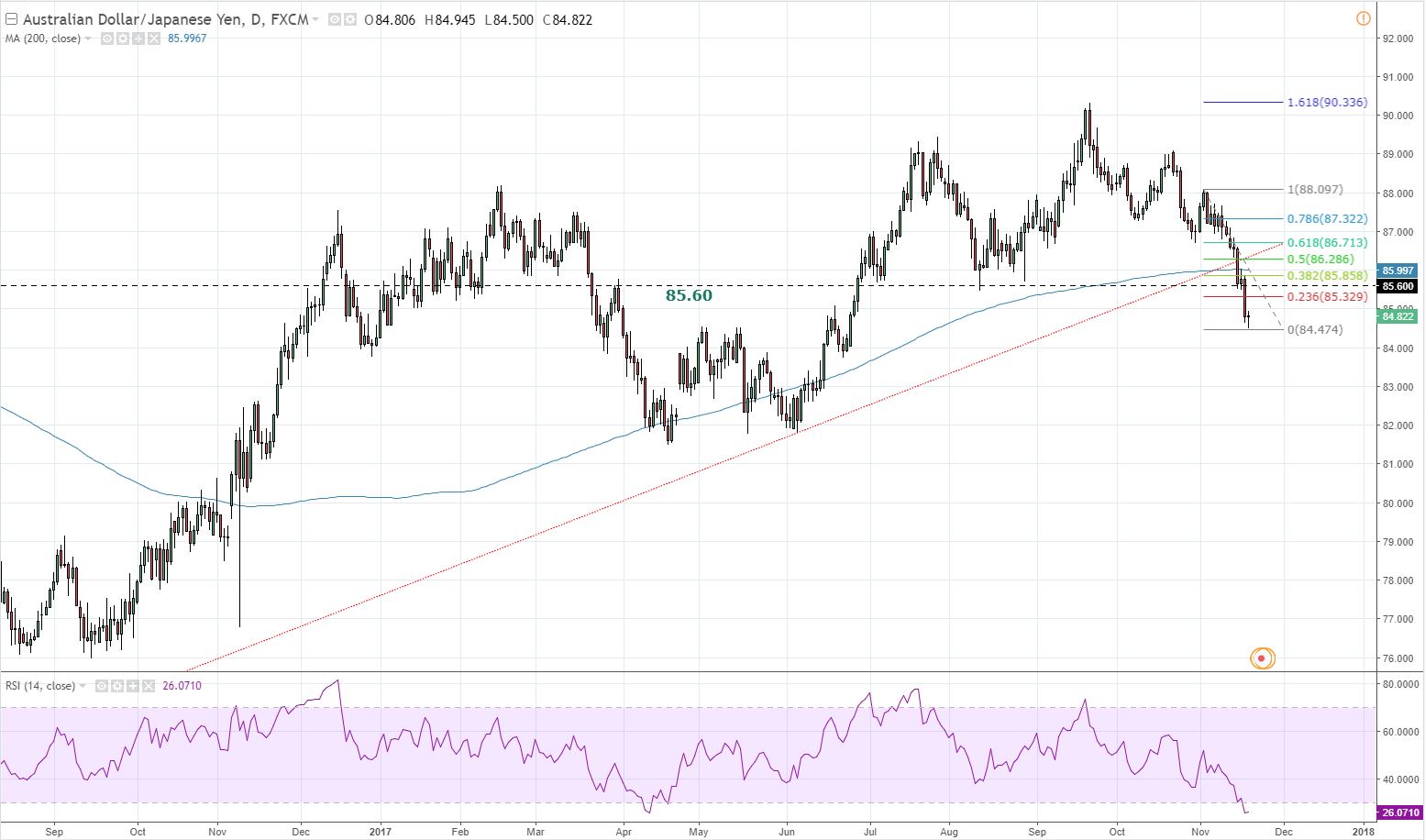
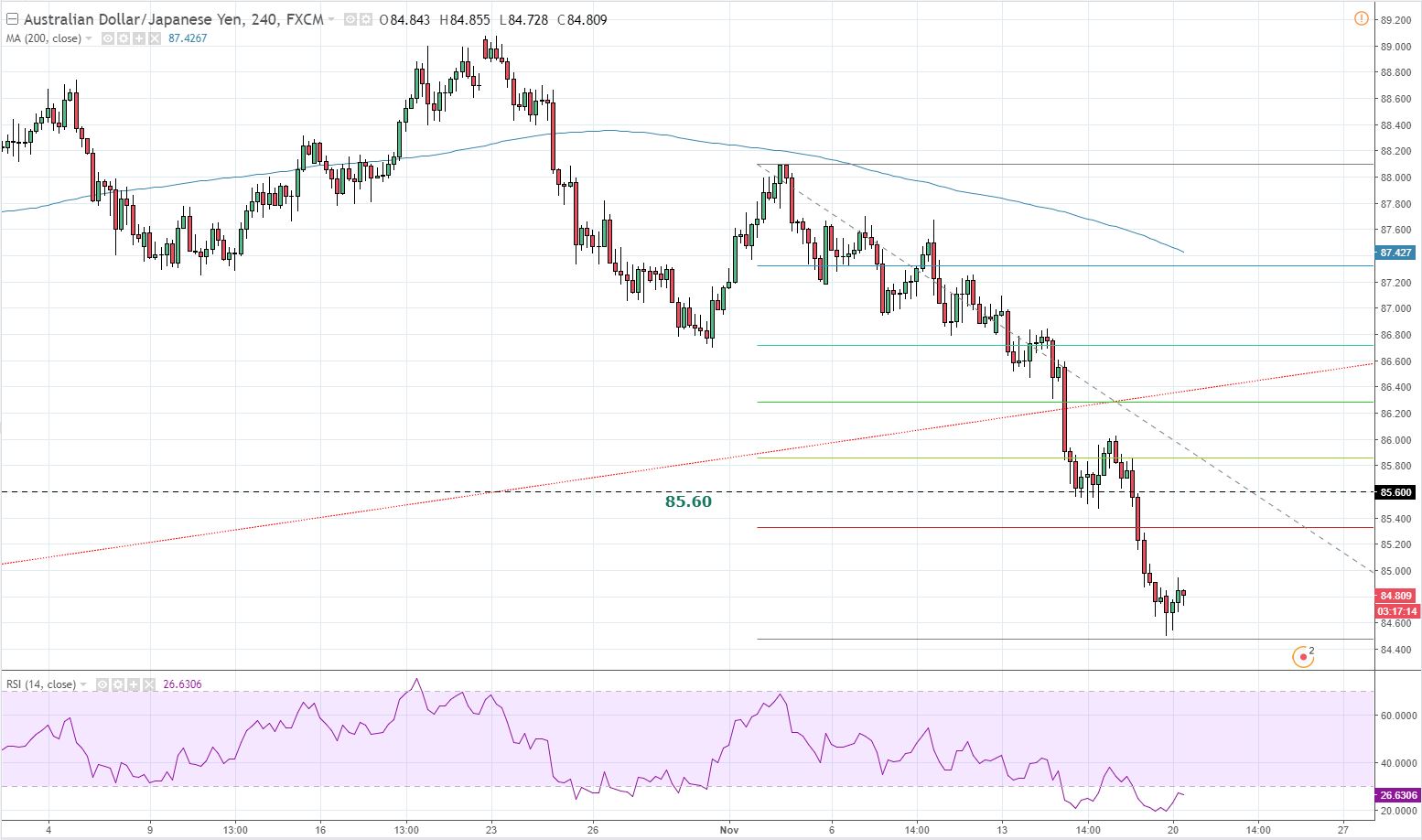
AUD/JPY has broken key trend line support in an impulsive manner suggesting further downside to come. However, right now price is stalling and the RSI on the daily and 4-hour charts is in oversold territory.

With this in mind, we look for a bounce towards the 85.60 level as an opportunity to sell. 85.60 is a previous major support level, it also coincides with the 200-day moving average, and falls between the 23.6 and 38.2 Fib retracement levels.
Chatt

Chart

Author

Nicky Ong

Nicky Ong

Traders Corner

Nicky Ong is a Financial Trader since 2006. Having traded his own book and managed investor funds, he strongly believes in having a logical process to allow for the consistent development of well thought out trade ideas.


More from Nicky Ong
Share:

Editor's Picks

EUR/USD hits two-day highs near 1.1820

EUR/USD picks up pace and reaches two-day tops around 1.1820 at the end of the week. The pair’s move higher comes on the back of renewed weakness in the US Dollar amid growing talk that the Fed could deliver an interest rate cut as early as March. On the docket, the flash US Consumer Sentiment improves to 57.3 in February.

GBP/USD reclaims 1.3600 and above

GBP/USD reverses two straight days of losses, surpassing the key 1.3600 yardstick on Friday. Cable’s rebound comes as the Greenback slips away from two-week highs in response to some profit-taking mood and speculation of Fed rate cuts. In addition, hawkish comments from the BoE’s Pill are also collaborating with the quid’s improvement.

Gold climbs further, focus is back to 45,000

Gold regains upside traction and surpasses the $4,900 mark per troy ounce at the end of the week, shifting its attention to the critical $5,000 region. The move reflects a shift in risk sentiment, driving flows back towards traditional safe haven assets and supporting the yellow metal.

Crypto Today: Bitcoin, Ethereum, XRP rebound amid risk-off, $2.6 billion liquidation wave

Bitcoin edges up above $65,000 at the time of writing on Friday, as dust from the recent macro-triggered sell-off settles. The leading altcoin, Ethereum, hovers above $1,900, but resistance at $2,000 caps the upside. Meanwhile, Ripple has recorded the largest intraday jump among the three assets, up over 10% to $1.35.

Three scenarios for Japanese Yen ahead of snap election

The latest polls point to a dominant win for the ruling bloc at the upcoming Japanese snap election. The larger Sanae Takaichi’s mandate, the more investors fear faster implementation of tax cuts and spending plans. 

XRP rally extends as modest ETF inflows support recovery

Ripple is accelerating its recovery, trading above $1.36 at the time of writing on Friday, as investors adjust their positions following a turbulent week in the broader crypto market. The remittance token is up over 21% from its intraday low of $1.12.














