$20 billion offered, $2 billion taken: Why Treasury doubled its buyback cap

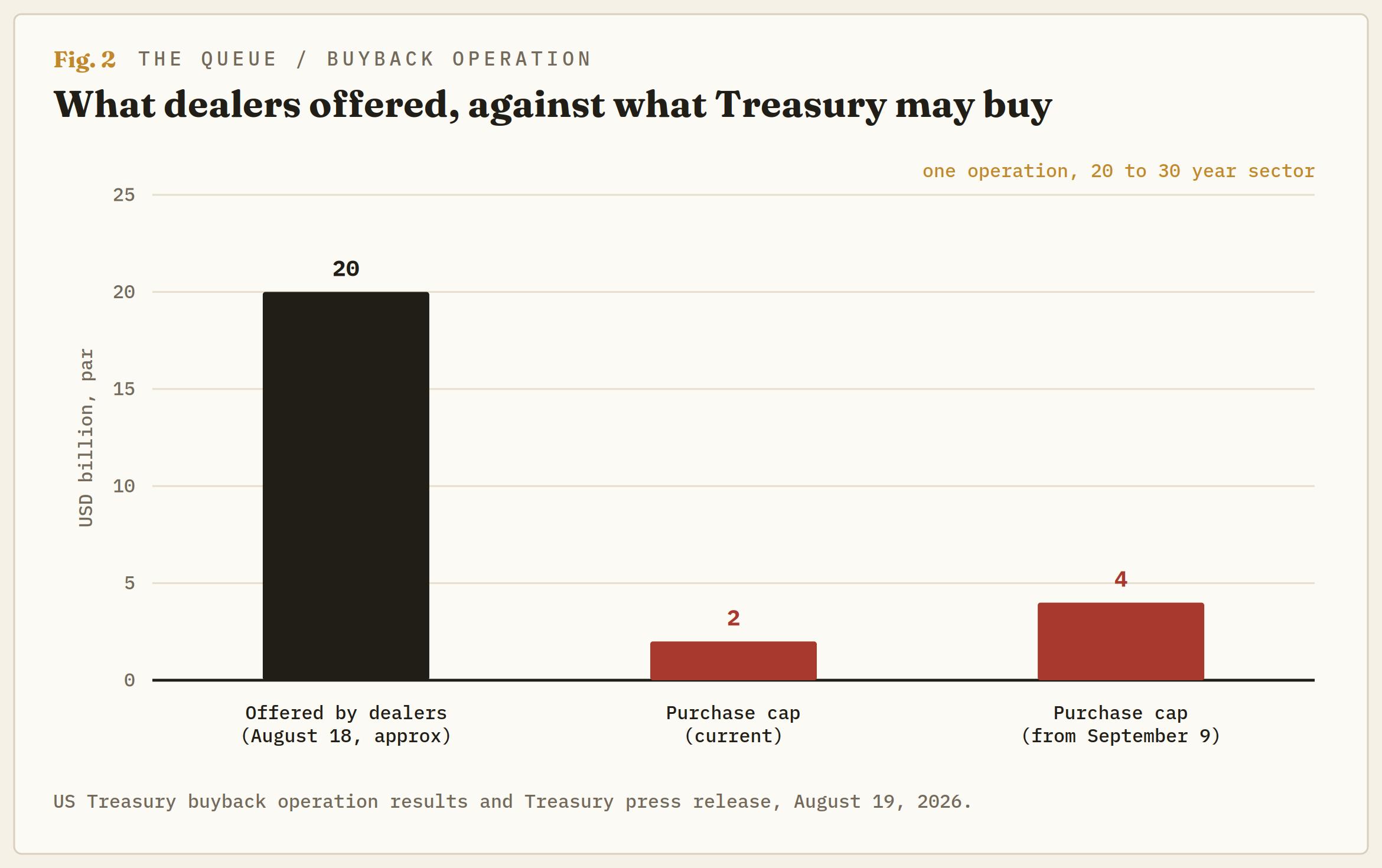
The US Treasury moved off its own calendar on Wednesday, and that is the part worth sitting with. At 12:32 GMT, the department said it would at least double the size of liquidity support buyback operations in the 10-year to 20-year and 20-year to 30-year sectors, lifting the maximum from $2 billion per operation to at least $4 billion, effective September 9 and running to November 4. Buyback parameters are set at the quarterly refunding. This one was revised two weeks after the schedule for the quarter was published.
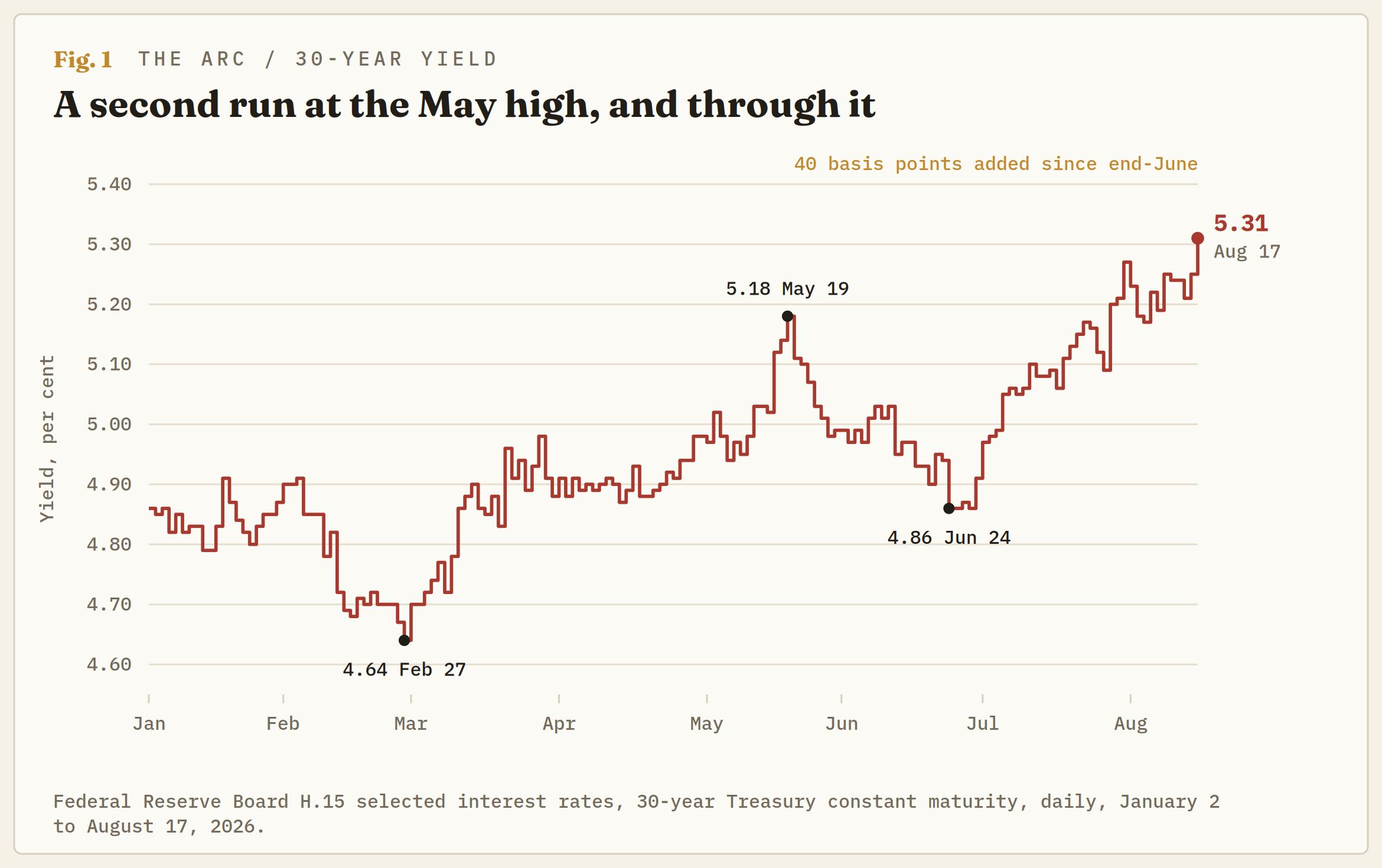
The backdrop is not a bad week. The 30-year has added roughly 40 basis points since the end of June, on its second assault of the year on the May high: turned back from 5.18% in May, bottomed at 4.86% on June 24, then ran to 5.31% by August 17. The first attempt failed. The second has not.
The instrument was already running
The detail that reframes the announcement: a scheduled buyback operation in the 20-year to 30-year sector ran on August 18 at the existing $2 billion size, into the selloff that carried the long bond to a 19-year high. Dealers offered close to $20 billion of paper. Treasury took $1 billion of a bond maturing in 2048 and $1 billion spread across two 2051s, the full permitted amount, and the market went higher in yield anyway.
The tool was not sitting in a drawer waiting to be deployed. It was live, at size, on the day, and it did not hold the line. The following morning it was doubled.
An offer is somebody selling
Treasury's stated reason is that the long-dated sectors show consistent strong sponsorship from market participants, evidenced by the significant volume of high-quality offers it routinely receives. Both halves are true and the conclusion drawn from them is not. An offer in a buyback is a holder asking the government to take paper off its hands. Ten times the permitted size arriving as offers is not a queue of buyers. It is a queue of sellers, and only primary dealers are in it, pricing near the market because the New York Fed evaluates offers on proximity to prevailing prices.
Nor does the demand-to-sell explain the timing, because it has been falling. The August 18 operation drew the smallest volume of offers of any of the eleven conducted in that sector this year. If the case for doubling the cap were that the queue is lengthening, the queue just got shorter.
There is a third document in the way. Treasury's published guidance on the buyback programme states plainly that it does not currently intend to use these operations to mitigate episodes of acute market stress, and defines liquidity support as a regular and predictable opportunity to sell off-the-run securities. Either the long end is not under stress, or the doctrine moved on Wednesday without anyone saying so.
The test came four hours later
The market did not wait for September to grade this. Treasury sold $16 billion of new 20-year bonds at 17:00 GMT, roughly four hours after telling the market it would buy more long paper. The bond cleared 5.204% against a when-issued level near 5.27% on August 14, so the announcement took several basis points off the coupon Washington pays for the next two decades.
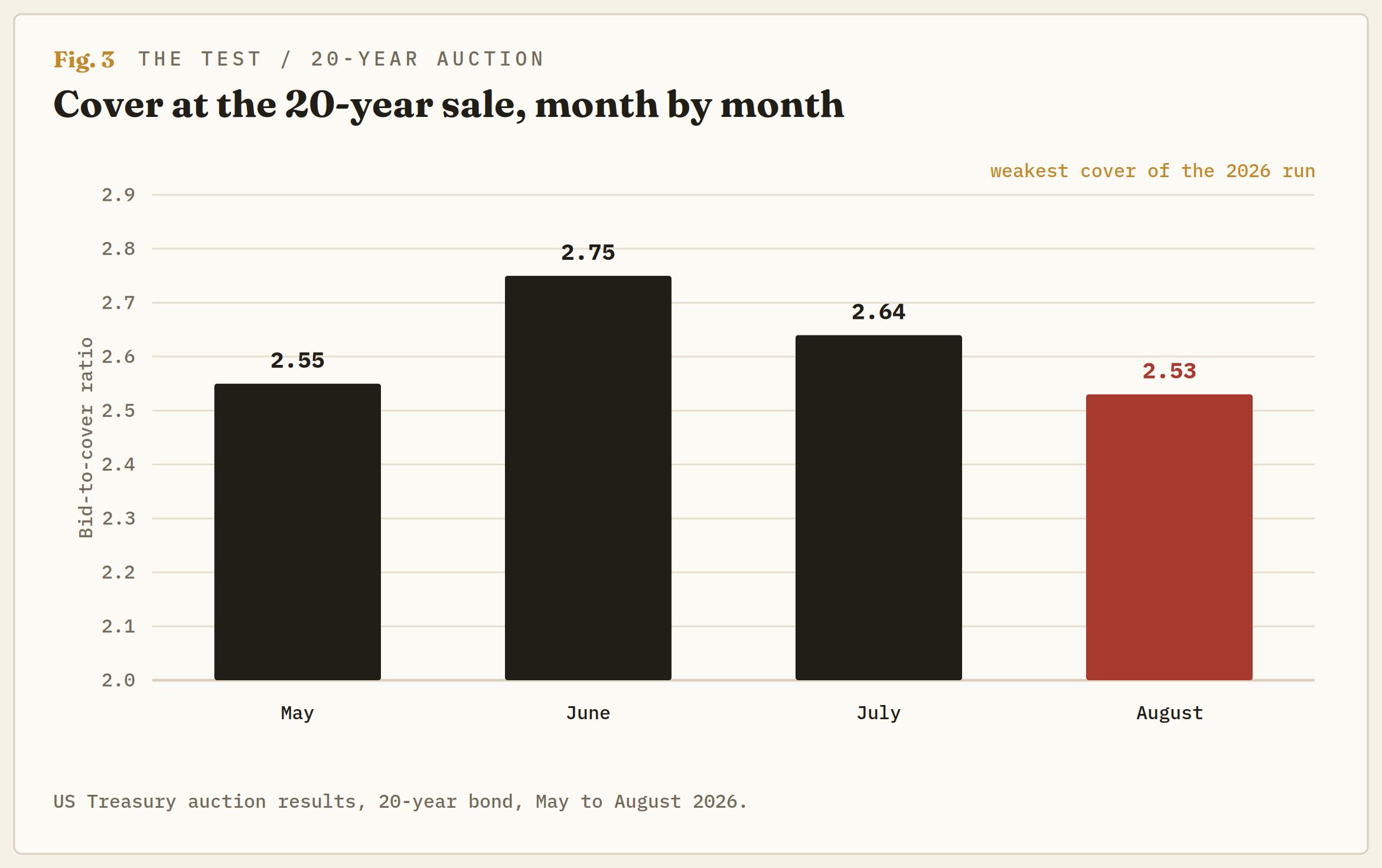
Then it tailed half a basis point anyway. Cover came in at 2.53, the weakest of the 2026 run, against 2.55 in May, 2.75 in June and 2.64 in July. Just under 66% of bids were filled at the high yield, which says the bid thinned out precisely where it mattered.
Who is actually left
The allotment is the more useful line. Indirect bidders, the category that captures foreign central banks and overseas institutions working through the New York Fed, took 62.9%. In June, the same tenor gave them 71.2%. Last week's 30-year sale put them at 66.8%, already under its average. Direct bidders filled the gap at 24.6% and dealers absorbed 12.5%, above their norm for the second long-end auction running.
That is the Treasury International Capital (TIC) data showing up live in an auction book three days after publication. Foreign holdings fell $72.1 billion in June, with Japan cutting $26.4 billion while defending the Yen and China cutting $25.9 billion. The marginal buyer of American duration is now domestic, and domestic buyers price duration off the same real yields that have been climbing all summer rather than off a reserve-management mandate. Substituting one for the other is not a like-for-like swap, and the 8-point drop in the foreign share across two months is what that substitution costs at the margin.
What was actually bought
Strip the announcement back to what changes hands and the arithmetic is thin. Nothing has been bought at the new size. The next 10-year to 20-year operation runs on September 10 and the next in the 20-year to 30-year sector on September 24, so the doubled cap does not touch a bond for three weeks. Against that, the 30-year has come back roughly 9 basis points from the August 17 high and trades near 5.20%.
Which means the market paid for the sentence, not the flow. Two extra billion an operation, four times a quarter, is a rounding error beside the $25 billion of 30-year supply the August refunding alone put on the screen. A signal that cheap moving a market that far says the market wanted to be told something, which is a more fragile foundation than a bid.
It is also worth noting where the relief stopped. Near 5.20%, the long bond sits almost exactly where it was rejected in May and roughly where it traded a week ago. Treasury spent its off-cycle move and bought back a week.
The fork
This resolves on operations, not on levels, and the calendar is short. September 10 is the first test: if offers arrive at multiples of the new $4 billion cap and yields keep climbing regardless, the department has demonstrated that the size was never the constraint and will be asked what else is in the toolkit. If offers thin out and the long end steadies, the announcement will look like well-timed plumbing and the November 4 refunding becomes a formality.
The tell in between is the September 16 rate decision and the auctions either side of it. Watch the indirect share rather than the cover ratio. Cover measures how much paper was waved at the auction, while the allotment measures who was willing to own it afterwards, and the second number has been deteriorating in a straight line since June.
For positioning, the asymmetry runs against fading this rally in the long end on the announcement alone. A durable turn needs the foreign bid to come back, and nothing in the June TIC data, last week's 30-year sale or today's 20-year says it has. A close back above the August 17 high would confirm the buyback did nothing but buy time, and would put the question where it has been heading all summer, which is whether the department is managing liquidity or managing the curve, and whether it intends to admit the difference before November 4.
Author

Joshua Gibson
FXStreet
Joshua joins the FXStreet team as an Economics and Finance double major from Vancouver Island University with twelve years' experience as an independent trader focusing on technical analysis.

















