100: Indian Rupee at record lows and counting towards the critical threshold
The Indian Rupee´s weakness is no news.

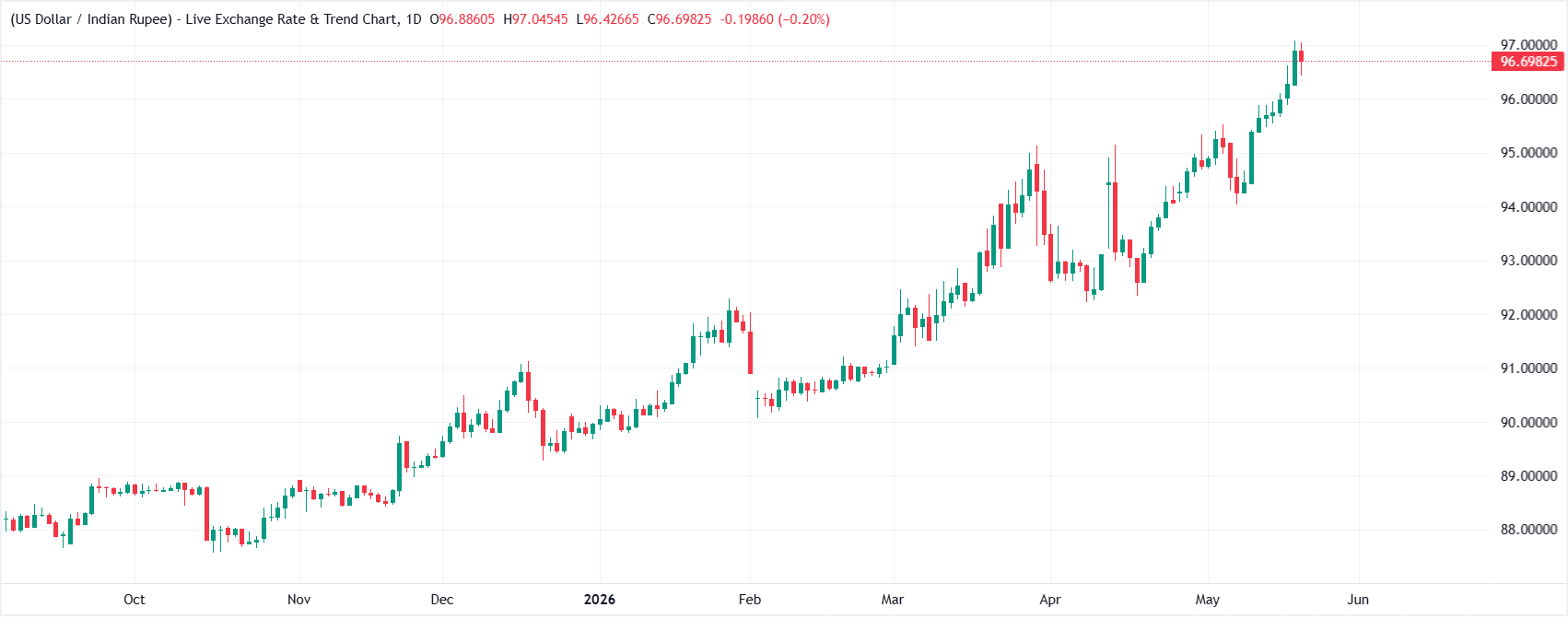
The INR has been under strong selling pressure for pretty much a year, with the bearish trend kicking off in April 2025 and gaining momentum in February 2026. The slump, however, is far from done, and there is more pain in sight for the INR: not only the USD/INR could reach 100.00, but it could also establish above it for good.
The Rupee suffers due to external and internal factors
External factors are easy to explain but hard to comprehend. Internal factors are more complex, but also part of the problem.
The global context explains the broad US Dollar (USD) strength. The Oil war in the Middle East has jeopardized energy supply, boosting prices and hence, pushing inflation out of central banks’ comfort zone.
The country is quite vulnerable to Oil supply disruptions caused by the war, as it imports nearly 85% of its fuel needs and relies on the Strait of Hormuz for about 50% of its crude imports, 60% of its liquefied natural gas, and almost all of its liquefied petroleum gas supplies.
There are, however, some good news: The annual inflation rate surged to 3.48% in April from 3.4% in the previous month, marking the fastest inflation rate in one year, while missing expectations of 3.8%. The Reserve Bank of India (RBI) targets a headline inflation rate of 4%, with a tolerance band of +/- 2%. This means a band between 2% and 6% is tolerable.
Still, the RBI warned in early April that the Iran war had raised inflation worries while also flagging risks to economic growth. The country is the world’s fastest-growing large economy, yet the RBI downwardly reviewed its growth projections for the April-June quarter to 6.8% from 6.9% and for the July-September quarter to 6.7% from 7.0%.
The longer the war continues, the harder it will be for the country to neutralize its impact on economic progress.
Moving into internal factors, corruption and poverty made it to the top of the list. Unfortunately, common in developing countries, systemic corruption is embedded at all levels, public and private. Massive population coupled with a high level of bureaucracy fuels corruption that translates into limited transparency, inflated costs of public projects, and reduced foreign investment.
Regarding poverty, India has significantly reduced it in the last 5 years, but the problem is far from solved. Higher inflation indeed will play a negative role in recent progress.
Even further, Indian Prime Minister Narendra Modi warned recently that decades of hard-won progress against poverty stood at serious risk if the world's cascading crises were not urgently reversed.
“First came the coronavirus pandemic; then wars began to break out, and now there is an energy crisis. This decade is turning into a decade of disasters for the world,” he noted, adding that, if these situations are not rapidly changed, he said, “achievements of the past many decades would be washed away, and a huge section of the world's population would be pushed back into poverty".
The situation is not yet worrisome, but it’s heading that way. With that in mind, further INR weakness and continued USD strength should lead to lower lows ahead for the Asian currency.
The Indian government has taken some measures to cope with the latest global crisis, but there’s little it can do if the situation continues. So far, fuel costs have been hiked, while Gold import taxes have been increased. Authorities may consider encouraging foreign inflows, while the RBI may need to move beyond its current wait-and-see stance.
USD/INR reaching and even surpassing 100 is just a matter of days, unless a sudden agreement between Iran and the United States over the reopening of the Strait of Hormuz.
Author

Valeria Bednarik
FXStreet
Valeria Bednarik was born and lives in Buenos Aires, Argentina. Her passion for math and numbers pushed her into studying economics in her younger years.

















