Dow Jones Industrial Average keeps half a bid nobody made
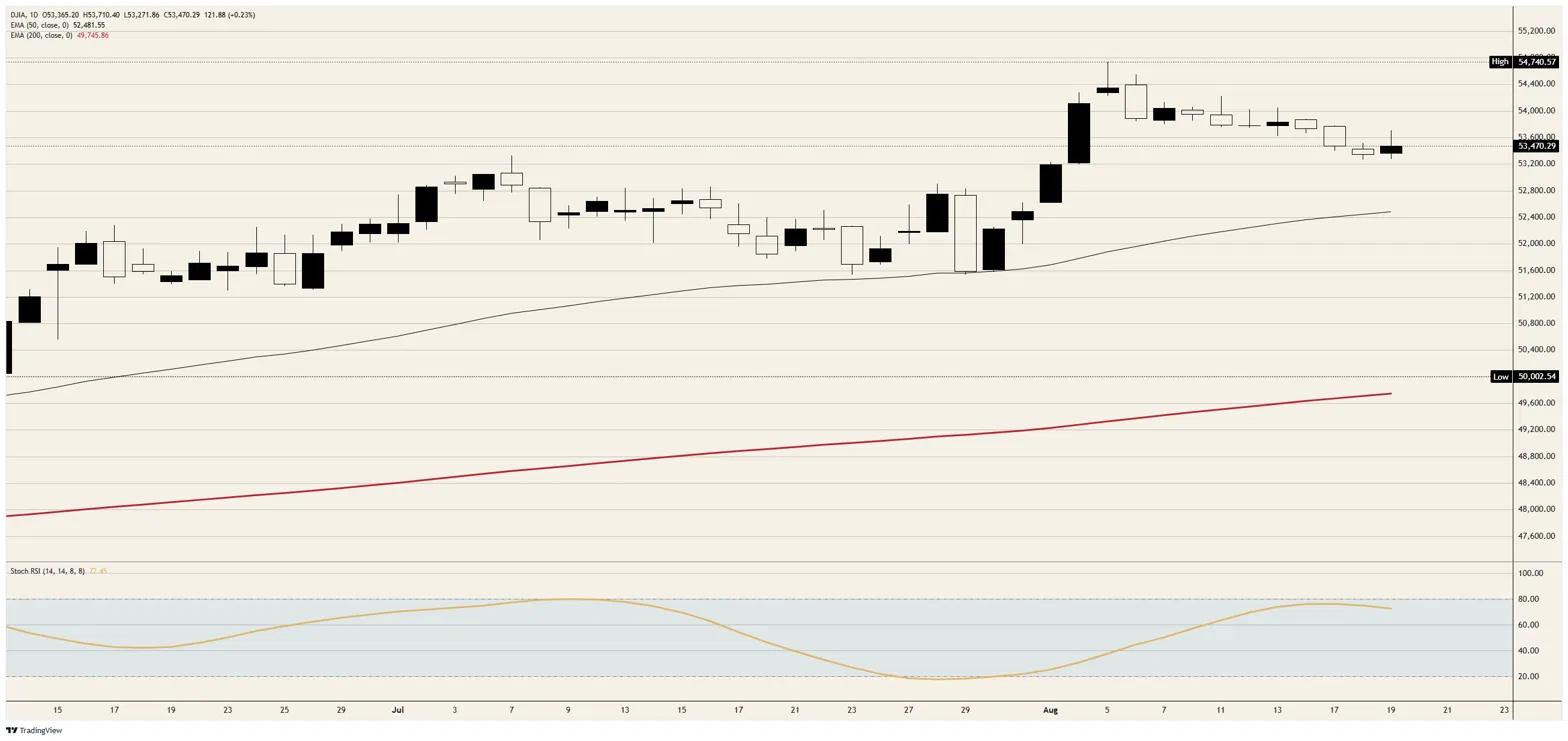
- DJIA holds under 53,500, up 0.23%, after shedding 240 points from the high.
- Treasury doubles its long-bond buyback ceiling to at least 4 billion Dollars.
- FOMC minutes show several policymakers ready to hike and the index barely moved.

The Dow Jones Industrial Average holds just beneath 53,500 on Wednesday, up roughly 120 points and 0.23%, having surrendered more than 240 points from a session high just above 53,700. What put it up there arrived at midday, when the Treasury Department said it will at least double the maximum size of its liquidity-support buyback operations in longer-dated coupons, lifting the ceiling from 2 billion Dollars per operation to at least 4 billion. Roughly half that advance is already gone.
The bid that has not been made
The calendar attached to that announcement is doing none of the work the tape credited it with. Those larger operations do not begin until September 9, run only through November 4, and are revisited at the quarterly refunding on that same date. Not one additional bond has been bought.
The thirty-year bond yield, which printed above 5.33% on Tuesday and its highest since June 2007, gave up more than nine basis points to near 5.19%, and the ten-year note shed around five to near 4.65%. A ceiling rising by 2 billion Dollars per operation moved the long end that far three weeks before the first larger operation runs. That measures how thin the bid has become in a sector running a buyers' strike since late June, not how much demand has returned to it.
A rearrangement, not a paydown
What the Treasury announced is not debt reduction. Repurchasing long-dated coupon paper while refunding the difference at the front of the curve rearranges the maturity schedule rather than shrinking it, and the issuer ends up shortening the average maturity of its own borrowing. A government chooses that when it does not like the price the long end is charging.
The fiscal arithmetic makes the motive legible. July's federal deficit ran 432.3 billion Dollars, the largest monthly shortfall since March 2021, inside a fiscal-year total near 1.8 trillion Dollars, with interest expense already past 1.1 trillion Dollars. Foreign holdings of Treasuries fell in June as the United Kingdom, China and Japan each trimmed. A borrower in that position does not double a facility to be helpful.
The minutes asked for the opposite
Minutes of the July Federal Open Market Committee (FOMC) meeting were published at 18:00 GMT and they read awkwardly against the afternoon that preceded them. Three regional Fed presidents dissented in favour of a quarter-point increase, the first unified three-way dissent since September 2016, and the record shows the hawkish case ran well beyond them, with several policymakers prepared to tighten and some doubting that financial conditions were tight enough to return inflation to 2%.
Those conditions include the long end, and the chair has said the tightening delivered by the bond market was doing part of the committee's work for it. The fiscal authority spent Wednesday undoing a piece of that. Duration support supplied by the issuer is accommodation arriving through another door, and no member of the committee voted for it. The index did not move on the release at all.
Where the points came from
The session's largest single-name move delivered the index nothing. Moderna (MRNA) surged more than 175%, its best day on record, after a personalized cancer therapy developed with Merck (MRK) cut the risk of melanoma recurrence in a late-stage trial. Moderna sits outside the thirty. Merck sits inside it, gained around 12%, and was the largest single contributor to a roughly 120-point advance.
The pattern repeated on the other side of the tape. Lowe's (LOW) fell close to 2% on soft full-year guidance and cost the index nothing, because the home improvement member is Home Depot (HD), which reported a day earlier. Healthcare led all eleven S&P 500 sectors to a record, and the Dow's share of it arrived through essentially one name. Whatever separates the averages on a session like this is membership rather than the economy.
The rest of the week
Initial jobless claims are forecast at 210K on Thursday at 12:30 GMT against 209K, alongside a Philadelphia Fed manufacturing survey expected at 25 after 41.4, which would be a severe give-back inside a single month. A regional Fed president speaks at 15:10 GMT. Friday brings the preliminary August S&P Global Purchasing Managers Index (PMI) surveys at 13:45 GMT, manufacturing expected at 53.8 from 53.9 and services at 54 from 54.6, against a composite prior of 54.5.
Levels
Resistance: Just above 53,700 marks the session high, and the 53,800 area beyond it has turned back every attempt since the middle of the month. Above that, 54,100 is the early-August ledge and the record sits just short of 54,750.
Support: The 53,250 area held the session low, printed inside the opening half hour, with the 53,000 handle beneath it. The 50-day Exponential Moving Average (EMA) near 52,500 is the first structural floor and is rising, with the 200-day near 49,750 far below.
Bias: Bearish while the 53,800 area caps. The daily Stochastic Relative Strength Index (Stoch RSI) at 72.45 sits in the upper band with no new high beneath it, and a rally that surrendered more than half its gain on the same day its catalyst landed has already priced what that catalyst is worth. Objectives are the 53,250 area then the 53,000 handle. Invalidation is a daily close above 53,900.
Dow Jones daily chart
Dow Jones FAQs
The Dow Jones Industrial Average, one of the oldest stock market indices in the world, is compiled of the 30 most traded stocks in the US. The index is price-weighted rather than weighted by capitalization. It is calculated by summing the prices of the constituent stocks and dividing them by a factor, currently 0.152. The index was founded by Charles Dow, who also founded the Wall Street Journal. In later years it has been criticized for not being broadly representative enough because it only tracks 30 conglomerates, unlike broader indices such as the S&P 500.
Many different factors drive the Dow Jones Industrial Average (DJIA). The aggregate performance of the component companies revealed in quarterly company earnings reports is the main one. US and global macroeconomic data also contributes as it impacts on investor sentiment. The level of interest rates, set by the Federal Reserve (Fed), also influences the DJIA as it affects the cost of credit, on which many corporations are heavily reliant. Therefore, inflation can be a major driver as well as other metrics which impact the Fed decisions.
Dow Theory is a method for identifying the primary trend of the stock market developed by Charles Dow. A key step is to compare the direction of the Dow Jones Industrial Average (DJIA) and the Dow Jones Transportation Average (DJTA) and only follow trends where both are moving in the same direction. Volume is a confirmatory criteria. The theory uses elements of peak and trough analysis. Dow’s theory posits three trend phases: accumulation, when smart money starts buying or selling; public participation, when the wider public joins in; and distribution, when the smart money exits.
There are a number of ways to trade the DJIA. One is to use ETFs which allow investors to trade the DJIA as a single security, rather than having to buy shares in all 30 constituent companies. A leading example is the SPDR Dow Jones Industrial Average ETF (DIA). DJIA futures contracts enable traders to speculate on the future value of the index and Options provide the right, but not the obligation, to buy or sell the index at a predetermined price in the future. Mutual funds enable investors to buy a share of a diversified portfolio of DJIA stocks thus providing exposure to the overall index.
Author

Joshua Gibson
FXStreet
Joshua joins the FXStreet team as an Economics and Finance double major from Vancouver Island University with twelve years' experience as an independent trader focusing on technical analysis.

















