115 words, six meetings: Why the Fed keeps shrinking the record
The July minutes arrived on Wednesday and the line that matters sits near the end, in the paragraph most readers will already have scrolled past. The Chairman told the Federal Open Market Committee (FOMC) that six scheduled meetings a year, held roughly every two months, would let more information accumulate between them and give policymakers and staff more time on strategic questions. He asked for input. No decisions were taken and nothing changes for 2026.
Read alone it is a housekeeping note. Read against the eight weeks behind it, it is the fourth item on a list. Since June 17, this Fed has retired forward guidance, cut its statement to roughly 115 words and skipped the July projections. The calendar is next.
The channels this Fed has already shut
Each removal is defensible on its own terms. Guidance committing a committee to a path it may not want is a liability when supply shocks keep arriving. A statement that says less cannot be over-parsed. Projections invite readers to trade the dots rather than the data. Taken one at a time, each is an argument a serious central banker can make.
Taken together, they describe a Committee that has been steadily reducing the number of occasions on which it is obliged to explain itself. The case for six meetings follows the same logic, and it is not a bad one: more data between decisions, less pressure to act on noise. The cost is arithmetic. A committee meeting eight times a year has eight scheduled opportunities to change its mind. One that meets six has six, and it has just recorded a three-way dissent, which is not the profile of a body needing fewer chances to argue.
The irony is built into the document itself. The minutes are the last channel this regime has not compressed, and they are where the compression of the next one was announced.
Nineteen speak, twelve vote
The July decision went 9-3, with Beth Hammack, Neel Kashkari and Lorie Logan preferring a quarter-point increase. That tally counts members. Participants is the wider set, and the gap is where the document leaks.
Nineteen people sit at the table and twelve of them vote. The minutes credit several participants with favouring an immediate increase, then describe a few of those participants as holding a particular rationale, that moving now would forestall a steeper sequence later. A few is a subset of several, which means several is larger than a few, which puts the hawkish bloc at four or more. Only three could vote for it. At least one non-voting president wanted a hike at that meeting and had no way to register it.
The larger number is the one to carry forward. Many participants judged that tightening would likely be necessary if inflation did not decline, and some questioned whether financial conditions are restrictive enough to return inflation to 2% at all. Many is a bigger set than several. The hike did not lose nine to three. It lost on timing, with conditional support from most of the room.
The dissent that never reached a tally
Here is the detail nobody will pull. On the June language committing the Committee to delivering price stability, the minutes record that almost all members agreed it was appropriate to retain it in July.
Almost all of twelve is not twelve. At least one member who voted for the decision did not want that sentence in the statement, and no vote anywhere records it. The statement everyone reported as frozen had its own quiet split on the single most load-bearing phrase in it. In a regime that has removed every other channel, the wording of a 115-word statement is not a detail. It is most of what is left, and it was not unanimous.
The labour paragraphs are the ones to reread
The Committee's read of the labour market on July 29 was that conditions were stable, with demand and supply in balance and payroll gains having strengthened this year. Some participants went further, treating the broadening of gains beyond health care and social assistance as evidence of modest strengthening. A few noted lingering softness, specifically the low job-finding rate and a persistently elevated long-term unemployment rate.
Nine days later, payrolls printed -23,000, the first negative month since December and the fourth straight step down from March. The few were right, the room was wrong, and the room sets the rate.
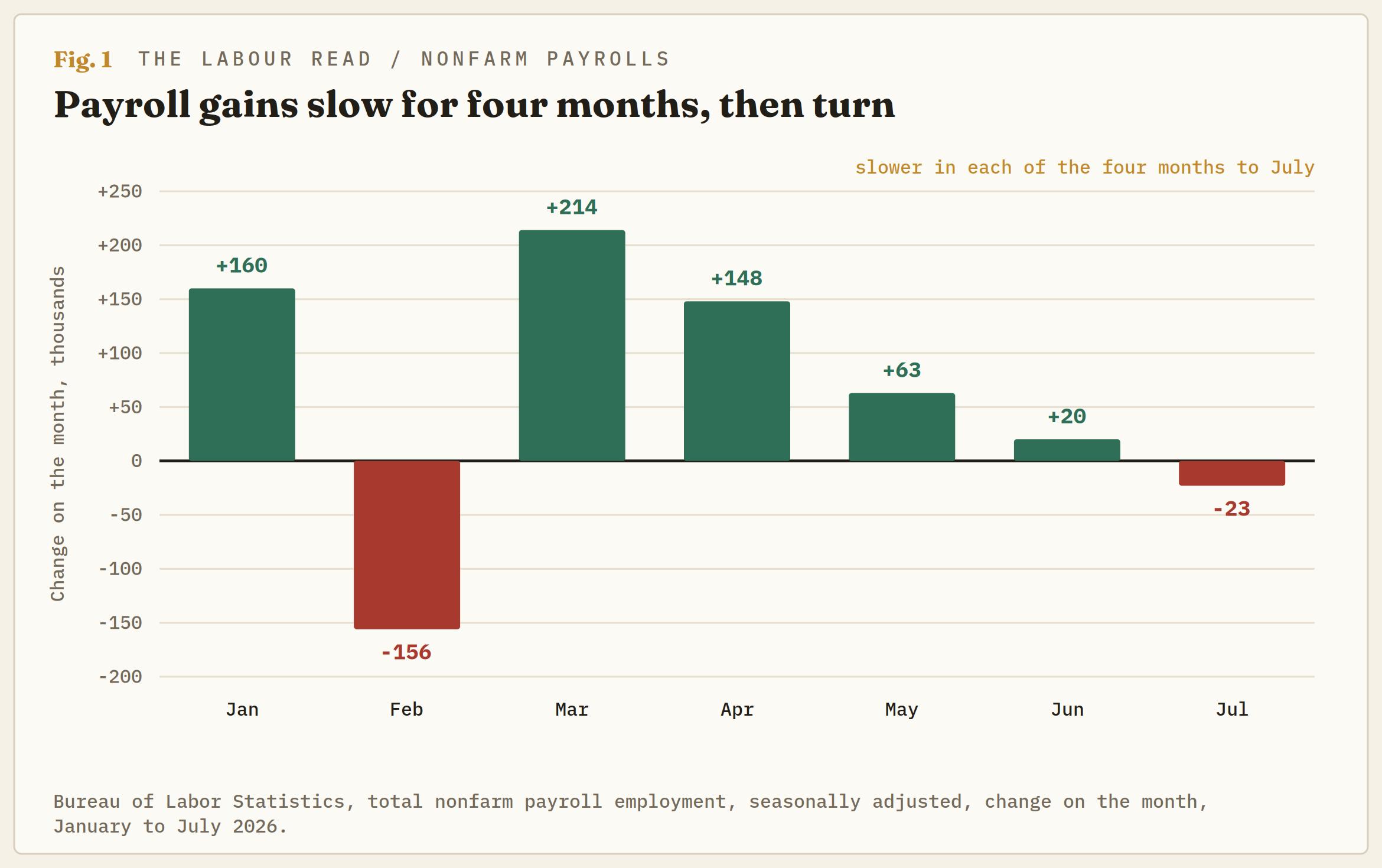
That would be a footnote if the measurement itself were reliable, and it is not. The Bureau of Labor Statistics (BLS) publishes its preliminary benchmark revision to the establishment survey at 14:00 GMT on August 28, alongside first-quarter Quarterly Census of Employment and Wages (QCEW) data, the near-universal count the benchmark is drawn from. That lands inside Jackson Hole. The BLS has already said falling household survey response rates make its precision target hard to hold and has changed its accuracy goal for the current fiscal year. A Committee that has launched a task force on data sources is about to find out how much of its July labour picture survives contact with the count.
The dealers were right and the curve was wrong
The market context in the document is worth the price of admission. At the meeting, pricing carried roughly a one-in-three chance of a July move, a full quarter-point increase by September, and another by the end of the first quarter of 2027. The median respondent to the Desk's own survey of market expectations saw none of it: no change this year or next, and a cut in early 2028.
Three weeks on, the survey is winning. The September hike has been priced out and the move has slid into 2027. That is an unusual direction of travel, because the curve is normally the thing that gets it right.
The Committee also logged that Treasury yields rose 25-30 basis points over the intermeeting period, driven by real rates rather than inflation compensation, and that various participants judged financial conditions had tightened. Most participants discussed balance sheet policy and deferred it, listing the appropriate maturity composition of the Fed's own Treasury holdings among the open questions for a task force and future meetings. That question did not stay open for long, and it was not the Fed that answered it.
What resolves this
Two dates. September 16 tells you whether the conditional hawks convert, and the tell is not the decision but the dissent count: a 9-3 that becomes 8-4 with inflation still elevated says the many are becoming the several, regardless of where the funds rate sits. August 28 tells you whether the labour reading that underwrites the hold was ever there.
The fork worth positioning around is not hawkish against dovish. It is whether a committee this split can keep operating a communications regime this thin. Fewer meetings, a shorter statement and no projections work when a Committee agrees. This one does not, and the pressure has to go somewhere. On current form, it is going into the minutes, three weeks late, which is a strange place for the most informative thing a central bank says.
Author

Joshua Gibson
FXStreet
Joshua joins the FXStreet team as an Economics and Finance double major from Vancouver Island University with twelve years' experience as an independent trader focusing on technical analysis.