|

Zigzag structure in Russell Futures (RTY) nears resolution around 2300 [Video]

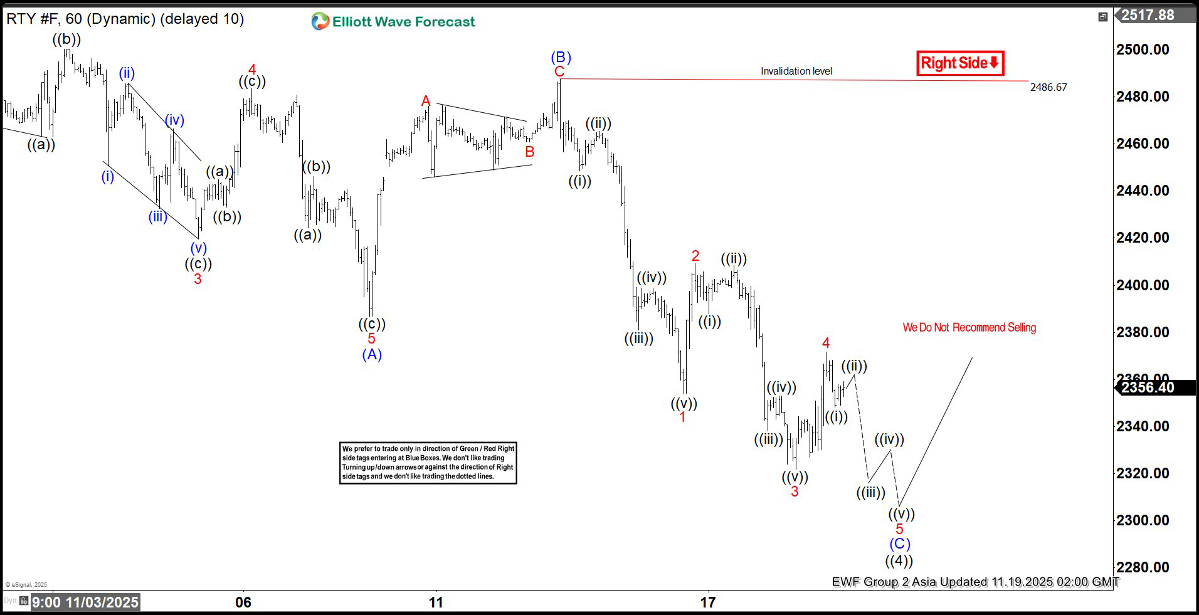
The short-term Elliott Wave outlook for the Russell 2000 Index (RTY) indicates that the decline from the October 25, 2025 peak is unfolding as a zigzag corrective structure. From that high, wave 1 concluded at 2473.9, followed by a corrective rally in wave 2 that terminated at 2517.2. The Index then extended lower in wave 3, reaching 2419.6. A brief recovery in wave 4 ended at 2483.4, while the final leg, wave 5, completed at 2386.6. This sequence marked the completion of wave (A) at a higher degree.

Subsequently, the Index corrected higher in wave (B), which concluded at 2486.67, as illustrated in the accompanying one-hour chart. From that point, the Index has resumed its descent in wave (C), which is unfolding internally as a five-wave diagonal. Within this structure, wave 1 ended at 2353.8, and the corrective rally in wave 2 peaked at 2409.1. Wave 3 then declined to 2321.9, followed by a modest rebound in wave 4 to 2371.6.

The Index is expected to extend lower in wave 5, thereby completing wave (C) of ((4)). The projected downside target lies within the 100%–161.8% Fibonacci extension range from the October 27 peak, spanning 2316.3 to 2307.4. In the near term, as long as the pivot high at 2486.6 remains intact, any rally is anticipated to fail in three, seven, or eleven swings, paving the way for further downside pressure.

Russell 2000 Futures (RTY) 60-minute Elliott Wave chart from 11.19.2025
Russell 2000 Futures Elliott Wave [Video]

Youtube preview

Author

Elliott Wave Forecast Team

Elliott Wave Forecast Team

ElliottWave-Forecast.com

More from Elliott Wave Forecast Team
Share:

Editor's Picks

GBP/USD remains offered; bears target 1.3600

GBP/USD now leaves behind part of its recent recovery and revisits the low 1.3600s at the beginning of the week. Indeed, Cable trades with a mild downward bias amid decent gains in the Greenback as investors remain wary of upcoming US data releases and the Jackson Hole event.

EUR/USD remains sidelined above 1.1650

EUR/USD trades on the defensive following the closing bell on Wall Street on Monday, hovering around the 1.1660 region and adding to Friday’s small decline. The pair’s pullback comes in response to an acceptable rebound in the US Dollar in a context of generalised caution ahead of key US data releases and Chair Warsh’s speech in Jackson Hole.

Gold advances to over three-month high as bulls look to reclaim $4,700

Gold climbs to a fresh high since mid-May, with bulls now eyeing $4,700 and extending the rally witnessed since the beginning of this month. The US Treasury's bond market intervention failure fuels concerns about fiscal sustainability and boosts demand for bullion as an alternative store of value. Moreover, the US Dollar struggles to attract any meaningful buyers, which, along with receding bets for an immediate Fed rate hike, continues to benefit the non-yielding yellow metal.

Ethereum: BitMine scoops 32K ETH, hints at further gains
Ethereum (ETH) treasury company BitMine Immersion Technologies (BMNR) expanded its digital asset holdings last week with another round of acquisitions. The firm purchased 32,447 ETH during the week, lifting its holdings to 5.847 million ETH. That represents its largest purchase since the first week of July.
Will Jackson Hole ignite Gold and Silver’s next explosive breakout?
The 2026 Jackson Hole Economic Policy Symposium arrives at a pivotal moment. The U.S economy faces record debt, elevated borrowing costs, a weaker dollar and renewed momentum across hard assets. For The Gold & Silver Club, the backdrop increasingly validates its early-year call: “2026 will be the Year of Hard Assets.”
$20 billion offered, $2 billion taken: Why Treasury doubled its buyback cap

The US Treasury moved off its own calendar on Wednesday, and that is the part worth sitting with. At 12:32 GMT, the department said it would at least double the size of liquidity support buyback operations in the 10-year to 20-year and 20-year to 30-year sectors, lifting the maximum from $2 billion per operation to at least $4 billion, effective September 9 and running to November 4.
















