|

WTI slumps over 2% amid China’s economic slowdown, unexpected PBoC rate cuts

  • China’s central bank slashes key lending rates in response to slowing economic recovery, impacting global oil demand outlook.
  • OPEC+ supply cuts by Saudi Arabia and Russia provide limited support as WTI retreats from YTD highs.
  • Barclay’s revises China’s GDP forecast downwards, while WTI finds some relief in rising Chinese refinery throughput.

Western Texas Intermediate (WTI), the US crude oil benchmark, registers losses of more than 2%, as economic data from China portrays a slowing recovery, while the People’s Bank of China (PBoC) unexpectedly cut rates in key rates to stir the economy after the Covid-19 pandemic. WTI is trading at $80.49 per barrel, down 2.35%.

China’s disappointing Retail Sales and Industrial Production data weigh on crude; PBoC’s rate adjustments add to concerns

The latest round of economic data from China, with Retail Sales coming below estimates and Industrial Production disappointing market participants, spurred a reaction by the PBoC. China’s central bank cut its 7-day lending rates by ten basis points to 2.80% and applied the same measures to the overnight Standing Facility (SLF) rate from 2.75% to 2.65%.

That, alongside the supply cuts implemented by Saudi Arabia and Russia, which are part of the Organization of Petroleum Exporting Countries and its allies (OPEC+), have helped to lend a lifeline to oil’s rally, with prices reversing from year-to-date (YTD) highs.

The investment community’s concern about China’s meeting its 5% growth target in the year would likely pressure WTI’s prices. On Tuesday, Barclay’s cut China’s GDP forecast to 4.5%, citing the ongoing deterioration in the housing market.

Conversely, WTI’s fall was cushioned by the technical support level, and China’s refinery thought, climbing 17.4% in July from a year earlier. WTI traders’ focus shifts to US crude inventories.

WTI Price Analysis: Technical outlook
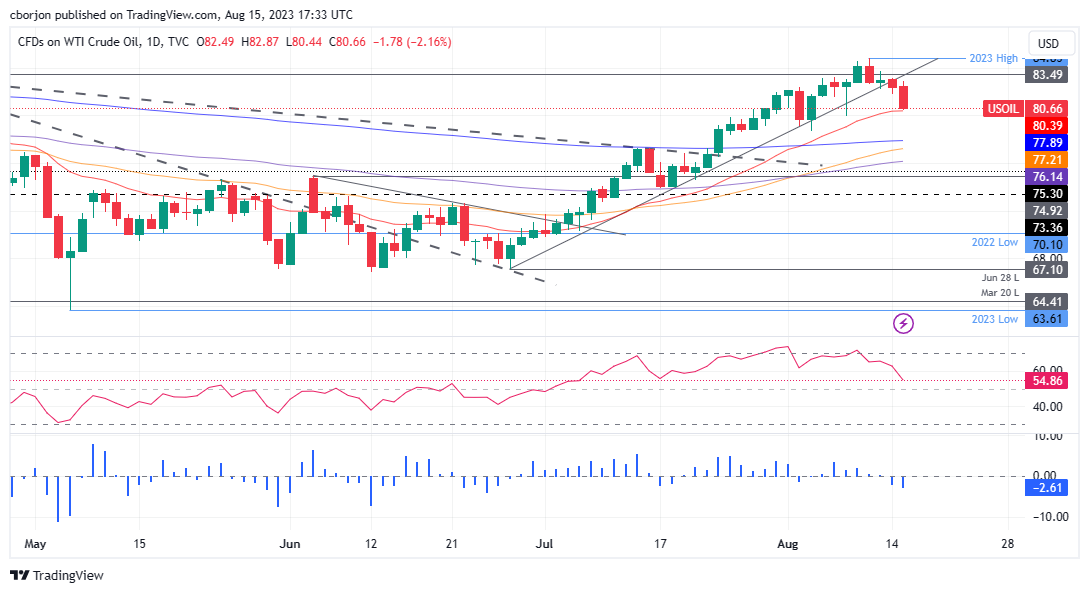
WTI Daily chart

WTI reversed its course and dipped towards the 20-day Exponential Moving Average (EMA( at $80.47 per barrel, seen as first support, which, if broken, can pave the way for WTI to edge below $80.00. A breach of the latter will expose the August 3 daily low of $78.74, followed by the 200-day EMA at $77.89. Conversely, if WTI holds its ground above $80.00, that would be positive for buyers, which could re-test the year-to-date (YTD) high of $84.85, but firstly they need to break above the April 23 daily high of $83.49.

WTI US OIL

Overview
Today last price80.19
Today Daily Change-1.75
Today Daily Change %-2.14
Today daily open81.94
 
Trends
Daily SMA2080.13
Daily SMA5074.92
Daily SMA10074.88
Daily SMA20076.26
 
Levels
Previous Daily High82.6
Previous Daily Low81.27
Previous Weekly High84.32
Previous Weekly Low79.66
Previous Monthly High81.78
Previous Monthly Low69.77
Daily Fibonacci 38.2%81.78
Daily Fibonacci 61.8%82.09
Daily Pivot Point S181.28
Daily Pivot Point S280.61
Daily Pivot Point S379.95
Daily Pivot Point R182.61
Daily Pivot Point R283.27
Daily Pivot Point R383.94

Author

Christian Borjon Valencia

Markets analyst, news editor, and trading instructor with over 14 years of experience across FX, commodities, US equity indices, and global macro markets.


More from Christian Borjon Valencia
Share:

Editor's Picks

AUD/USD stabilizes near 0.7100 as the post-Fed USD rally pauses

AUD/USD consolidates the previous day's losses near 0.7100 in the Asian session on Thursday as the US Dollar pauses its hawkish Fed-inspired rally to its highest level since late July. However, RBA rate-hike bets and hopes for US-Iran diplomatic efforts lift risk sentiment and support the risk-sensitive Australian Dollar and the major.

USD/JPY reverses a dip below 156.00 as focus shifts to BoJ

USD/JPY is reversing a brief dip below 156.00 in the Asian session on Thursday, looking to snap a three-day winning streak to a nearly two-week top set the previous day. The US Dollar pauses following the post-Fed rally to seven-week highs, while a more hawkish repricing of the BoJ's policy normalization path supports the Japanese Yen. This keeps the pair's upside limited, with the focus now shifting to the BoJ policy decision due on Friday.

Gold bounces but not out of the woods yet

Gold is facing fresh sellers above $4,300 early Thursday, stalling its recovery from six-week lows of $4,235 reached soon after hawkish US Federal Reserve monetary policy announcements.

Bitcoin, crypto market see muted activity following FOMC rate hike

Bitcoin traded above $76,000 on Wednesday as the Federal Reserve raised its benchmark interest rate by 25 basis points, bringing the federal funds target range to 3.75%-4.00%. The unanimous 12-0 decision marked the Fed’s first rate hike since July 2023.

The Fed rate hike: What happens now?
The dust has settled on tonight’s Fed meeting and the market reaction is clear: the Fed’s signal that there could be a series of rate hikes has spooked financial markets. Bonds sold off at the short end of the Treasury curve and US stocks also fell, led by the Dow Jones Industrial Average, which slipped more than 1% on Wednesday night.
How Japan became the World's Banker and why that era may be ending

Japan's ultra-low interest rates helped finance trillions of dollars in global investments for more than a decade, making the Japanese Yen one of the world’s cheapest sources of funding. With the Bank of Japan expected to tighten policy again this week, that advantage may be entering a new phase. While most major economies raised interest rates, Japan remained the world's outlier.