WTI rises as geopolitical tensions ahead of US-Russia summit offset bearish fundamentals
- WTI Crude Oil climbs above $63.00, up 1.50%, after rebounding from its lowest level in over two months.
- Geopolitical tensions rise ahead of Friday’s US–Russia summit in Alaska; Trump warns of possible sanctions if talks fail.
- CNN reports Trump threatened “very severe” consequences if Russia does not halt its Ukraine offensive, raising risk of tighter sanctions on Russian energy exports.

West Texas Intermediate (WTI) Crude Oil edges higher on Thursday, supported by heightened geopolitical tensions ahead of the Friday US-Russia summit in Alaska. At the time of writing, WTI trades near $63.00 per barrel, up around 1.50% on the day, after touching its lowest level in over two months on Wednesday.
Comments from US President Donald Trump ahead of the meeting added to the geopolitical risk premium. Speaking to Fox News Radio, Trump said secondary sanctions on India had influenced Russian President Vladimir Putin’s decision to attend, and while an immediate ceasefire was unlikely, he was more interested in securing a swift peace deal. Trump added that this meeting would set the stage for a second round of talks to “make a deal” and warned that sanctions would be imposed if no resolution was reached.
Separately, CNN reported on Wednesday that Trump warned of “very severe” consequences should Russia refuse to halt its military offensive in Ukraine, raising the prospect of tighter sanctions on Russian energy exports.
However, gains remain limited as bearish fundamentals continue to overshadow the broader outlook. The latest US Energy Information Administration (EIA) report showed a surprise build of 3 million barrels in commercial crude stockpiles last week, defying expectations for a draw. The agency’s updated Short-Term Energy Outlook projects WTI prices will fall below $60 by September and remain under $50 for most of 2026, driven by persistent supply growth from OPEC+ producers and non-OPEC output.
Concerns that tariffs could slow global economic activity are acting as a drag on oil prices, while futures market trends indicate that the premium for near-term deliveries over later-dated contracts has been shrinking. This narrowing gap signals that traders expect supply to become more plentiful relative to demand as summer consumption eases.
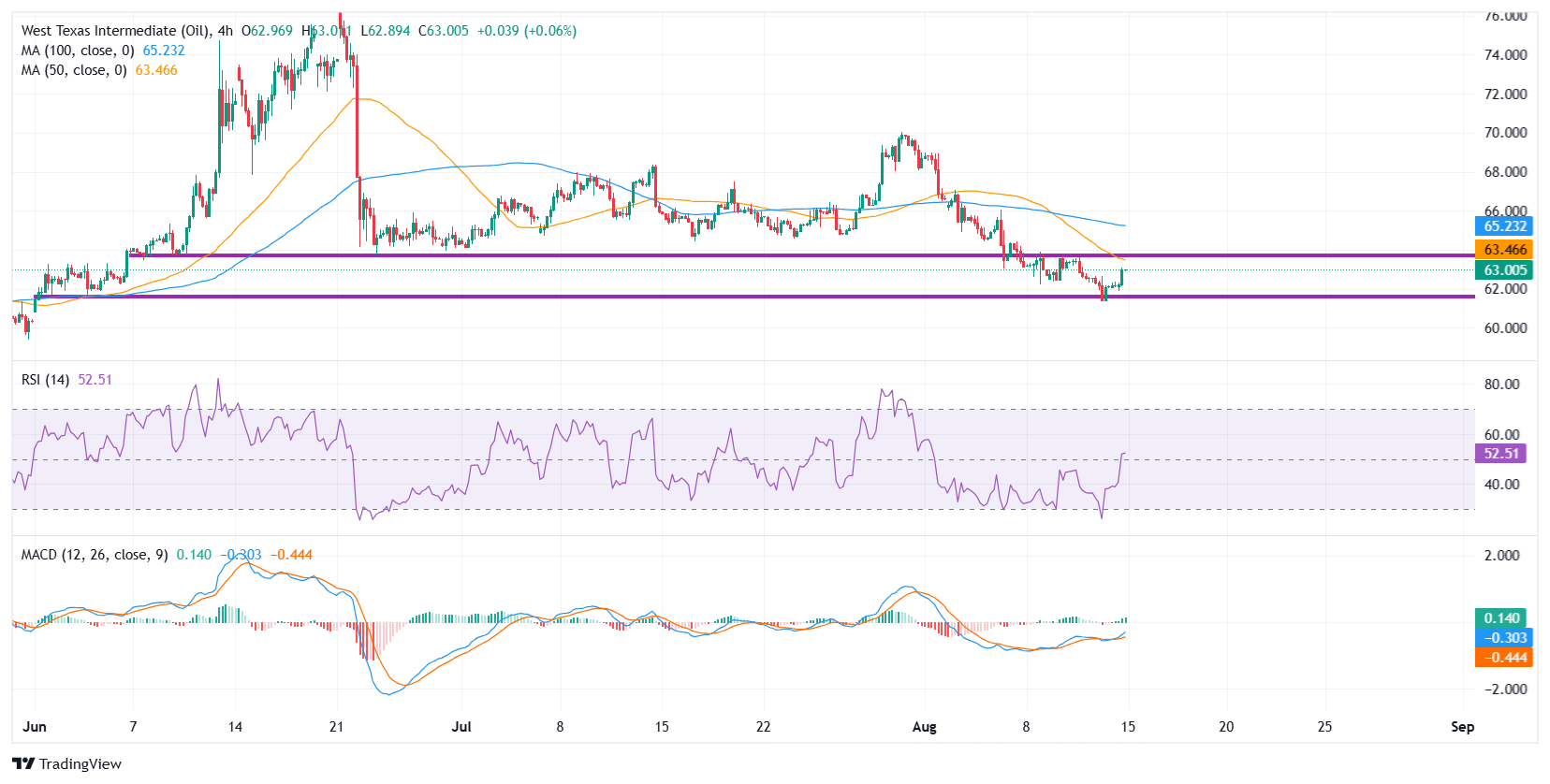
From a technical perspective, WTI is bouncing off its lowest level in over two months after defending horizontal support near $61.50. On the 4-hour chart, immediate resistance aligns at $63.40-$63.50, reinforced by the 50-period Simple Moving Average (SMA). A sustained break above this zone could pave the way for a test of the 100-period SMA near $65.23.
Momentum signals are improving, with the Relative Strength Index (RSI) recovering to 52.51 and the Moving Average Convergence Divergence (MACD) signaling the early stages of a bullish crossover. On the downside, a break below $61.50 would expose the next key psychological support at $60.00, followed by the May low near $59.50.
Author

Vishal Chaturvedi
FXStreet
I am a macro-focused research analyst with over four years of experience covering forex and commodities market. I enjoy breaking down complex economic trends and turning them into clear, actionable insights that help traders stay ahead of the curve.