|

WTI Price Analysis: 100-SMA, previous hurdle back buyers around $68.00

  • WTI remains sidelined after two-day downtrend, defends bounce off short-term key supports.
  • Steady RSI adds to the bullish bias amid sustained trading beyond important supports.

WTI seesaws around $68.10, after a two-day downtrend, during Thursday’s Asian session.

In doing so, the oil benchmark defends the previous day’s U-turn from 100-SMA and the resistance-turned-support from August 06 amid steady RSI.

Given the quote’s ability to stay firmer beyond the short-term important support levels, WTI prices should recover.

However, a clear upside break of 61.8% Fibonacci retracement of July 30 to August 23, around $69.25, becomes necessary for the buyers to retake controls.

Following that, the $70.00 will validate the black gold’s rally towards late July’s peak close to $73.90.

Meanwhile, the stated support line near $67.30 restricts immediate losses of the WTI prices ahead of the 100-SMA level of $67.00.

Also acting as crucial support is the August 09 swing low near $65.00, a break of which will direct bears toward the last month’s low near $61.70.

WTI: Four-hour chart
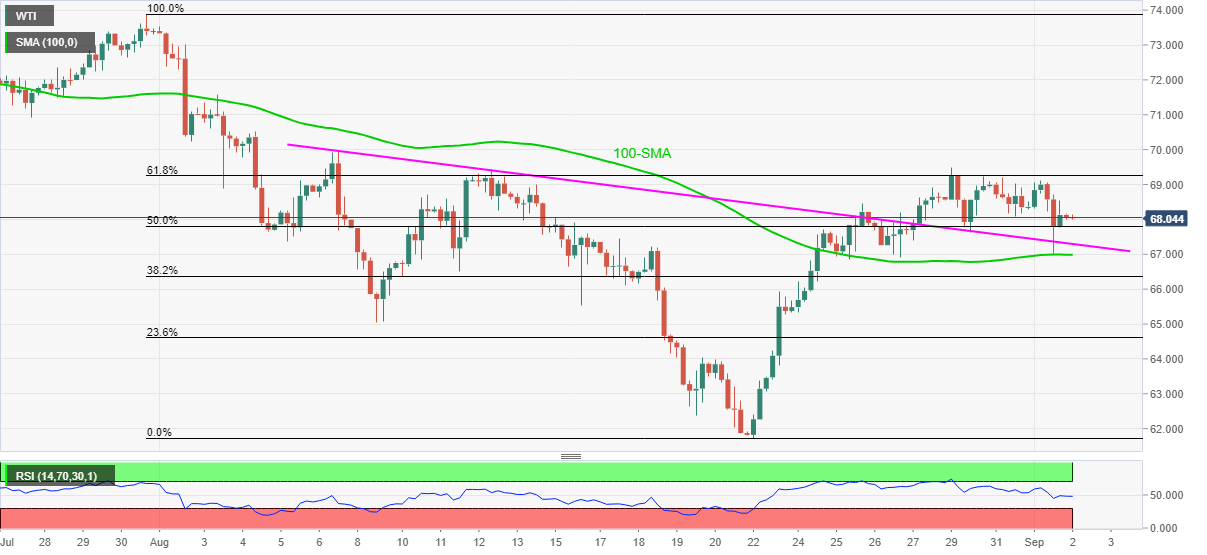
Trend: Recovery expected

Additional important levels

Overview
Today last price68.09
Today Daily Change0.00
Today Daily Change %0.00%
Today daily open68.09
 
Trends
Daily SMA2067.16
Daily SMA5070.13
Daily SMA10068.29
Daily SMA20061.7
 
Levels
Previous Daily High69.11
Previous Daily Low67.02
Previous Weekly High68.91
Previous Weekly Low61.73
Previous Monthly High73.54
Previous Monthly Low61.73
Daily Fibonacci 38.2%67.81
Daily Fibonacci 61.8%68.31
Daily Pivot Point S167.04
Daily Pivot Point S265.98
Daily Pivot Point S364.95
Daily Pivot Point R169.13
Daily Pivot Point R270.16
Daily Pivot Point R371.22

Author

Anil Panchal

Anil Panchal

FXStreet

Anil Panchal has nearly 15 years of experience in tracking financial markets. With a keen interest in macroeconomics, Anil aptly tracks global news/updates and stays well-informed about the global financial moves and their implications.


More from Anil Panchal
Share:

Editor's Picks

AUD/USD sticks to positive bias above 0.7100; lacks bullish conviction

AUD/USD trades with a positive bias for the second straight day, holding above 0.7100 in the Asian session on Friday as softer US bond yields keep US Dollar bulls on the back foot. Furthermore, hawkish RBA Governor Bullock's comments boost rate hike bets and support the Aussie. However, the Fed's hawkish outlook, along with geopolitical uncertainties, limits USD losses and caps the pair.

USD/JPY approaches 158.00 as Japanese Yen resumes decline

USD/JPY is resuming its upside in the European session on Friday, refreshing two-week highs and nearing 158.00. The Japanese Yen extends losses, despite the Bank of Japan's (BoJ) expected rate hike to 1.25% and hawkish Governor Ueda's comments, as two surprise dissents against the rate hike weigh on it.

Gold keeps the bid tone in place; still below $4,400

Gold adds to the optimism seen in the second half of the week, trading with decent gains just below the $4,400 mark per troy ounce on Friday. The precious metal’s advance finds traction in declining crude oil prices and fresh selling pressure on the US Dollar.

Why altcoin season isn't coming back — and what stole its capital
If, after two years of being frozen in ice, Katara and Sokka woke you up to the crypto market, it would seem like 100 years have passed. With Bitcoin soaring to record highs just over a year ago, everyone expected a routine altcoin season, where investors take profits from the top crypto to chase higher returns in altcoins.
BoJ Recap: Not as hawkish as expected

The BoJ raised its short-term interest-rate target to 1.25% from 1.00% in a 7-2 vote, marking another step in the normalisation of monetary policy and widely matching what everyone has been expecting for weeks. Governor Kazuo Ueda said the policy phase had changed.

BoJ Recap: Not as hawkish as expected

The Bank of Japan (BoJ) raised its short-term interest-rate target to 1.25% from 1.00% in a 7-2 vote, marking another step in the normalisation of monetary policy and widely matching what everyone has been expecting for weeks.












