WTI hits multi-month high near $75.50 amid Middle East tensions
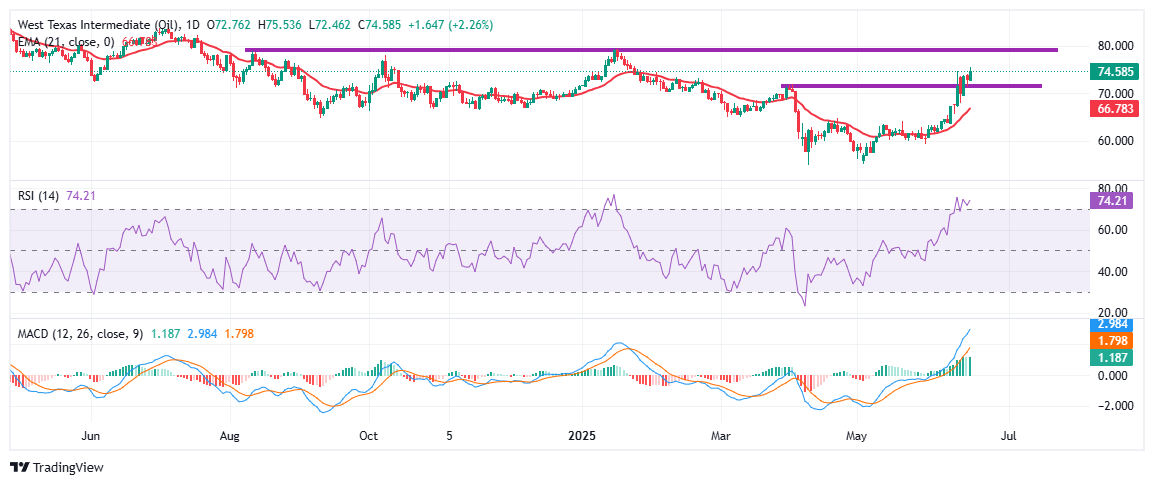
- WTI Crude trades near $74.58, up over 2.5% on the day after hitting an intraday high of $75.54.
- Israeli strikes on Iranian infrastructure spark fresh supply concerns and add a ~$10 per barrel geopolitical premium.
- Technicals remain bullish: price holds well above the 21-day EMA near $66.80; RSI at 74.21 signals overbought conditions.

West Texas Intermediate (WTI) Crude Oil climbed above the $75.00 mark on Thursday, hitting its highest level since late January. At the time of writing, the US benchmark is trading around $74.58, up more than 2.5% on the day, after marking an intraday high of $75.54 as traders respond to the escalating Iran–Israel conflict and a sharp drop in US stockpiles.
This multi-month high underscores how quickly Middle East tensions and supply fundamentals can inject fresh bullish momentum into the oil market, keeping investors on edge and fueling talk of further gains if risks to key shipping routes intensify.
The recent Israeli airstrikes on Iranian nuclear and oil infrastructure have intensified concerns over potential supply disruptions in a region vital to global energy flows. The Strait of Hormuz, a narrow passageway through which approximately 20-30% of the world’s oil supply moves daily, is now under heightened scrutiny as tensions flare. In response, traders have swiftly factored in a significant geopolitical risk premium, with Goldman Sachs estimating that the ongoing conflict has added roughly $10 per barrel to crude prices.
Adding to the bullish momentum, a sharp drawdown in US crude inventories has reinforced concerns about tighter near-term supply. Latest data showed that stockpiles tumbled by over 11 million barrels last week, marking one of the steepest weekly declines in over a year. This fundamental squeeze, combined with the geopolitical premium, has pushed WTI prices firmly into the mid-$70s. However, market strategists caution that while heightened Middle East tensions support further upside, strong US shale production and ample spare capacity within the Organization of the Petroleum Exporting Countries (OPEC) could cap any extended rally. Unless the conflict escalates into a wider regional crisis or disrupts shipping through the Strait of Hormuz, crude prices may struggle to sustain levels well above $80 per barrel.
From a technical perspective, WTI crude oil stays in bullish territory, trading well above its rising 21-day EMA near $66.80. This shows buyers still have the upper hand for now. That said, the daily Relative Strength Index (RSI) sitting around 75 suggests the market is getting overheated, so a short pause or some profit-taking wouldn’t be a surprise. The Moving Average Convergence Divergence (MACD) remains firmly in positive territory, supporting the view that momentum remains strong. If prices push past the $78.00 mark, a run toward $80.00 could be on the cards. On the downside, any dip is likely to find a cushion around $70.00, with solid support waiting closer to the EMA zone near $66.80.
Author

Vishal Chaturvedi
FXStreet
I am a macro-focused research analyst with over four years of experience covering forex and commodities market. I enjoy breaking down complex economic trends and turning them into clear, actionable insights that help traders stay ahead of the curve.