WTI Crude Oil falls below $65 amid rising output and cloudy demand signals
- West Texas Intermediate declines as Venezuela and OPEC+ increase concerns about oversupply.
- Clarity on US–EU and US–China trade talks may guide the direction of WTI.
- WTI Crude Oil drops below $65.00 as technical pressure aligns with rising supply outlook.

West Texas Intermediate (WTI) is under pressure on Friday as markets respond to a growing global supply outlook and remain cautious on demand prospects.
At the time of writing, WTI is trading below $65.00, with daily losses exceeding 1.50%.
The market is reacting to the prospect that Venezuela could resume Oil exports, following the US decision to reinstate Chevron’s license to operate in the country.
The move came after a high-profile prisoner exchange that led to the release of ten American hostages. Under the revised authorization, Chevron may conduct restricted oil-for-debt transactions and resume contractor payments, without enabling direct financial benefit to the Maduro regime.
While immediate production gains are expected to be limited due to Venezuela’s weakened infrastructure, the move reopens the door to significant long-term supply potential. Venezuela holds the world’s largest proven Crude reserves, and even a partial recovery could impact global supply dynamics.
Optimism surrounding the ongoing US–EU and US–China trade talks has helped lift broader risk sentiment. But until clarity emerges regarding the negotiations, WTI gains are likely to remain limited.
Meanwhile, the Organization of the Petroleum Exporting Countries and its allies (OPEC+) is set to increase output by 548,000 barrels per day (bpd) in August.
A follow-up meeting on August 3 is expected to confirm a similar increase for September.
The combination of rising OPEC+ output and the potential return of Venezuelan supply is fueling concerns about oversupply.
These supply-side risks currently outweigh supportive factors, such as improving demand indicators, stronger macroeconomic data, and easing trade tensions.
WTI Crude Oil drops below $65.00 as technical pressure aligns with rising supply outlook
WTI crude is trading below $65, reinforcing the bearish tone as fundamentals and technicals move in tandem.
The price has slipped decisively below the 50-day Simple Moving Average (SMA) at $65.44. It is now pressuring key support at the 100-day SMA ($64.61) and the 38.2% Fibonacci retracement at $64.18.
This zone of confluency is critical. Failure to hold above this area would expose the June low at $63.73, with a clean break targeting the next major 23.6% Fibo level at $60.58.
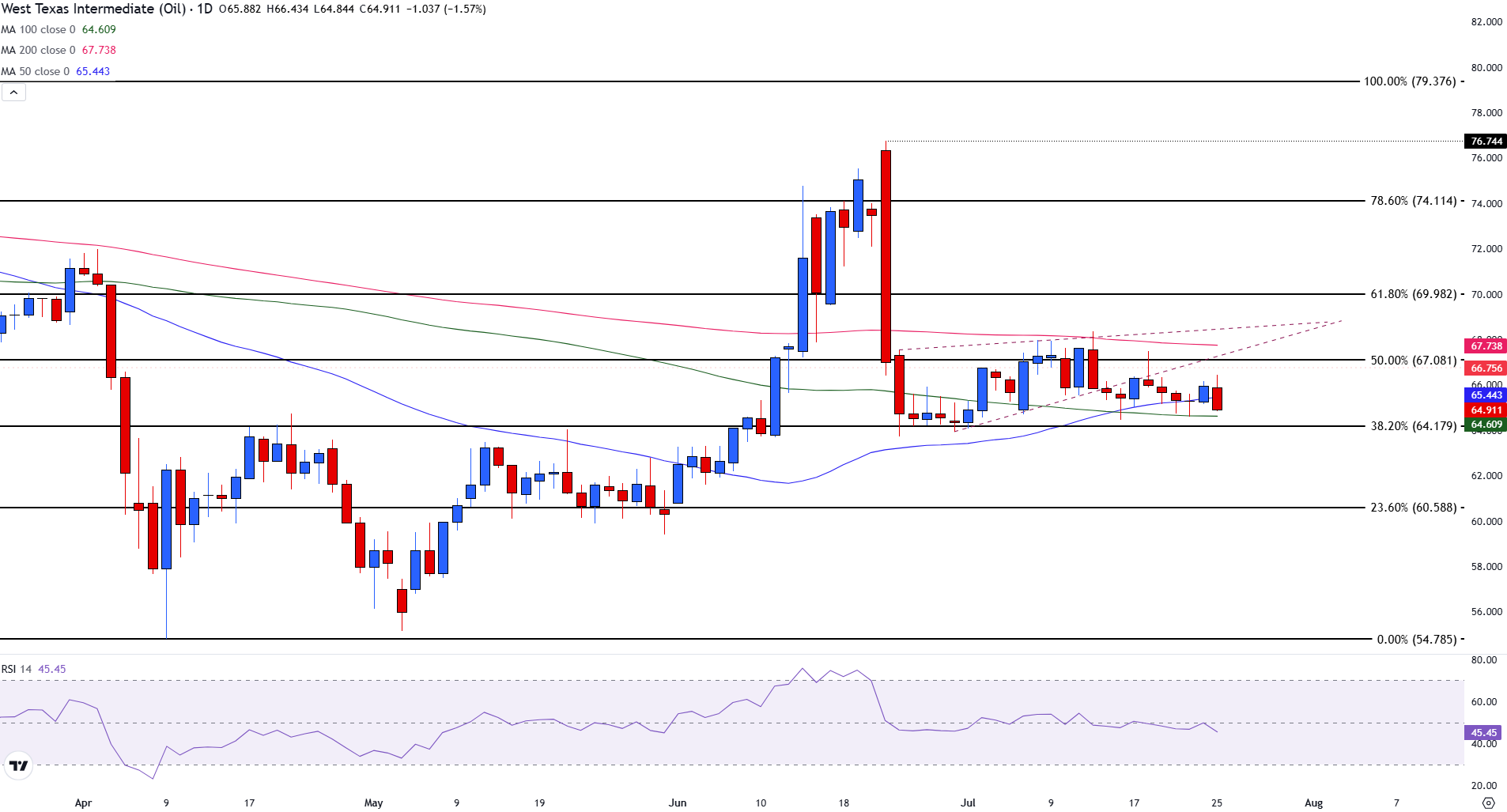
WTI Crude Oil daily chart
On the upside, resistance remains at the 50-day SMA, followed by $66.75 and the 50% retracement at $67.08.
The Relative Strength Index (RSI) at 46 signals weakening momentum, supporting the view that downside risks remain in focus as supply concerns weigh on sentiment.
WTI Oil FAQs
WTI Oil is a type of Crude Oil sold on international markets. The WTI stands for West Texas Intermediate, one of three major types including Brent and Dubai Crude. WTI is also referred to as “light” and “sweet” because of its relatively low gravity and sulfur content respectively. It is considered a high quality Oil that is easily refined. It is sourced in the United States and distributed via the Cushing hub, which is considered “The Pipeline Crossroads of the World”. It is a benchmark for the Oil market and WTI price is frequently quoted in the media.
Like all assets, supply and demand are the key drivers of WTI Oil price. As such, global growth can be a driver of increased demand and vice versa for weak global growth. Political instability, wars, and sanctions can disrupt supply and impact prices. The decisions of OPEC, a group of major Oil-producing countries, is another key driver of price. The value of the US Dollar influences the price of WTI Crude Oil, since Oil is predominantly traded in US Dollars, thus a weaker US Dollar can make Oil more affordable and vice versa.
The weekly Oil inventory reports published by the American Petroleum Institute (API) and the Energy Information Agency (EIA) impact the price of WTI Oil. Changes in inventories reflect fluctuating supply and demand. If the data shows a drop in inventories it can indicate increased demand, pushing up Oil price. Higher inventories can reflect increased supply, pushing down prices. API’s report is published every Tuesday and EIA’s the day after. Their results are usually similar, falling within 1% of each other 75% of the time. The EIA data is considered more reliable, since it is a government agency.
OPEC (Organization of the Petroleum Exporting Countries) is a group of 12 Oil-producing nations who collectively decide production quotas for member countries at twice-yearly meetings. Their decisions often impact WTI Oil prices. When OPEC decides to lower quotas, it can tighten supply, pushing up Oil prices. When OPEC increases production, it has the opposite effect. OPEC+ refers to an expanded group that includes ten extra non-OPEC members, the most notable of which is Russia.
Author

Tammy Da Costa, CFTe®
FXStreet
Tammy is an economist and market analyst with a deep passion for financial markets, particularly commodities and geopolitics.