WTI Crude Oil collapses below $60 after Trump reignites US-China trade war fears
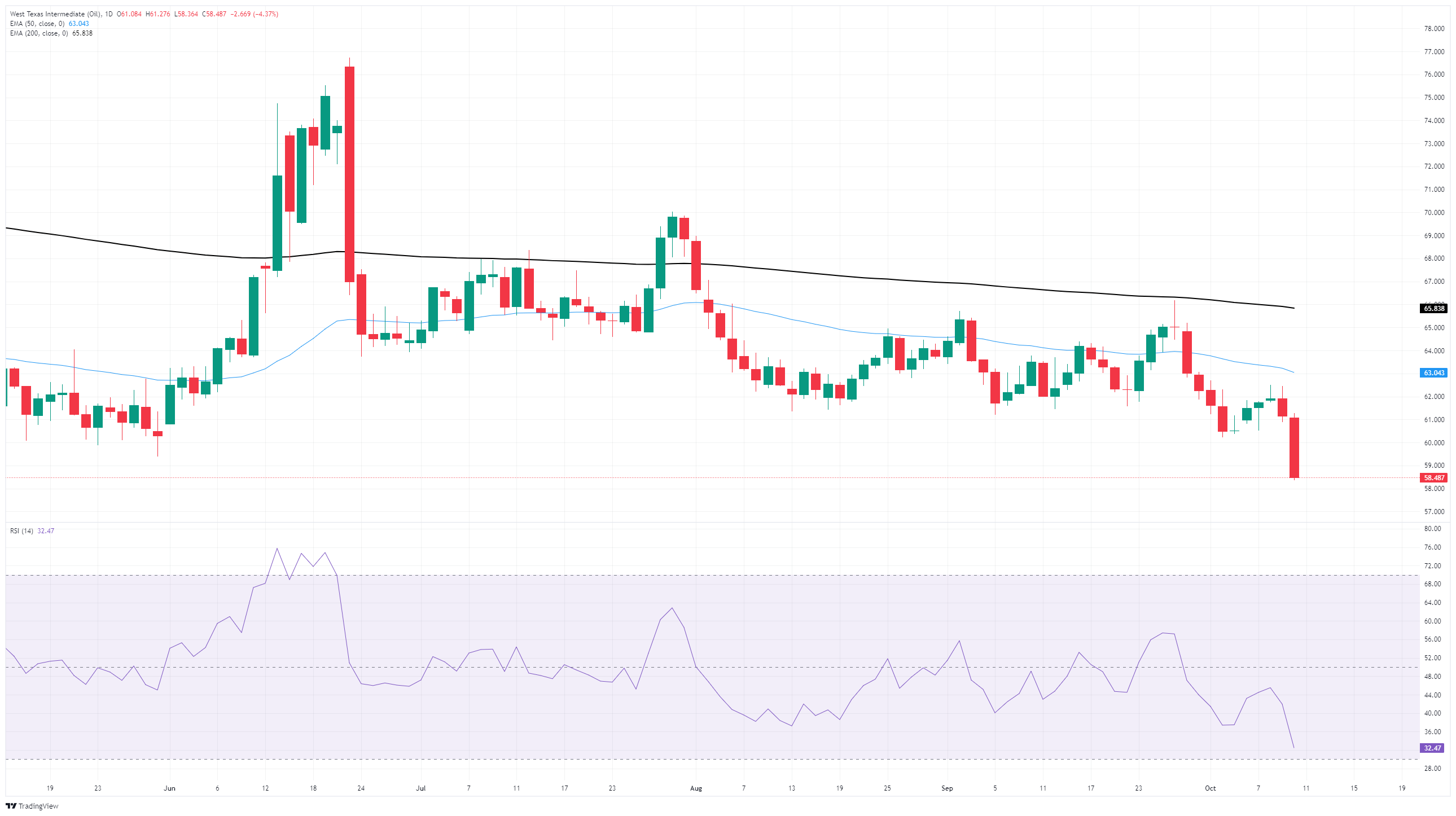
- WTI barrel bids tumbled below $60 per barrel for the first time since May on Friday.
- Risk assets took a hammering after President Trump delivered fresh tariff threats.
- China is tightening its control over rare mineral exports, a move that threatens tariff easing talks.

West Texas Intermediate (WTI) US Crude Oil prices collapsed below $60.00 per barrel on Friday, tumbling over 4% in Oil’s worst single-day performance since June’s sharp pullback. Hopes for a cooling of tariffs between the US and China were swept off the table to end an otherwise unremarkable week, souring already-weak investor sentiment amidst an extending US government shutdown.
More tariffs incoming?
US President Donald Trump publicly pulled out of an upcoming trade meeting between himself and Chinese President Xi Jinping, and vowed via social media proclamation to impose additional steep import tariffs on all goods being imported into the US from China. China has ramped up its strict controls over critical rare earths exports, requiring all foreign entities to obtain an export license. President Trump decried the move as China holding the rest of the world “hostage”, and has threatened that he now see “no point” in participating in a sideline discussion about trade with Jinping at the Asia-Pacific Economic Cooperation summit in South Korea towards the end of October.
Investors have quickly adapted to an environment in which US President Donald Trump makes grandiose tariff threats that end in a whisper. However, Friday’s escalating trade-war rhetoric is knocking investor sentiment even lower at a time when the Trump administration is unable to force the two sides of the US government to agree on a funding bill to keep federal operations open.
WTI daily chart
WTI Oil FAQs
WTI Oil is a type of Crude Oil sold on international markets. The WTI stands for West Texas Intermediate, one of three major types including Brent and Dubai Crude. WTI is also referred to as “light” and “sweet” because of its relatively low gravity and sulfur content respectively. It is considered a high quality Oil that is easily refined. It is sourced in the United States and distributed via the Cushing hub, which is considered “The Pipeline Crossroads of the World”. It is a benchmark for the Oil market and WTI price is frequently quoted in the media.
Like all assets, supply and demand are the key drivers of WTI Oil price. As such, global growth can be a driver of increased demand and vice versa for weak global growth. Political instability, wars, and sanctions can disrupt supply and impact prices. The decisions of OPEC, a group of major Oil-producing countries, is another key driver of price. The value of the US Dollar influences the price of WTI Crude Oil, since Oil is predominantly traded in US Dollars, thus a weaker US Dollar can make Oil more affordable and vice versa.
The weekly Oil inventory reports published by the American Petroleum Institute (API) and the Energy Information Agency (EIA) impact the price of WTI Oil. Changes in inventories reflect fluctuating supply and demand. If the data shows a drop in inventories it can indicate increased demand, pushing up Oil price. Higher inventories can reflect increased supply, pushing down prices. API’s report is published every Tuesday and EIA’s the day after. Their results are usually similar, falling within 1% of each other 75% of the time. The EIA data is considered more reliable, since it is a government agency.
OPEC (Organization of the Petroleum Exporting Countries) is a group of 12 Oil-producing nations who collectively decide production quotas for member countries at twice-yearly meetings. Their decisions often impact WTI Oil prices. When OPEC decides to lower quotas, it can tighten supply, pushing up Oil prices. When OPEC increases production, it has the opposite effect. OPEC+ refers to an expanded group that includes ten extra non-OPEC members, the most notable of which is Russia.
Author

Joshua Gibson
FXStreet
Joshua joins the FXStreet team as an Economics and Finance double major from Vancouver Island University with twelve years' experience as an independent trader focusing on technical analysis.