WTI consolidates near 100-day SMA as $65 resistance comes into play
- WTI Crude Oil rebounds near $64.50 after a 7.42% monthly drop in August, its first decline since April.
- Russian exports slip to a four-week low, while US officials accuse India of profiteering from discounted Russian crude.
- Technically, WTI is testing the $64.80-$65.00 resistance zone; a breakout could target $66.00 (Aug 6 high) and $67.00 (Aug 4 peak).

West Texas Intermediate (WTI) Crude Oil is rebounding modestly on Monday, trading near $64.45 after logging its first monthly decline since April with a 7.42% drop in August as rising US supply and weaker seasonal demand weighed on sentiment. The fresh month begins with a 1.19% gain on the day, coming amid thin trading conditions following the US Labor Day holiday, while markets gear up for key catalysts later this week, including the US Nonfarm Payrolls (NFP) report and the September 7 OPEC+ meeting.
Geopolitical tensions continue to offer mild support to Oil prices, with Russian crude exports slipping to a four-week low of 2.72 million barrels per day amid ongoing infrastructure disruptions. Analysts have also flagged the risk of a major supply shock if India reduces or halts its Russian crude purchases, a move that could push prices toward $100 per barrel, according to a recent warning from CLSA.
US Treasury Secretary Scott Bessent accused India of profiteering, alleging the country engaged in “arbitrage” by buying discounted Russian crude and reselling refined fuel at higher margins. Meanwhile, White House trade adviser Peter Navarro claimed in a Fox News interview that Indian oil purchases are indirectly funding Russia’s war effort, controversially describing India as a “laundromat for the Kremlin.”
Despite Washington’s mounting pressure, India has reaffirmed its energy partnership with Moscow, with Russian Oil making up over 31% of India’s total crude imports in July. In a column published Monday in The Hindu, India’s Oil Minister, Hardeep Singh Puri, publicly pushed back against US criticism, refuting claims of profiteering and asserting that India's imports are legal and compliant with G7 price cap mechanisms. He also argued that Indian crude sourcing has played a stabilizing role in global markets, helping prevent Oil prices from surging toward $200 per barrel.
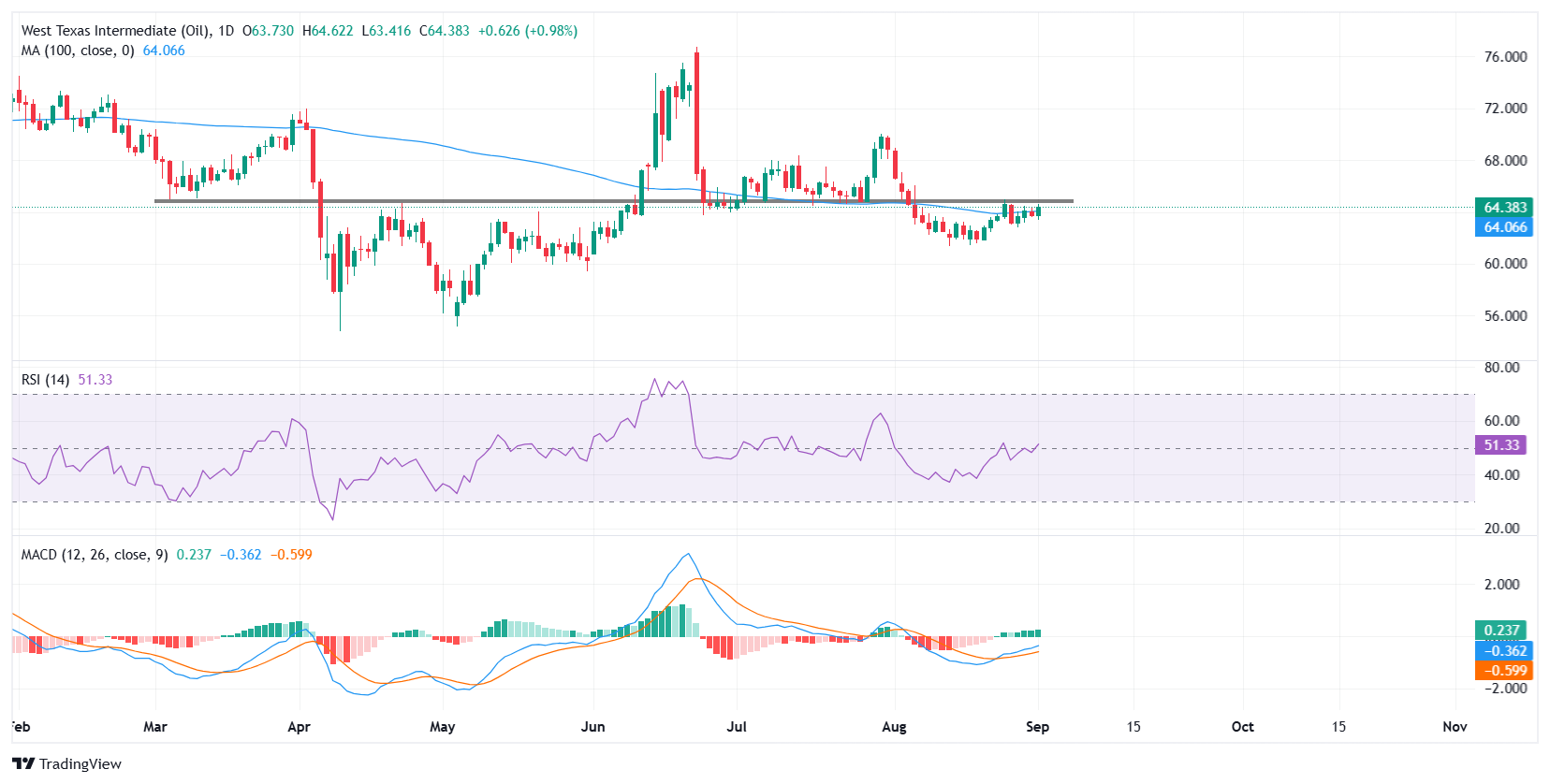
WTI Crude Oil is consolidating around $64.40, holding just above the 100-day Simple Moving Average (SMA) at $64.06. The market is retesting the $64.80-$65.00 area, a previous support that has now turned into resistance. A decisive daily close above this band could open the way toward the $66.00 high from August 6, followed by the $67.00 peak from August 4, while another rejection here would reinforce the broader range-bound structure that has capped upside momentum in recent weeks.
Momentum indicators show a cautiously constructive tilt. The Relative Strength Index (RSI) sits at 51.3, indicating neutral positioning with modest room for upside. The Moving Average Convergence Divergence (MACD) has turned slightly positive with a crossover near the zero line and green histogram bars are starting to expand, signaling early bullish traction. Still, without a clear breakout above $65.00, downside risks linger, with immediate support at the 100-day SMA and stronger buying interest expected around $62.00-$61.50, the August swing low.
WTI Oil FAQs
WTI Oil is a type of Crude Oil sold on international markets. The WTI stands for West Texas Intermediate, one of three major types including Brent and Dubai Crude. WTI is also referred to as “light” and “sweet” because of its relatively low gravity and sulfur content respectively. It is considered a high quality Oil that is easily refined. It is sourced in the United States and distributed via the Cushing hub, which is considered “The Pipeline Crossroads of the World”. It is a benchmark for the Oil market and WTI price is frequently quoted in the media.
Like all assets, supply and demand are the key drivers of WTI Oil price. As such, global growth can be a driver of increased demand and vice versa for weak global growth. Political instability, wars, and sanctions can disrupt supply and impact prices. The decisions of OPEC, a group of major Oil-producing countries, is another key driver of price. The value of the US Dollar influences the price of WTI Crude Oil, since Oil is predominantly traded in US Dollars, thus a weaker US Dollar can make Oil more affordable and vice versa.
The weekly Oil inventory reports published by the American Petroleum Institute (API) and the Energy Information Agency (EIA) impact the price of WTI Oil. Changes in inventories reflect fluctuating supply and demand. If the data shows a drop in inventories it can indicate increased demand, pushing up Oil price. Higher inventories can reflect increased supply, pushing down prices. API’s report is published every Tuesday and EIA’s the day after. Their results are usually similar, falling within 1% of each other 75% of the time. The EIA data is considered more reliable, since it is a government agency.
OPEC (Organization of the Petroleum Exporting Countries) is a group of 12 Oil-producing nations who collectively decide production quotas for member countries at twice-yearly meetings. Their decisions often impact WTI Oil prices. When OPEC decides to lower quotas, it can tighten supply, pushing up Oil prices. When OPEC increases production, it has the opposite effect. OPEC+ refers to an expanded group that includes ten extra non-OPEC members, the most notable of which is Russia.
Author

Vishal Chaturvedi
FXStreet
I am a macro-focused research analyst with over four years of experience covering forex and commodities market. I enjoy breaking down complex economic trends and turning them into clear, actionable insights that help traders stay ahead of the curve.
















